Who AI recommends, and when it changes.
Data as of Apr 11, 2026 · Based on 80 AI answers · A buyer need in AI Developer Productivity Tools. · See how Parse measures this
Between March and June 2026, AI assistants are divided between two leaders for legacy code documentation, with and tied for the most recommendations. is cited for full-platform generation including UML diagrams and API references, while is valued for IDE-integrated docstring creation. The landscape remains fragmented with many specialized tools.
Where a different pick wins:
Fujitsu Application Transform reduces legacy analysis time by 97% by generating COBOL design documents without expert knowledge. · 1 source
 CodeSee
CodeSee automatically generates visual maps of code structure and service dependencies to help developers navigate complex legacy architectures. · 3 sources
 Workik
Workik excels at bulk documentation generation for entire modules and databases, speeding up onboarding. · 3 sources
 Docullim
Docullim adds doc generation via annotations for Python projects, making it lightweight for Python legacy code. · 1 source
 Theneo
Theneo specializes in API documentation with automated release notes, ideal for legacy APIs. · 1 source
 Swimm
SwimmSwimm's living documentation automatically updates as code changes, preventing staleness. · 3 sources
Recommendation share
DocuWriter leads at 10% of AI recommendations; Tabnine follows at 10%.
By platform
Platforms disagree: Tabnine leads on Google AI Overviews, AutoCodeDocs on ChatGPT.
Representative prompts behind this market ranking, and how AI tends to answer.
Buyer needs that sit next to this one in the same market.
Why here: Generates full documentation including UML diagrams and API references, with continuous updates from repository integration. · 3 sources
Why here: IDE-integrated assistant that explains legacy logic and generates docstrings and comments for specific code blocks. · 3 sources
Why here: Real-time IDE suggestions for docstrings and explanations, with deep integration into VS Code and JetBrains. · 3 sources
Why here: Instantly generates structured docs, API references, README files, and inline comments across many languages. · 3 sources
Why here: VS Code extension that uses AI (GPT-4, Claude) to generate docstrings, API docs, and inline comments inline. · 3 sources
Why here: Designed for legacy systems, it connects codebases, Jira, and databases to create living knowledge graphs and documentation. · 3 sources
Why here: Auto-generates interactive visual maps of code structure and dependencies to aid understanding of legacy systems. · 3 sources
Why here: Produces professional multi-format documentation (Markdown, HTML) from repos with GitHub/GitLab integration. · 3 sources
Why here: Free AI assistant that generates inline comments and explanations across 70+ languages, suitable for undocumented code. · 3 sources
Why here: Focuses on bulk documentation generation for legacy enterprise systems, monoliths, and databases. · 3 sources
Why here: Automatically syncs documentation with code changes, generates API docs, and provides coverage scoring. · 3 sources
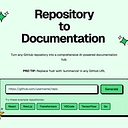
Why here: AI-native platform that scans Git repos to produce structured documentation. · 2 sources
“Our legacy code is undocumented and hard to maintain. Who offers AI tools that auto-generate code documentation?”
AI assistants respond with a diverse set of tools that generate documentation from legacy codebases. Most cited are 

 GitHub