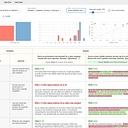
Data as of Aug 25, 2026 · Based on 304 AI responses from ChatGPT Search and Google AI Mode · See how Parse measures this
For CI/CD integration where static analysis, quality gates, and security scanning matter, 

Named in 68% of answers
Named in 66% of answers
Best when you need industry-standard SAST, code quality gates, and vulnerability detection in CI/CD; robust for technical-debt tracking but focused on static analysis rather than context-aware code suggestions.
Named in 51% of answers
Named in 43% of answers
Source | Citation share |
|---|---|
 The Top 18 Best Code Review Tools of 2026https://www.aikido.dev/blog/best-code-review-tools | 2.6% |
 The 6 Best AI Code Review Tools for Pull Requests in 2025 - DEV Communityhttps://dev.to/heraldofsolace/the-6-best-ai-code-review-tools-for-pull-requests-in-2025-4n43 | 2.1% |
 Best Automated Code Review Tools for Developers in 2026https://www.code-quality.io/best-automated-code-review-tools-in-2026 | 2.0% |
Top 8 CodeRabbit Alternatives for AI Code Review in 2026https://www.aikido.dev/blog/coderabbit-alternatives | 1.7% |
 GitHub - reviewdog/reviewdog: 🐶 Automated code review tool integrated with any code analysis tools regardless of programming language · GitHubhttps://github.com/reviewdog/reviewdog | 1.7% |
12 Best Code Review Automation Tools for 2025 | PullNotifierhttps://blog.pullnotifier.com/blog/12-best-code-review-automation-tools-for-2025 | 1.6% |
Top 9 Best AI Code Review Tools in 2026https://www.aikido.dev/blog/best-ai-code-review-tools | 1.5% |
 Best AI Code Review Tools for GitHub CI/CD Pipelines in 2026https://www.codeant.ai/blogs/best-ai-code-review-tools-github-ci-cd | 1.5% |
 Top 12 Code Review Tools To Ace Code Qualityhttps://www.qodo.ai/blog/code-review-tools/ | 1.4% |
7 Best GitLab Code Review Tools in 2026https://www.codeant.ai/blogs/gitlab-code-review-tools | 1.3% |
If your goal is **an automated reviewer that runs as part of CI/CD and comments on PRs/MRs**, I’d shortlist these: Option | Best for | Main strength | Watch-out --- | --- | --- | ---
If your goal is an automated reviewer that runs as part of CI/CD and comments on PRs/MRs, I’d shortlist these:
| Option | Best for | Main strength | Watch-out |
|---|---|---|---|
| CodeRabbit | Most teams | Mature, broad PR review workflow | Can produce a lot of feedback |
| Greptile | Large/complex repos | Whole-codebase context and cross-file bugs | More specialized/expensive |
| Qodo | Enterprise/governance | Rules, multi-agent review, test generation | More setup/governance overhead |
| GitHub Copilot Code Review | GitHub shops already using Copilot | Minimal additional tooling | Best fit is GitHub-centric |
| SonarQube + AI reviewer | Security/quality gates | Deterministic SAST + AI review | SonarQube isn't a replacement for contextual AI review |
Recent 2026 comparisons broadly converge on those tradeoffs.
Start with CodeRabbit if you're looking for the fastest path from "nothing" to useful automated reviews. It is particularly attractive if you use a mixture of GitHub, GitLab, Bitbucket, or Azure DevOps.
Pick Greptile if your biggest problem is bugs that require understanding the rest of the repository, rather than just the changed lines. Its repository indexing/graph approach is specifically aimed at cross-file and architectural reasoning.
Pick Qodo if this is an enterprise engineering-governance project—for example, you want centrally managed review rules, scoped policies, and review + test generation.
Don't make the AI reviewer your only CI gate. A good pipeline looks more like:
Pull Request
    │
    ├── Build / unit tests
    ├── Lint / formatting
    ├── SAST / dependency scanning
    │
    └── AI code review
           │
           ├── Post findings to PR
           └── Fail/check CI only for high-confidence blockers
                    │
                    ▼
              Human approval
                    │
                    ▼
                  Merge
The important design choice is not to fail builds on every AI comment. AI reviewers can produce false positives; use deterministic tools for hard security/quality gates and AI for contextual reasoning. This distinction is also recommended in current guidance comparing AI review with tools such as SonarQube.
If you tell me GitHub/GitLab/Bitbucket/Azure DevOps, language stack, team size, and whether self-hosting is required, I can narrow this to the best 2–3 options and show you the actual CI/CD configuration for your platform.
Start with CodeRabbit if you're looking for the fastest path from "nothing" to useful automated reviews. It is particularly attractive if you use a mixture of GitHub, GitLab, Bitbucket, or Azure DevOps.
Pick Greptile if your biggest problem is bugs that require understanding the rest of the repository, rather than just the changed lines. Its repository indexing/graph approach is specifically aimed at cross-file and architectural reasoning.
Pick Qodo if this is an enterprise engineering-governance project—for example, you want centrally managed review rules, scoped policies, and review + test generation.
Don't make the AI reviewer your only CI gate. A good pipeline looks more like:
Pull Request
    │
    ├── Build / unit tests
    ├── Lint / formatting
    ├── SAST / dependency scanning
    │
    └── AI code review
           │
           ├── Post findings to PR
           └── Fail/check CI only for high-confidence blockers
                    │
                    ▼
              Human approval
                    │
                    ▼
                  Merge
The important design choice is not to fail builds on every AI comment. AI reviewers can produce false positives; use deterministic tools for hard security/quality gates and AI for contextual reasoning. This distinction is also recommended in current guidance comparing AI review with tools such as SonarQube.
Integrating an AI-powered code review bot into your CI/CD pipeline or Git workflow (GitHub, GitLab, Bitbucket) can drastically speed up PR velocity and catch logic, style, or security flaws early. The top options range from dedicated autonomous reviewers to ecosystem-native tools. 1. CodeRabbit (Best for Popularity &…
Integrating an AI-powered code review bot into your CI/CD pipeline or Git workflow (GitHub, GitLab, Bitbucket) can drastically speed up PR velocity and catch logic, style, or security flaws early.
The top options range from dedicated autonomous reviewers to ecosystem-native tools.
PR-Agent ) can be self-hosted or run via cloud app./review, /describe , or /improve on a PR to get targeted feedback, score the PR on readability, or auto-generate missing test cases./utils quietly shatters a legacy service in an entirely different directory or separate connected repository.Comparison Checklist: How to Choose
If you let me know your Git provider (GitHub, GitLab, Bitbucket) and whether you have strict data/compliance requirements (e.g., cloud vs. self-hosted/air-gapped), I can narrow down the exact setup path for you.
If you want an **AI code-review bot that runs as part of CI/CD**, I’d shortlist these: Option | Best for | CI/CD fit | Main strength --- | --- | --- | ---
If you want an AI code-review bot that runs as part of CI/CD, I’d shortlist these:
| Option | Best for | CI/CD fit | Main strength |
|---|---|---|---|
| CodeRabbit | Most teams | ⭐⭐⭐⭐⭐ | Easy PR reviews, broad Git-platform support |
| Qodo | Enterprise / regulated teams | ⭐⭐⭐⭐⭐ | Deep repo context + governance/rules |
| GitHub Copilot Code Review | Teams already using GitHub + Copilot | ⭐⭐⭐⭐ | No extra vendor/workflow |
| Greptile | Large/complex codebases | ⭐⭐⭐⭐ | Whole-codebase/architecture context |
| SonarQube/SonarCloud | Security + deterministic quality gates | ⭐⭐⭐⭐⭐ | Static analysis + enforceable CI gates |
This would be my first thing to trial. It automatically reviews PRs, performs incremental reviews when new commits are pushed, understands repository context, and can suggest/apply fixes. Its CLI can also be incorporated into CI/CD rather than relying solely on the PR integration.
It supports GitHub, GitLab, Bitbucket, and Azure DevOps, which is particularly useful if your pipeline isn't GitHub-centric.
Pick it if: you want something you can install quickly and have reviewing PRs with minimal engineering effort.
Qodo is more than a basic PR bot. Its current review system uses multiple specialized agents, repository/PR context, and a centralized rules system for enforcing organizational standards.
A particularly important differentiator is deployment: Qodo advertises on-premises, single-tenant, and air-gapped/BYOK options, which can matter if your source code can't be sent to a conventional SaaS service.
Pick it if: you're a larger engineering organization where security, governance, custom rules, and auditability matter as much as catching bugs.
If your repositories are on GitHub and you're already paying for Copilot, I'd evaluate its built-in code review before adding another vendor. It's the lowest-friction option because the review capability lives directly in the GitHub workflow.
Pick it if: you want "good enough" automated review without introducing another platform or subscription.
Greptile is worth testing if your biggest problem is that a PR can't be evaluated from the diff alone. Its differentiator is deeper codebase understanding/indexing, making it attractive for large monorepos and changes involving many interconnected components.
Pick it if: architectural regressions and cross-file/cross-service bugs are more important than simple lint-style findings.
I'd actually consider this a different category rather than a direct replacement. Sonar gives you deterministic static analysis, security findings, code-quality rules, and CI quality gates. An AI reviewer is better at reasoning about intent and higher-level bugs.
For a serious production pipeline, Sonar + an AI reviewer is often a stronger architecture than choosing one or the other.
For a typical engineering team, I'd structure the pipeline roughly like this:
                    Pull Request
                         │
             ┌───────────┴───────────┐
             │                       │
       Deterministic             AI review
       checks                    (CodeRabbit/Qodo)
             │                       │
       ┌─────┴─────┐           ┌─────┴─────┐
       │           │           │           │
     Tests       SAST        Bugs       Design/
     Lint        Secrets     Logic       standards
       │           │           │           │
       └───────────┴───────────┴───────────┘
                         │
                  Quality gate
                         │
                    Human review
                         │
                       Merge
Don't make the AI bot the sole merge gate initially. Let it comment and identify issues, while tests/security/static analysis remain hard CI gates. Once you've measured its false-positive/false-negative behavior on your own repositories, you can decide which AI findings should block merges.
One important caveat: AI review should complement, not replace, tests, SAST, dependency scanning, and human review. Current tools are very good at finding certain bugs and inconsistencies, but they still aren't reliable judges of product intent or every subtle architectural decision.
If you tell me GitHub/GitLab/Bitbucket/Azure DevOps, your CI system (GitHub Actions/Jenkins/GitLab CI/etc.), languages, and roughly how many developers/PRs you have, I can narrow this to 2–3 options and show you exactly how I'd integrate them into your pipeline.
Integrating an AI code review bot into your CI/CD or pull request workflow can drastically cut down review bottlenecks. Rather than just relying on generic static analysis, modern tools contextualize PR diffs, check for security vulnerabilities , and write line-by-line comments directly inside GitHub, GitLab, or…
Integrating an AI code review bot into your CI/CD or pull request workflow can drastically cut down review bottlenecks. Rather than just relying on generic static analysis, modern tools contextualize PR diffs, check for security vulnerabilities , and write line-by-line comments directly inside GitHub, GitLab, or Bitbucket.
The best options available feature native app-level integrations or workflow actions:
/review, /describe, /improve ) to tailor the depth of the automated feedback.Experiences with Code Review Bots
Developers often note that while AI reviewers are fantastic safety nets, fine-tuning the prompt or sensitivity is key to avoiding noise:
“CodeRabbit is the safety net between ‘AI wrote it’ and ‘we're shipping it.’ It keeps your workflow fast, clean, and secure — right from your Terminal.”
To help narrow down the ideal choice, what Git provider (GitHub, GitLab, Bitbucket) and CI/CD tool are you using, and do you prefer a fully managed SaaS or a self-hosted/open-source approach?
If your goal is **“run an automated reviewer on every PR as part of CI/CD, with useful findings rather than thousands of lint-style comments,”** I’d shortlist these: Option | Best for | CI/CD fit | Key strength --- | --- | --- | ---
If your goal is “run an automated reviewer on every PR as part of CI/CD, with useful findings rather than thousands of lint-style comments,” I’d shortlist these:
| Option | Best for | CI/CD fit | Key strength |
|---|---|---|---|
| coderabbit.ai | Most teams | ⭐⭐⭐⭐⭐ | Easy PR reviews across GitHub/GitLab/Bitbucket/Azure DevOps |
| qodo.ai | Enterprise / complex codebases | ⭐⭐⭐⭐⭐ | Deep repo context + customizable organizational rules |
| GitHub Copilot Code Review | GitHub-centric teams | ⭐⭐⭐⭐⭐ | Very tight GitHub integration |
| GitLab Duo Code Review | GitLab-centric teams | ⭐⭐⭐⭐⭐ | Native GitLab workflow |
| Semgrep | Security-focused CI | ⭐⭐⭐⭐⭐ | Excellent deterministic/static security analysis |
| SonarQube/SonarCloud | Traditional quality gates | ⭐⭐⭐⭐⭐ | Mature quality/security gates and CI integration |
CodeRabbit is probably the easiest place to start. It automatically reviews PRs and supports GitHub, GitLab, Azure DevOps, Bitbucket Cloud and Bitbucket Data Center. It also has CLI/IDE workflows, so you can eventually shift some review earlier than the PR.
Good architecture:
Developer
   │
   ▼
Pull Request
   │
   ├── Tests / lint / build
   ├── Semgrep / SAST
   └── CodeRabbit
          │
          ▼
     Review comments
          │
          ▼
      Merge gate
I'd choose this if you want low setup effort and useful AI review without building the bot yourself.
Qodo is particularly interesting if your reviewer needs to understand more than the diff. Its current platform uses multiple review agents, repository context, PR history and organization-specific rules.
It also supports multi-repository context and enterprise deployment options, including on-prem/air-gapped environments.
I'd favor Qodo when you have:
This is actually what I'd recommend for a serious CI/CD pipeline rather than relying on an AI reviewer alone.
Use deterministic tools for things that must never be missed, and AI for contextual reasoning:
                 ┌── Unit/integration tests
                 │
PR ──────────────┼── Linter/type checker
                 │
                 ├── Semgrep/SAST
                 │
                 ├── Dependency scanning
                 │
                 └── AI code reviewer
                         │
                         ▼
                  Review findings
                         │
                ┌────────┴────────┐
                ▼                 ▼
          Blocking issues     Suggestions
                │                 │
             FAIL CI           Comment
That's important because an LLM shouldn't be your sole enforcement mechanism for things like SQL injection patterns, dependency vulnerabilities, formatting, type errors, or license policies.
Small/medium engineering team: → CodeRabbit + your existing tests/linter
Large enterprise / complicated codebase: → Qodo + SAST + conventional CI checks
Security-sensitive application: → Semgrep/SAST + dependency scanner + AI reviewer
GitHub-only organization already paying for Copilot: → Start with GitHub Copilot Code Review before adding another vendor.
Don't make the AI bot automatically fail the build for every comment.
I'd configure three severity levels:
review:
  blocking:
    - security_vulnerability
    - data_loss
    - breaking_api_change
    - critical_bug

  warning:
    - likely_bug
    - performance_problem
    - missing_error_handling

  informational:
    - readability
    - refactoring
    - style
Only blocking findings should normally prevent merging. Otherwise developers quickly learn to ignore the bot.
If you tell me GitHub/GitLab/Bitbucket, your CI system (GitHub Actions/Jenkins/GitLab CI/etc.), language(s), and whether you need self-hosting, I can narrow this down to the best 2–3 options and show exactly how I'd wire one into your pipeline.
Here are top web results for exploring this topic: [](https://codeant.ai/blogs/best-ai-code-review-tools-github-ci-cd)  CodeAnt AI·https://codeant.ai**Best** AI **Code Review** Tools for GitHub **CI**/**CD Pipelines in** 2026 Your CI/CD…
Here are top web results for exploring this topic:
CodeAnt AI·https://codeant.ai**Best** AI Code Review Tools for GitHub CI/CD Pipelines in 2026 Your CI/CD pipeline runs fast until PRs pile up. SonarQube floods your reviews with false positives. Snyk only catches security issues. You're juggling three tools, reconciling conflicting findings, a
Reddit·https://www.reddit.com What's the best approach for integrating AI-based code review into ...What's the best approach for integrating AI-based code review into existing CI/CD pipelines? I've been exploring ways to enhance our code quality checks and am curious about integrating AI/ML-based co
Augment Code·https://www.augmentcode.com 12 Best Open Source Code Review Tools in 2026 12 Best Open Source Code Review Tools in 2026. Jan 23, 2026Last updated: Aug 14, 2026•. Molisha Shah. 12 Best Open Source Code Review Tools in 2026. The best open-source code review tool for self-host Sourcegraph·https://sourcegraph.com 13 Best Automated Code Review Tools in 2026: AI and Static ...SonarQube, Semgrep, and the open-source linter family (ESLint, Pylint, RuboCop) live here. The output is deterministic, which makes these tools the right substrate for compliance gates and regulated e
Kunal Ganglani·https://www.kunalganglani.com AI Code Review in Your CI/CD Pipeline : 2026 Setup - Kunal Ganglani Set up automated AI code review in your CI/CD pipeline with a complete GitHub Actions config: triggers, secrets, cost caps, and a merge gate you can copy.
www.braintrust.dev·https://www.braintrust.dev/articles/best-ai-evals-tools-cicd-2025**Best** AI Eval Tools for CI/CD Pipelines (2026 Review ) - Braintrust Compare the top AI evaluation tools that integrate with CI/CD pipelines: Braintrust, Promptfoo, Arize Phoenix, and Langfuse.
Martin Alderson·https://martinalderson.com Using OpenCode in CI/CD for AI pull request reviews - Martin Alderson Why I replaced SaaS code review tools with OpenCode running in CI/CD pipelines - cheaper, more secure, and works with any Git provider.
Panto AI·https://www.getpanto.ai 12 Best AI Code Reviewers for Infrastructure-as-Code in 2026 12 Most Innovative IaC Code Review Solutions. 1. Panto AI. Panto AI Code Review · 1. Panto AI. Panto AI Code Review. Panto AI stands out as a powerful AI code review agent · 2. Checkov. Checkov is the
onehorizon.ai·https://onehorizon.ai/blog/ai-powered-code-review-tools 10 Best AI-Powered Code Review Tools in 2026 - Blog - One Horizon 8. OpenAI Codex: GPT-5 reasoning for code review. What it does: OpenAI's purpose-built AI that navigates your codebase, reasons through dependencies, and runs tests to validate correctness during code
CodeRabbit·https://www.coderabbit.ai AI Code Reviews | CodeRabbit | Try for Free.AI-first pull request reviewer with context-aware feedback, line-by-line code suggestions, and real-time chat.
No sources cited
Integrating an AI code review bot into your CI/CD pipeline is a great way to catch bugs, enforce style guides, and speed up pull request reviews. Here are the top tools available for CI/CD…
Integrating an AI code review bot into your CI/CD pipeline is a great way to catch bugs, enforce style guides, and speed up pull request reviews. Here are the top tools available for CI/CD integration:
If you'd like, let me know:
I can help you narrow down the best option for your stack.
If your goal is **an automated reviewer that runs as part of CI/CD and comments on PRs/MRs**, I’d shortlist these: | Option | Best for | CI/CD fit | Main strength | |---|---|---|---|
If your goal is an automated reviewer that runs as part of CI/CD and comments on PRs/MRs, I’d shortlist these:
| Option | Best for | CI/CD fit | Main strength |
|---|---|---|---|
| CodeRabbit | Most teams | ⭐⭐⭐⭐⭐ | Turnkey AI PR reviews |
| Qodo | Enterprise / customizable pipelines | ⭐⭐⭐⭐⭐ | Multi-agent review, tests, governance |
| SonarQube/SonarCloud | Security & quality gates | ⭐⭐⭐⭐⭐ | Deterministic static analysis + merge blocking |
| reviewdog | DIY / open source | ⭐⭐⭐⭐⭐ | Connects virtually any linter to PRs |
| GitHub Copilot Code Review | GitHub-centric teams | ⭐⭐⭐⭐ | Minimal setup if you're already on GitHub |
| Greptile | Large/complex codebases | ⭐⭐⭐⭐ | Whole-repository context |
For a conventional GitHub/GitLab/Bitbucket/Azure DevOps setup, I'd start here. It reviews PRs automatically, understands repository context, and can be configured with repository-specific review instructions. It supports all four major Git platforms rather than tying you to one.
It's also a mature product at this point: Reuters reported in August 2026 that CodeRabbit was reviewing more than 2 million PRs per week across 17,000+ customers.
Use it if: you want something you can install quickly and have reviewing PRs without building much infrastructure.
Qodo is particularly interesting if your review process needs custom rules, multiple agents, test generation, or tighter control over where/how analysis runs.
I'd favor it over CodeRabbit when you have requirements like:
Use it if: code review is becoming an engineering governance system rather than simply "have an AI comment on my PR."
This is a somewhat different category. Sonar isn't primarily an LLM reviewer; it's a code-quality/security analysis and quality-gate system.
That's actually an advantage in CI/CD. You can make the pipeline fail when a PR introduces unacceptable issues, rather than relying on an AI reviewer to decide whether something should block deployment. Sonar's PR analysis can report findings directly in the DevOps platform and enforce quality gates before merging.
My preferred architecture for serious production systems is often:
SonarQube quality gate + AI reviewer
The former catches deterministic/static-analysis problems; the latter catches higher-level issues such as questionable logic, missing edge cases, API misuse, and maintainability concerns.
If by "code review bot" you mean I want something that plugs into my existing CI tools, reviewdog is excellent.
It can take output from linters and analysis tools and turn findings into GitHub PR comments/checks, GitLab MR discussions, Bitbucket Code Insights, etc. It supports GitHub Actions, GitLab CI, Bitbucket Pipelines, Jenkins, and others.
For example:
review:
  script:
    - eslint . -f rdjson | reviewdog \
        -f=rdjson \
        -reporter=github-pr-review
This isn't an AI reviewer by itself. Instead, it's a review-result transport layer. You can combine it with ESLint, Semgrep, Ruff, golangci-lint, custom scripts, or your own AI agent.
Use it if: you want maximum control and minimal vendor lock-in.
If you're already heavily invested in GitHub + Copilot, the native option is compelling because there's very little infrastructure to introduce.
The downside is that it's substantially less interesting if your source control isn't GitHub. For example, GitHub Copilot Code Review doesn't solve a GitLab-centric workflow.
Use it if: you're already a GitHub/Copilot shop and want the lowest-friction solution.
Greptile is worth evaluating if your biggest problem is understanding changes in the context of a large codebase, rather than merely analyzing the changed lines.
That's particularly useful for things like:
PR changes authentication middleware
        ↓
AI understands callers
        ↓
AI finds incompatible assumptions elsewhere
        ↓
AI comments on the PR
That whole-repository context is one of the main differentiators among the newer AI reviewers.
For a typical startup/engineering team:
GitHub/GitLab
      │
      ▼
   Pull Request
      │
      ├──── CodeRabbit ────► AI review comments
      │
      ├──── SonarQube ─────► quality/security gate
      │
      └──── Tests/Linters ──► CI status
                  │
                  ▼
             Merge / Block
That's better than asking an AI bot to be the only gate.
For an enterprise with strict security requirements: Qodo + SonarQube, with the AI component deployed/configured to meet your data-handling requirements.
For a team that wants to own the whole stack: reviewdog + your existing static analyzers + an LLM/agent you control.
For the quickest proof of concept: CodeRabbit.
One important caveat: don't automatically fail builds on every AI comment. AI reviewers can produce false positives. I'd initially make the bot advisory, measure its precision for a few weeks, then promote only high-confidence categories to merge-blocking gates. Public 2026 evaluations show substantial differences between tools in both detection and false-positive rates, so benchmarking against your own historical bugs is much more useful than relying solely on vendor benchmarks.
If you tell me whether you're using GitHub Actions, GitLab CI, Jenkins, Azure DevOps, etc., and your main languages, I can narrow this down to the best 2–3 choices and show the actual CI configuration.
Integrating an automated AI code review bot into your CI/CD pipeline helps catch logic gaps, stylistic inconsistencies, and security issues before human eyes ever see the pull request.[](https://www.getpanto.ai/blog/ai-code-review-tools-gitlab-merge-requests)…
Integrating an automated AI code review bot into your CI/CD pipeline helps catch logic gaps, stylistic inconsistencies, and security issues before human eyes ever see the pull request.
CodeRabbit
Widely popular for deep context and comprehensive PR breakdowns. It reads the whole repository structure rather than just looking at isolated diffs, generating structured feedback on readability, potential bugs, and maintainability. It supports GitHub, GitLab, Bitbucket, and Azure DevOps.
“CodeRabbit has become the most-installed AI app on GitHub and GitLab, and after using it on a few production repos, I get why. It generates structured feedback on every pull request — readability, maintainability, security, potential bugs.”
Qodo (formerly Codium) & PR-Agent
Built explicitly for enterprise-scale code validation and governance rather than just code generation. It utilizes a multi-agent structure where individual specialized agents target specific layers—such as breaking changes, security vulnerabilities (like SQL injections), and adherence to custom-coded team guidelines.
Native Platform Options (GitHub Copilot / GitLab Duo)
If your organization is already standardized on a specific ecosystem, native tools provide frictionless setup:
Greptile & Macroscope
Emerging favorites for complex codebases and heavy monorepos. They excel at architectural-level awareness and cross-file dependencies, occasionally outperforming mainstream options in catching subtle logic or configuration bugs across a sprawling codebase.
To help narrow down the best fit for your stack, tell me:
If you want a **code-review bot that runs automatically in CI/CD**, I’d shortlist these: | Option | Best for | CI/CD fit | Main strength | |---|---|---|---|
If you want a code-review bot that runs automatically in CI/CD, I’d shortlist these:
| Option | Best for | CI/CD fit | Main strength |
|---|---|---|---|
| CodeRabbit | General-purpose AI PR review | Excellent | Deep PR/codebase review with relatively low setup |
| Qodo | Enterprise teams | Excellent | Review + test generation + configurable rules |
| GitHub Copilot Code Review | Teams already on GitHub/Copilot | Excellent | Lowest integration friction |
| Greptile | Large/complex repositories | Excellent | Strong whole-repository context |
| SonarQube | Enforced quality/security gates | Excellent | Deterministic static analysis + CI quality gates |
| Semgrep | Security-focused pipelines | Excellent | SAST/security rules with AI-assisted analysis |
1. CodeRabbit — best default
I'd start here if your goal is "automatically review every PR and leave useful comments." It supports PR-stage review, codebase-aware analysis, custom review guidelines, linters/security scanners, and pre-merge checks.
It is also a particularly established option: Reuters reported this week that CodeRabbit now reviews more than 2 million code reviews weekly and has over 17,000 customers.
2. Qodo — best if you want review + testing
Good choice when you want the bot to go beyond commenting on a PR and help with test generation, review rules, and enterprise engineering standards. Qodo positions its platform around multi-agent review and configurable rules.
3. GitHub Copilot Code Review — best if you're already a GitHub shop
If you're already paying for Copilot, this is probably the first thing I'd enable before buying another product. It can automatically review PRs, use repository-specific instructions, and be invoked through GitHub's APIs.
One important caveat: Copilot's review is a comment review and doesn't itself count as an approval or block merging. For actual CI enforcement, pair it with GitHub rulesets/Code Quality or another deterministic gate.
4. Greptile — consider it for large monorepos
Its differentiator is repository-wide context rather than just analyzing the changed lines. That's attractive when bugs arise from interactions between multiple packages/files/services.
For a production pipeline, I'd use two layers:
Pull Request
     │
     ├── AI review
     │     ├── logic / bugs
     │     ├── maintainability
     │     ├── architecture
     │     └── review comments
     │
     ├── Static analysis
     │     ├── lint
     │     ├── SAST
     │     └── dependency vulnerabilities
     │
     ├── Tests
     │     └── unit / integration / e2e
     │
     └── Merge gate
           └── block on deterministic failures
That's important because AI review is probabilistic, whereas things like compilation, tests, vulnerability rules, and lint violations can provide deterministic CI gates. Current enterprise guidance similarly treats AI review and static analysis/SAST as complementary layers rather than substitutes.
If you tell me GitHub vs GitLab vs Bitbucket, your CI system (GitHub Actions/GitLab CI/Jenkins/etc.), team size, and whether source code can leave your infrastructure, I can narrow this to the best 2–3 options and show exactly how I'd wire one into your pipeline.