Data as of Aug 25, 2026 · Based on 340 AI responses from ChatGPT Search and Google AI Mode · See how Parse measures this
For complex state machines, your ideal tool depends on your target platform. Use 


 Eraser
Brands AI recommends here
Named in 72% of answers
Best for web-based state management that requires visual mapping. Using the XState library, it is excellent for TypeScript and JavaScript developers building complex UI flows with predictable, testable logic.
Named in 61% of answers
Named in 45% of answers
Named in 37% of answers
Best for high-reliability embedded and system-level applications. It converts visual diagrams into clean C, C++, or Python with no dependencies, making it ideal for performance-restricted microcontrollers.
Source | Citation share |
|---|---|
Stately.aihttps://stately.ai/ | 5.1% |
GitHub - StateSmith/StateSmith: A state machine code generation tool suitable for bare metal, embedded and more. · GitHubhttps://github.com/StateSmith/StateSmith | 4.3% |
AI State Diagram Generatorhttps://www.eraser.io/ai/state-diagram-generator | 3.3% |
 AI State Diagram Generator - Create State Diagrams with AIhttps://www.mermaidonline.live/ai-state-diagram-generator | 2.6% |
Stately Studio 2.0https://stately.ai/blog/2023-11-20-stately-studio-2-0 | 1.5% |
When your brain is breaking, try Stately.ai | Swizec Tellerhttps://swizec.com/blog/when-your-brain-is-breaking-try-stately-ai/ | 1.2% |
 AI State Diagram Generator | Create UML State Machine Diagramshttps://aiutility.tools/en/graph/state-diagram | 1.0% |
 Free AI State Machine Diagram Maker | Design Effortlesslyhttps://www.chatdiagram.com/tool/state-machine-diagram-tool | 1.0% |
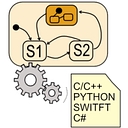 Generate production-ready source code from state diagrams or sysmlv2 textual model | Sinelabore Homepagehttps://www.sinelabore.de/ | 0.9% |
 Umplehttps://en.wikipedia.org/wiki/Umple | 0.9% |
Yes. **The closest thing to what you’re describing today is Stately + XState**, especially if the state machine is genuinely complex. [stately.ai](https://stately.ai/?utm_source=chatgpt.com) can take you from **natural-language requirements → state diagram → executable state machine → generated code → generated test…
Yes. The closest thing to what you’re describing today is Stately + XState, especially if the state machine is genuinely complex.
stately.ai can take you from natural-language requirements → state diagram → executable state machine → generated code → generated test paths. Its current MCP tooling explicitly supports creating an XState v5 machine from a natural-language request, and it can work with XState, SCXML, XGraph, D2, JSON/YAML, and Mermaid.
The important distinction is that this isn't simply "ask an LLM to write a bunch of if statements."
You can have:
Natural language
      ↓
State machine / statechart
      ↓
Visual simulation
      ↓
XState machine
      ↓
Generated TypeScript
      ↓
Generated test paths
Stately's editor lets you visually model and simulate transitions before implementing them, and it can export JavaScript/TypeScript/XState code. It also has automatic test-path generation.
And XState is specifically designed for complex application/workflow logic using state machines, hierarchical statecharts, actors, guards, events, and parallel states.
I wouldn't trust any AI to take a complicated natural-language description and produce genuinely bug-free state management without verification.
The better architecture is:
AI generates → formal state model validates → simulator explores paths → tests are generated → human reviews edge cases.
That's much safer than:
AI generates TypeScript → ship it.
For example, if your system has:
I'd strongly prefer an explicit statechart over conventional Redux/Zustand-style state management. XState is particularly well suited to this.
Stately's MCP integration means an AI coding agent can actually interact with the state-machine tooling. Its create_state_machine operation accepts a natural-language request and produces an XState v5 machine, with optional visualization.
So you could give an agent something like:
"Build the state machine for a checkout process. A customer can add/remove items, begin checkout, enter payment, experience payment failure with retry, require 3DS authentication, complete payment, cancel before payment, and recover an interrupted checkout from persisted state. Identify all illegal transitions and generate tests for every transition." Then have the agent produce the machine, inspect the diagram, simulate it, and generate the implementation/tests.
That's considerably more compelling to me than asking Claude/ChatGPT/Copilot to directly invent the state-management code.
Even better.
Stately currently supports importing/working with formats including Mermaid, and its tooling supports conversion from several machine-description formats.
So if you already have something like:
stateDiagram-v2
    Idle --> Loading: FETCH
    Loading --> Success: SUCCESS
    Loading --> Error: FAILURE
    Error --> Loading: RETRY
    Success --> Idle: RESET
you can use that as the starting specification rather than asking an LLM to infer the architecture from scratch.
If you tell me what kind of state machine you're building (frontend UI, backend workflow, distributed process, game, AI agent, etc.) and your target language/framework (TypeScript/React, Python, Kotlin, Swift, etc.), I can recommend the best AI/toolchain for it—and, if you have the diagram or requirements, I can also show you what the AI-generated architecture would look like.
Then have the agent produce the machine, inspect the diagram, simulate it, and generate the implementation/tests.
That's considerably more compelling to me than asking Claude/ChatGPT/Copilot to directly invent the state-management code.
Even better.
Stately currently supports importing/working with formats including Mermaid, and its tooling supports conversion from several machine-description formats.
So if you already have something like:
stateDiagram-v2
    Idle --> Loading: FETCH
    Loading --> Success: SUCCESS
    Loading --> Error: FAILURE
    Error --> Loading: RETRY
    Success --> Idle: RESET
you can use that as the starting specification rather than asking an LLM to infer the architecture from scratch.
Yes, there are tools built specifically for this. The gold standard ecosystem for visual + code state management is **Stately** (the creators of **XState**).[](https://github.com/statelyai/xstate) [[1]](https://github.com/statelyai/xstate)[[2]](https://stately.ai/) Rather than relying on a generic LLM (like raw…
Yes, there are tools built specifically for this. The gold standard ecosystem for visual + code state management is Stately (the creators of XState).
Rather than relying on a generic LLM (like raw ChatGPT or Claude) which can hallucinate invalid transitions or messy syntax, specialized tools combine visual statecharts with deterministic code engines.
Top Options for AI State Machine Generation
Why using an ecosystem like Stately + XState works better than raw AI code:
If you want to move forward, tell me:
Yes. **The closest match to what you’re describing right now is Stately + XState**, especially if this is application state management in JavaScript/TypeScript. ### Best fit: Stately + XState [stately.ai](https://stately.ai/?utm_source=chatgpt.com) can take a natural-language description and generate an **XState v5…
Yes. The closest match to what you’re describing right now is Stately + XState, especially if this is application state management in JavaScript/TypeScript.
stately.ai can take a natural-language description and generate an XState v5 state machine, visualize it, simulate it, and export TypeScript/JavaScript code. Its current AI tooling can also take machine definitions in formats such as XState, SCXML, XGraph, D2, JSON/YAML, and Mermaid.
The important part is that you're not just asking an LLM to spit out a giant reducer:
Natural language → state machine → visual inspection/simulation → generated code → generated tests Stately explicitly supports AI-generated flows, edge-case suggestions, code generation, and automatic test generation.
And XState is specifically designed for complex state management/orchestration in TypeScript/JavaScript, including hierarchical states, guards, actors, events, and predictable transitions.
This is particularly interesting. Stately's tooling can consume Mermaid diagrams, among other formats, and turn them into an interactive/simulatable state machine.
So you could give it something conceptually like:
Unauthenticated
    ↓ LOGIN
Authenticating
    ├── SUCCESS → Authenticated
    └── FAILURE → Unauthenticated

Authenticated
    ├── SESSION_EXPIRED → Refreshing
    ├── LOGOUT → Unauthenticated
    └── REQUEST → Loading

Refreshing
    ├── SUCCESS → Authenticated
    └── FAILURE → Unauthenticated
and then have the machine represented explicitly rather than relying on an AI-generated collection of if/else statements.
If by "state machine" you mean long-running backend processes, jobs, retries, queues, approvals, etc., I'd also look at AWS Step Functions.
Its Workflow Studio lets you draw the workflow visually and automatically generates the Amazon States Language definition. You can switch between the visual graph and generated code, validate it, run it, and debug executions.
That's a different beast from XState:
| Stately/XState | AWS Step Functions --- | --- | --- Frontend UI state | Excellent | Poor fit Complex application logic | Excellent | Sometimes TypeScript/JavaScript | Excellent | Not its primary purpose Visual statecharts | Excellent | Excellent Backend workflows | Good | Excellent Long-running jobs | Possible | Excellent AI → state machine | Yes | More limited Generated tests | Yes | Testing/debugging tooling Avoid impossible transitions | Strong | Strong
I wouldn't trust any AI to generate a genuinely bug-free complex state machine from prose.
The more reliable architecture is:
AI generates the model → formal state machine constrains behavior → simulator explores transitions → generated/property tests verify paths → human reviews semantics.
That's precisely why I like the Stately approach more than simply asking Claude/Codex/GPT to "write me a state manager." Stately describes its diagrams as a source of truth and provides simulation and generated tests, while XState gives you an executable representation of the statechart.
In fact, Stately now exposes an MCP server with a create_state_machine operation that specifically takes a natural-language request and produces an XState v5 machine.
If you tell me what kind of state machine you're building (frontend UI, game, workflow engine, IoT/device lifecycle, distributed system, business process, etc.) and what language/framework you're using, I can recommend the best AI/toolchain—and I can also show you what I'd use to turn your actual state diagram into tested code.

Yes, specialized tools and AI models can bridge the gap between natural language/diagrams and state management code, but achieving a truly "bug-free" complex system usually requires a hybrid approach: **AI for scaffolding and logic derivation, paired with a deterministic state machine library for ironclad execution**…
Yes, specialized tools and AI models can bridge the gap between natural language/diagrams and state management code, but achieving a truly "bug-free" complex system usually requires a hybrid approach: AI for scaffolding and logic derivation, paired with a deterministic state machine library for ironclad execution .
The best tools and workflows available for this task include:
transitions library, SCXML, or Redux/Zustand logic). You can then paste the Mermaid code into a live viewer to visually audit the logic before coding.Why "Pure AI" Code Generation Can Still Fail on Complex States
While LLMs are fantastic at writing the first 80% of a state machine, complex state machines fail on edge cases: race conditions, unexpected concurrent states, and improper cleanup during abrupt transitions. Pure LLMs can hallucinate a valid-looking transition that leaks memory or deadlocks under stress.
The Recommended Workflow for Robust Results
transitions for Python) rather than raw boolean flags or switch-case statements. These frameworks enforce the rules at runtime, guaranteeing your code behaves exactly as the diagram specifies.If you'd like to share a brief natural language description of your state machine or tell me the programming language/framework you are targeting, I can help draft the initial state logic or a Mermaid.js diagram to get you started.
Here are top web results for exploring this topic: [](https://www.eraser.io/ai/state-diagram-generator)  Eraser·https://www.eraser.io**AI State Diagram Generator** Generate beautiful state diagrams in seconds from plain English or code…
Here are top web results for exploring this topic:
Eraser·https://www.eraser.io**AI State Diagram Generator** Generate beautiful state diagrams in seconds from plain English or code snippet prompts. Use AI to make and edit state diagrams. Try Eraser's AI state diagram maker for free.
mermaidonline.live·https://www.mermaidonline.live**Generate State Diagrams** with AI - Mermaid Online What is AI State Diagram Generator. AI State Diagram Generator is an intelligent tool that transforms natural language state machine descriptions into professional state diagrams. Perfect for software
Visual Paradigm·https://updates.visual-paradigm.com**AI State Diagram Generator** : New Support in OpenDocs Key Highlights of the State Diagram Update: AI-Powered Creation: Use the AI State Diagram tool to generate complex state machines from simple text descriptions. Two Ways to Integrate: Embedded Compone
Stately.ai·https://stately.ai Stately.ai Design how it works with a visual language for everyone on the team. Our drag and drop editor brings together contributors of all backgrounds. Code, diagrams, documentation, test generation, and more
Reddit·https://www.reddit.com Model-driven development tool that lets AI agents generate code ...It's architecture and structure first, you just define what goes where. On the code level you can - but don't have to - define data models, functions, and processes as named descriptions, which is j
www.mermaideditor.io·https://www.mermaideditor.io/ai/state-diagram-generator**AI State Diagram Generator** - Free Online Tool - Mermaid Editor AI models the state machine. Our AI identifies states, transitions, guards, start/end states, and nested states to produce valid Mermaid state diagram syntax.
Cloudairy·https://cloudairy.com**State Diagram** Maker — AI State Machine Tool | Cloudairy Create state diagrams and FSM diagrams with AI in seconds. UML 2.5 statechart notation, Mealy and Moore machines. Export to Visio and draw.io. Try it free.
Reddit·https://www.reddit.com**We built** an AI -agent with a state machine instead of a giant prompt 32 votes, 16 comments. Hola Pythonistas, Last year we tried to bring an LLM “agent” into a real enterprise workflow. It looked easy in the demo…
YouTube·https://www.youtube.com**Build State Machine Diagrams** with Visual Paradigm AI - YouTube Unlock the power of AI-assisted modeling with Visual Paradigm! In this video, you'll learn how to effortlessly generate UML state machine diagrams using the Visual Paradigm AI Chatbot. Whether you're
Medium·https://kitfucoda.medium.com**Building state machine** library with help from AI tools - KitFu Coda And the schema would look something like this (in truncated YAML form for clarity) machine: initial_state: pending_payment states: pending_payment: · Therefore, to set everything up, we call import ge
No sources cited
Yes. **The closest thing to what you’re describing today is Stately + XState**, especially if the goal is not merely “generate some code,” but to generate a *verifiable state machine* and then turn it into production code. ### My top pick: Stately + XState [stately.ai](https://stately.ai/?utm_source=chatgpt.com) lets…
Yes. The closest thing to what you’re describing today is Stately + XState, especially if the goal is not merely “generate some code,” but to generate a verifiable state machine and then turn it into production code.
stately.ai lets you:
More interestingly, Stately now exposes an MCP server whose create_state_machine tool can take a natural-language request and create an XState v5 machine, while validate_machine can check the resulting machine and generate_test_code can produce Vitest tests for paths through it.
That makes it considerably more compelling than simply asking ChatGPT/Claude/Copilot:
"Here's my state diagram, write the code." The workflow can instead be:
requirements → AI-generated statechart → validation → simulation → generated tests → TypeScript implementation
No AI system can honestly guarantee bug-free state-management code. The hard part isn't generating transitions; it's catching missing transitions, contradictory requirements, race conditions, impossible states, stale events, guards, retries, cancellation, persistence, and concurrency.
Statecharts help enormously because the model becomes an explicit artifact that can be analyzed rather than arbitrary application code.
XState is particularly suited to this. It's designed around state machines, statecharts, actors, guards, effects, and event-driven logic, and is specifically intended for complex application/workflow logic.
That's actually a very good starting point.
Stately's tooling can work with XState, SCXML, XGraph, D2, JSON, YAML, and Mermaid representations, and its newer Sketch tool can take Mermaid stateDiagram-v2 diagrams and turn them into interactive, simulatable machines.
So you could have something like:
Requirements / Mermaid diagram
             ↓
       Stately / AI
             ↓
       XState machine
             ↓
    ┌────────┴────────┐
    ↓                 ↓
 validation        simulation
    ↓                 ↓
 generated tests ←───┘
             ↓
       TypeScript code
If this is a serious production state machine, I'd use Claude Code or Codex alongside Stately/XState, rather than expecting one AI product to do everything.
The division of labor I'd recommend is:
That gives you an important separation between "AI wrote some code" and "AI constructed a formal model that we can inspect and test."
If you give me your state diagram (image/Mermaid/etc.) or the natural-language description, I can also tell you whether I'd model it as a simple FSM, hierarchical statechart, parallel states, or an actor system—and what I'd use to generate the production code.
No AI system can honestly guarantee bug-free state-management code. The hard part isn't generating transitions; it's catching missing transitions, contradictory requirements, race conditions, impossible states, stale events, guards, retries, cancellation, persistence, and concurrency.
Statecharts help enormously because the model becomes an explicit artifact that can be analyzed rather than arbitrary application code.
XState is particularly suited to this. It's designed around state machines, statecharts, actors, guards, effects, and event-driven logic, and is specifically intended for complex application/workflow logic.
That's actually a very good starting point.
Stately's tooling can work with XState, SCXML, XGraph, D2, JSON, YAML, and Mermaid representations, and its newer Sketch tool can take Mermaid stateDiagram-v2 diagrams and turn them into interactive, simulatable machines.
So you could have something like:
Requirements / Mermaid diagram
             ↓
       Stately / AI
             ↓
       XState machine
             ↓
    ┌────────┴────────┐
    ↓                 ↓
 validation        simulation
    ↓                 ↓
 generated tests ←───┘
             ↓
       TypeScript code
If this is a serious production state machine, I'd use Claude Code or Codex alongside Stately/XState, rather than expecting one AI product to do everything.
The division of labor I'd recommend is:
Yes. While general-purpose LLMs (like Claude 3.5 Sonnet or GPT-4o) can write decent state machine code from text, they often hallucinate edge cases or miss complex hierarchical transitions. To get truly robust, bug-free implementations, the best approach is to use **specialized visual/model-driven tools with built-in…
Yes. While general-purpose LLMs (like Claude 3.5 Sonnet or GPT-4o) can write decent state machine code from text, they often hallucinate edge cases or miss complex hierarchical transitions. To get truly robust, bug-free implementations, the best approach is to use specialized visual/model-driven tools with built-in AI capabilities rather than asking a raw chatbot to spit out a monolithic script.
The top tools and workflows for this include:
Recommended Workflow for a Complex State Machine
If you can share:
I can recommend the exact toolchain and help you draft the initial prompt or specification to feed into it.
Yes. **For complex state machines, the closest thing to what you're describing today is Stately + XState**, rather than a generic coding agent alone. ### My top pick: Stately Stately has an unusually good workflow for this:
Yes. For complex state machines, the closest thing to what you're describing today is Stately + XState, rather than a generic coding agent alone.
Stately has an unusually good workflow for this:
Natural language → state machine → visual diagram → executable TypeScript → tests
Its current tooling can take a natural-language description and create an XState v5 machine, normalize/validate it, visualize it, and generate tests for paths through the machine. It can also ingest existing XState, SCXML, XGraph, D2, JSON/YAML, and Mermaid representations.
The important distinction is that the diagram isn't merely documentation. With XState, the statechart itself becomes executable logic, so you can keep the diagram and implementation synchronized.
I'd structure the workflow like this:
                    ┌─────────────────┐
                    │ Natural language│
                    │ requirements    │
                    └────────┬────────┘
                             ↓
                    ┌─────────────────┐
                    │ Stately AI      │
                    │ generate model  │
                    └────────┬────────┘
                             ↓
                    ┌─────────────────┐
                    │ Visual statechart│
                    │ HUMAN REVIEW     │
                    └────────┬────────┘
                             ↓
                    ┌─────────────────┐
                    │ XState machine  │
                    │ TypeScript      │
                    └────────┬────────┘
                             ↓
              ┌──────────────┴──────────────┐
              ↓                             ↓
       generated tests              application code
              ↓                             ↓
       path exploration             actors / services
              └──────────────┬──────────────┘
                             ↓
                    CI + runtime tests
XState is particularly well suited to this because it handles hierarchical states, parallel states, guards, actions, actors, asynchronous effects, and event-driven transitions rather than just being a simple Redux-like store.
I wouldn't trust any AI to take a complicated natural-language spec and produce genuinely bug-free state management without verification.
The better goal is:
AI generates the machine; formal-ish state-machine tooling and tests make incorrect behavior difficult to introduce.
That's where Stately is substantially more interesting than simply asking Claude/Cursor/Copilot to write a giant reducer.
For example, Stately's tooling can generate a test for each path through a machine, and its MCP integration can validate machines and generate runnable Vitest tests.
It also gives you the ability to visually inspect things that are surprisingly easy for an LLM to get wrong:
I'd actually use a combination rather than choosing one AI.
Stately → authoritative state model
Claude/Cursor/Copilot → implementation around the model
XState → runtime semantics
generated/model-based tests → verification
human → requirements and edge-case review
The interesting part is that Stately now has an MCP server, so an AI coding agent can interact with the state-machine tooling directly. Its MCP interface can create machines from natural language, validate machines, generate test code, and convert between representations.
That makes a workflow like this possible:
"Here's our existing TypeScript code and these business requirements. Extract the state machine, identify missing transitions, propose corrections, update the machine, and generate tests for every reachable path."
That's much closer to the system you're envisioning than ordinary "AI writes code."
If your application is not JavaScript/TypeScript, I'd evaluate alternatives. XState is fundamentally a JS/TS ecosystem.
If you're building in React/TypeScript, though, I'd strongly recommend starting with Stately/XState before looking at generic AI state-management generators.
If you tell me what kind of state machine you're building (e.g. React UI, workflow engine, payments, game logic, distributed backend, agent orchestration) and your language/framework, I can recommend the best AI/toolchain and show you what an end-to-end "natural language → verified state machine → production code" workflow would look like.
While standard general-purpose Large Language Models (like ChatGPT or Claude) can write functional state machine code from natural language, they frequently hallucinate invalid transitions or miss edge cases in complex hierarchies.[](https://stately.ai/blog/2023-11-20-stately-studio-2-0)…
While standard general-purpose Large Language Models (like ChatGPT or Claude) can write functional state machine code from natural language, they frequently hallucinate invalid transitions or miss edge cases in complex hierarchies.
Instead of relying purely on an LLM prompt, the most robust approach combines specialized visual/AI modeling tools with formal state machine libraries.
Top Tools for AI-Driven State Management Code
Why a Hybrid Approach Beats Pure "Vibe Coding"
Generating state machines via pure natural language often results in code that looks right but fails silently under race conditions or unexpected event sequencing. Using a visualizer-to-code pipeline (like Stately or StateSmith) ensures the logic is deterministic and statically analyzable , meaning the AI assists with the layout and scaffolding, but a formal engine enforces the rigid mathematical boundaries of the state transitions.
If you can share:
I can recommend the exact workflow and library configuration to get this built safely.
Yes. **The strongest fit I found is Stately + XState**, especially if your goal is *complex* state management rather than simply having an LLM spit out a large switch statement. ### My top recommendation: Stately + XState [Stately](https://stately.ai/?utm_source=chatgpt.com) lets you:
Yes. The strongest fit I found is Stately + XState, especially if your goal is complex state management rather than simply having an LLM spit out a large switch statement.
Stately lets you:
Their current MCP integration is particularly interesting: an AI coding agent such as Claude Code, Cursor, Codex, or VS Code/Copilot can use Stately's machine tools directly. The create_state_machine tool accepts a natural-language request and produces a normalized XState v5 machine.
And XState is specifically designed for complex event-driven logic, hierarchical/parallel states, guards, actors, async operations, etc., rather than merely being a UI state container.
I wouldn't trust any AI to promise "bug-free" state-management code.
The better architecture is:
Natural language / existing diagram
↓
AI generates statechart
↓
Human reviews the statechart
↓
Machine is simulated / validated
↓
Generate TypeScript
↓
Generate tests from the state graph
↓
Run those tests in CI
That is substantially safer than:
"Here is my 4,000-word description. Generate production code."
Stately is unusually well suited to this workflow because the diagram itself becomes an executable specification, rather than just documentation. Their VS Code tooling also provides autocomplete, linting for state-machine errors, navigation, and refactoring support.
This is especially compelling.
Stately can work with XState, SCXML, XGraph, D2, and its newer Sketch tool can ingest Mermaid state diagrams and make them interactive/simulatable.
So, for example, you could give an AI something like:
User starts checkout
  ↓
CartValidating
  ├── invalid → CartInvalid
  └── valid → PaymentPending
                    ├── authorized → FulfillmentPending
                    ├── declined → PaymentFailed
                    └── timeout → PaymentRetry
                                      ├── retry available → PaymentPending
                                      └── exhausted → CheckoutFailed
and have it turn that into an actual statechart with:
rather than leaving those semantics implicit.
If you're building something genuinely complicated, I'd use:
Stately Studio → source-of-truth state diagram
XState v5 → runtime/state-management implementation
Claude Code / Cursor / Codex → AI-assisted implementation
Stately MCP → let the coding agent directly manipulate/inspect the state machine
Generated state-path tests + normal unit/integration tests → verification
The Stately/XState combination is also not tied exclusively to React; XState supports JavaScript/TypeScript applications including React, Vue, Svelte, backend workflows, and other JS environments.
If you tell me what kind of state machine you're building (e.g. React UI, workflow engine, payments, game logic, IoT, backend orchestration, AI agent, etc.) and what language/framework you're using, I can recommend the exact AI/toolchain—and, more importantly, show you a workflow for getting from your diagram → formally structured state machine → production code → automatically generated tests.