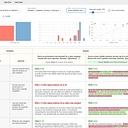
Data as of Aug 25, 2026 · Based on 327 AI responses from ChatGPT Search and Google AI Mode · See how Parse measures this
The best monitoring choice depends on your specific workflow. For automated, real-time hallucination detection, Patronus AI and Galileo AI are top recommended options. Developers heavily using LangChain often find 

 Maxim AI
Brands AI recommends here
Excellent for enterprise-ready, domain-specific hallucination detection. It provides real-time monitoring without requiring manual annotation, making it a strong choice for high-stakes accuracy needs.
The best-fit choice for developers already using LangChain. It excels at deep tracing and debugging of multi-step chains, though it is specifically optimized for that ecosystem rather than generic app monitoring.
Ideal for teams needing high recall to catch most hallucinations. It provides a clear view of how outputs compare to source context with boolean flags and is highly effective at tracing and dashboarding accuracy.
 Arize AI
Source | Citation share |
|---|---|
Top 5 Tools to Detect Hallucinations in AI Applications - Maxim AIhttps://www.getmaxim.ai/articles/top-5-tools-to-detect-hallucinations-in-ai-applications-a-comprehensive-guide/ | 5.0% |
 Best AI Hallucination Detection Tools 2026: Top 5https://futureagi.com/blogs/top-5-ai-hallucination-detection-tools-2025 | 3.9% |
Top 5 tools to detect hallucination in 2025 - Maxim AIhttps://www.getmaxim.ai/articles/top-5-tools-to-detect-hallucination-in-2025/ | 3.6% |
Top 5 Tools to Monitor and Detect Hallucinations in AI Agentshttps://www.getmaxim.ai/articles/top-5-tools-to-monitor-and-detect-hallucinations-in-ai-agents/ | 3.0% |
 Best LLM Observability Tools in 2026 - Firecrawlhttps://www.firecrawl.dev/blog/best-llm-observability-tools | 2.4% |
 Generative AI Monitoring | Watchlog — LLM Observability & Hallucination Detection · Watchloghttps://watchlog.io/products/gen-ai-monitoring | 2.0% |
 Top 9 LLM Observability Tools in 2025https://logz.io/blog/top-llm-observability-tools/ | 2.0% |
 Introducing hallucination detection for AI agents - Sendbirdhttps://sendbird.com/blog/ai-hallucination-detection | 1.7% |
 Detecting hallucinations with LLM-as-a-judge: Prompt engineering and beyondhttps://www.datadoghq.com/blog/ai/llm-hallucination-detection/ | 1.5% |
 5 best AI evaluation tools for AI systems in production (2026) - Articles - Braintrusthttps://www.braintrust.dev/articles/best-ai-evaluation-tools-2026 | 1.5% |
There is no single "best" dashboard for everyone, as the right choice depends heavily on your workflow (CI/CD testing vs. production observability), privacy needs (SaaS vs. self-hosted), and team makeup (engineers vs. data scientists).
The top platforms for monitoring hallucination and accuracy stand out in specific categories:
To help narrow down the ideal choice, let me know:
If you mean an LLM/AI dashboard for tracking hallucinations, correctness, and regressions in production, my pick right now is langfuse.com.
Don't make “accuracy” one giant number. I'd have:
| Metric | What it tells you |
|---|---|
| Hallucination rate | % responses containing unsupported/false claims |
| Answer correctness | Whether the answer matches a known/reference answer |
| Faithfulness | Whether the response is supported by retrieved context |
| Context relevance | Whether RAG retrieved the right information |
| Citation accuracy | Whether cited sources actually support the claims |
| User thumbs-up rate | Real-world quality signal |
| Failure rate by model/prompt | Where regressions are coming from |
| Cost + latency | Whether quality improvements are economically viable |
The important distinction is that hallucination detection and accuracy aren't the same thing. For production traffic where you don't have a reference answer, a judge can evaluate the response against the input/context; for pre-release testing, you can use a dataset with known answers.
If I were building this today: Langfuse + a small curated “golden” evaluation set + automated hallucination/faithfulness/correctness judges + human review of a sample. That gives you both production monitoring and a defensible measure of actual accuracy.
If you tell me whether you're monitoring a RAG chatbot, agent, customer-support bot, or general LLM API, I can recommend the exact dashboard layout and metrics I'd use.
If you mean an LLM application dashboard for tracking hallucinations, factual accuracy, and production quality, the “best” choice depends on your stack. There isn’t one universal winner, but these are the strongest options:
| Tool | Best for | Why it stands out |
|---|---|---|
| Langfuse | Most production teams | Strong all-around tracing, evaluations, prompt/version tracking, cost monitoring, and customizable dashboards. QASkills.sh Levelop |
| Arize AI / Phoenix | RAG accuracy + hallucination analysis | Excellent for measuring faithfulness, retrieval quality, grounding, and embedding/retrieval issues. Turion AI Levelop |
| LangChain LangSmith | LangChain/LangGraph apps | Deep tracing and debugging for agent workflows built on that ecosystem. Turion AI |
| Braintrust | Evaluation-heavy teams | Strong for systematic eval datasets, regression testing, and model/prompt comparisons. dreaming.press |
For most teams building a production RAG chatbot or AI agent:
This combination covers both monitoring and root-cause analysis.
A useful hallucination/accuracy dashboard should include:
For every bad answer, you want to see:
The biggest mistake is choosing a dashboard that only shows latency and token cost. Hallucinations are semantic failures, so you need trace data + automated evaluators + human feedback loops, not just traditional monitoring.
The "best" dashboard for monitoring hallucination and accuracy depends heavily on your stack, whether you want an open-source self-hosted tool or a managed enterprise platform , and whether you need offline CI/CD testing versus real-time production tracing.
The top tools dominating hallucination and accuracy monitoring are organized below by their strongest use case:
To help narrow down which dashboard fits your setup, tell me:
If you mean an LLM/AI application dashboard for monitoring hallucinations and answer accuracy, my pick in 2026 is Braintrust for most teams.
| Dashboard | Best for | Hallucination / accuracy monitoring | My take |
|---|---|---|---|
| Braintrust | Production eval + regression testing | ⭐⭐⭐⭐⭐ | Best overall |
| Arize Phoenix | Open-source / self-hosting | ⭐⭐⭐⭐⭐ | Best OSS option |
| Langfuse | Flexible observability + self-hosting | ⭐⭐⭐⭐ | Great general-purpose choice |
| LangSmith | LangChain/LangGraph apps | ⭐⭐⭐⭐ | Excellent if you're already in that ecosystem |
| Galileo | Runtime quality/guardrails | ⭐⭐⭐⭐⭐ | Strong for blocking bad outputs |
Why Braintrust: it connects pre-production evaluation with production monitoring. You can score traces for things like factuality, groundedness, contradiction, citation validity and custom hallucination criteria, then compare regressions when you change models, prompts or retrieval.
Why Phoenix is particularly compelling: its evaluation system supports both deterministic evaluators and LLM-as-a-judge, can evaluate production traces, and has prebuilt RAG/faithfulness evaluators. It's also open source and OpenTelemetry-based.
Don't use a single "accuracy %" metric. I'd monitor:
For a RAG application, I'd lean Phoenix or Braintrust. For an agent, Braintrust becomes especially attractive because you want to evaluate the whole trace rather than just the final response. Current comparisons similarly put Braintrust and Phoenix toward the top for eval-driven quality workflows.
If you tell me what you're monitoring (RAG chatbot, customer-support agent, internal copilot, API, etc.) and your stack, I can recommend the exact dashboard and metrics—and show you what the dashboard should look like.
There is no single "best" dashboard because the market is split between evaluation-first platforms (built specifically to run scoring tests for accuracy and hallucinations) and tracing-first infrastructure (built to log everything in production, on top of which you layer evaluations).
The top platforms for monitoring hallucination and accuracy break down by team needs:
To help narrow down the ideal dashboard for your stack, tell me:
There is no single "best" dashboard because the top tools split into distinct categories depending on whether you are doing pre-production testing, runtime blocking , or open-source self-hosting.
Evaluating hallucination (faithfulness/groundedness) and accuracy requires combining tracing (what the model and retrieval step did) with automated evaluators (LLM-as-a-judge or smaller verified scoring models).
The top platforms for monitoring hallucination and accuracy are organized below by their primary strength:
To help narrow down the ideal dashboard, tell me:
If you mean an LLM observability dashboard for tracking hallucinations, factual accuracy, and reliability, the “best” choice depends on your stack. There is no single winner, but these are the strongest options:
| Dashboard | Best for | Hallucination / accuracy monitoring strengths |
|---|---|---|
| Arize AI / Arize Phoenix | RAG systems and accuracy-focused teams | Strong built-in evaluations for faithfulness, answer correctness, retrieval quality, and embedding drift. turion.aifp8.co |
| LangChain LangSmith | Teams building with LangChain/LangGraph | Excellent trace inspection, datasets, human feedback loops, and LLM-as-judge evaluations. turion.aifp8.co |
| Langfuse | Open-source/self-hosted deployments | Good production tracing, evaluations, prompt/version tracking, and data ownership. turion.aifp8.co |
| Braintrust | Evaluation-driven development | Strong for regression testing, golden datasets, and comparing model/prompt versions. www.smartduke.comfp8.co |
RAG chatbot / knowledge assistant: → Arize Phoenix
Track:
AI agents with tools and multi-step workflows: → LangSmith or Langfuse
Track:
Enterprise with compliance/data residency needs: → Langfuse self-hosted or Phoenix self-hosted
A good hallucination/accuracy dashboard should not just show “hallucination rate.” Track:
Quality
RAG health
Production signals
Operational
A practical production stack many teams end up with is:
OpenTelemetry traces → Langfuse/Phoenix/LangSmith → automated evaluators → human review queue → regression test dataset
That gives you both real-time visibility and a way to prevent quality regressions.
If you tell me whether your system is RAG, chatbot, agent, or fine-tuned model, and whether you need self-hosted, I can narrow it to one choice.
There is no single "best" dashboard because the top platforms serve different workflows (pre-production testing vs. runtime blocking vs. open-source self-hosting). The top-performing platforms for tracking hallucination, groundedness, and accuracy are categorized below by their primary strength:
If you share:
I can help you narrow down the exact dashboard and metric configuration for your architecture.
If you mean an LLM application dashboard for tracking hallucinations, factual accuracy, and reliability, there isn’t one universal winner—the best choice depends on whether you care more about production monitoring, evaluation workflows, or RAG accuracy. Current LLM observability platforms generally combine tracing, automated evaluators, and human review rather than just a single “hallucination meter.”
My shortlist:
| Best for | Dashboard | Why |
|---|---|---|
| Overall production AI quality monitoring | Arize AI / Phoenix | Strong for tracing, RAG quality, drift detection, and debugging why answers fail. signoz.io |
| Enterprise eval + release gates | Braintrust | Good for golden datasets, regression tests, human review, and comparing model/prompt changes. www.braintrust.dev |
| Teams using LangChain/LangGraph | LangChain LangSmith | Strong trace visualization and workflow debugging. www.langchain.com |
| Open-source / self-hosted | Langfuse or Arize Phoenix | Better when you need data control and custom dashboards. signoz.io |
| RAG-heavy apps | Ragas + observability layer | Focuses on faithfulness, context relevance, and retrieval quality. www.langchain.comaiml.qa |
For a serious production dashboard, I’d track more than “hallucination rate”:
Core panels
A practical stack many teams end up with:
One caution: hallucination detectors themselves can be imperfect; research shows automated metrics do not always align with human judgments, so the dashboard should combine automated scores with sampled human review.
If you tell me your setup (RAG chatbot, agents, customer support, internal knowledge bot, regulated domain, etc.), I can narrow this to the best dashboard architecture.