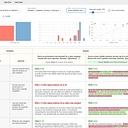
Data as of Aug 25, 2026 · Based on 273 AI responses from ChatGPT Search and Google AI Mode · See how Parse measures this
For production A/B testing of prompt variations, top recommendations include 


Brands AI recommends here
Named in 61% of answers
An open-source observability platform suitable for teams needing self-hosted control. It provides an SDK for prompt version labeling and tracing so you can effectively monitor and compare A/B prompt performance.
Named in 55% of answers
Offers a comprehensive SDK for managing versioned prompts and running live production A/B tests. It is well-suited for ML engineering teams needing to evaluate prompts against real-world datasets.
Named in 40% of answers
Named in 38% of answers
Best for enterprise and complex workflows, this platform allows you to treat prompts as artifacts. Its SDK supports gradual rollouts and segment-based testing, helping to decouple prompt management from your application code.
Source | Citation share |
|---|---|
A/B testing for LLM prompts: A practical guide - Articles - Braintrusthttps://www.braintrust.dev/articles/ab-testing-llm-prompts | 6.0% |
A/B Testing - Langfusehttps://langfuse.com/docs/prompt-management/features/a-b-testing | 4.7% |
Best Prompt Evaluation Tools in 2026 (Tested & Compared) - Articles - Braintrusthttps://www.braintrust.dev/articles/best-prompt-evaluation-tools-2025 | 3.7% |
How to Perform A/B Testing with Prompts - Bifrosthttps://www.getmaxim.ai/articles/how-to-perform-a-b-testing-with-prompts-a-comprehensive-guide-for-ai-teams/ | 3.2% |
 A/B Testing LLM Prompts - ABV Documentationhttps://docs.abv.dev/developer/prompt-management/ab-testing-llm-prompts | 2.2% |
PromptCompose SDKhttps://docs.promptcompose.ai/docs/sdk/ab-testing/ | 1.8% |
 A/B Testing - LangWatchhttps://langwatch.ai/docs/prompt-management/features/advanced/a-b-testing | 1.6% |
 9 Best Prompt Management Tools for ML and AI Engineering Teams - ZenML Bloghttps://www.zenml.io/blog/best-prompt-management-tools | 1.6% |
Top 5 prompt evaluation tools in 2025https://www.getmaxim.ai/articles/top-5-prompt-evaluation-tools-in-2025/ | 1.5% |
Best Prompt Versioning Tools for Production Teams (2026) - Articles - Braintrusthttps://www.braintrust.dev/articles/best-prompt-versioning-tools-2025 | 1.5% |
To A/B test and evaluate prompt variations directly in production, you need an LLMOps platform that decouples prompt management from your codebase via remote configuration SDKs, logs traces, and scores…
To A/B test and evaluate prompt variations directly in production, you need an LLMOps platform that decouples prompt management from your codebase via remote configuration SDKs, logs traces, and scores outputs.
The leading SDKs designed specifically for this workflow include:
loadPrompt() ), environment tagging (production, staging ), and native side-by-side trace comparisons. It lets you run experiments and evaluate prompt variants using code or their web interface, linking production outputs back to evaluation datasets.To help narrow down the best fit, could you tell me:
If you need an SDK specifically for **evaluating prompt variations and A/B testing them in production**, look for a tool that combines: - Prompt versioning - Runtime variant assignment (A/B routing)
If you need an SDK specifically for evaluating prompt variations and A/B testing them in production, look for a tool that combines:
Some strong options:
| SDK / platform | Best for | A/B testing approach |
|---|---|---|
| Langfuse | Open-source LLM observability + evals | Label prompt versions (for example prod-a / prod-b), route traffic between them, and compare metrics like evaluation scores, latency, cost, and token usage. Langfuse |
| Braintrust | Teams wanting rigorous eval pipelines | Strong for running experiments, scoring outputs, and comparing variants against datasets and production traces. |
| PromptLayer | Prompt lifecycle management | Uses release labels and production routing so you can test versions without redeploying application code. PromptLayer |
| Maxim AI | Agent workflows and multimodal evals | Supports prompt experiments, evaluation suites, and production deployment through its SDK. Maxim |
| Literal AI | Prompt version rollouts | Supports rollout percentages between prompt versions and tracking performance differences. Literal AI Documentation |
A typical production setup looks like:
customer_support_prompt_v12customer_support_prompt_v13For a first implementation, I’d usually choose:
If you tell me your stack (Python/TypeScript, OpenAI/Anthropic/self-hosted models, and whether you need self-hosting), I can narrow this to the best SDK.
If your key requirement is **A/B testing prompt variants in production**, I’d shortlist these: SDK / platform | Production A/B | Production evals | Prompt management | Best fit --- | --- | --- | --- | ---
If your key requirement is A/B testing prompt variants in production, I’d shortlist these:
| SDK / platform | Production A/B | Production evals | Prompt management | Best fit |
|---|---|---|---|---|
| langfuse.com | Yes | Yes | Yes | Best overall fit |
| phoenix.arize.com | Via instrumentation/experiments | Excellent | Yes | Evaluation-heavy teams |
| promptfoo.dev | More DIY | Excellent | Limited | Developer-first eval/CI |
Langfuse has an especially direct workflow for your use case: you can maintain prompt versions with labels such as prod-a and prod-b, have your application randomly select between them, and then compare latency, token usage, cost, and evaluation metrics for the variants. It has Python and JS/TS SDKs.
The important distinction is that this isn't merely an offline prompt benchmark—you can connect the selected prompt version to production generations and evaluate how each variant performs on real traffic.
phoenix.arize.com is particularly strong if you want sophisticated eval infrastructure. Its SDK supports experiments with datasets, tasks, and evaluators, while its evaluation SDKs support both deterministic code evaluators and LLM-as-a-judge evaluators.
Phoenix can also evaluate production traces, so you can feed real-world behavior back into your evaluation loop.
promptfoo.dev is excellent for systematically comparing prompts/models and running evals in CI/CD. It has a Node API as well as CLI/config-driven workflows.
I'd use it primarily for pre-production regression testing, rather than as the core production A/B experimentation layer.
Bottom line: if the architecture you have in mind is:
deploy prompt A + prompt B → route a percentage of real users to each → collect outcomes → run evaluators → determine winner → promote winner I'd start with Langfuse. If you tell me whether you're using Python or TypeScript, and OpenAI/Anthropic/etc., I can give you a minimal SDK architecture for doing this safely in production.
You can use **Braintrust** or **[LangSmith](https://www.langchain.com/langsmith)** , both of which provide robust SDKs for managing, A/B testing, and evaluating prompt variations directly in production.[](https://www.youtube.com/watch?v=9iN-cPnp7xg)…
You can use Braintrust or LangSmith , both of which provide robust SDKs for managing, A/B testing, and evaluating prompt variations directly in production.
Top SDKs for Production Prompt A/B Testing
| Feature / Capability | Braintrust | LangSmith | Maxim AI |
|---|---|---|---|
| Primary Focus | Enterprise LLM evals & data logging | Tracing & prompt hub | Agent tracing & experimentation |
| Production A/B Testing | Supported via online scoring | Supported via tagged commits | Supported via dynamic sampling |
| SDK Language Support | Python, TypeScript | Python, TypeScript | Python, TypeScript |
If you can tell me which programming language you are using (Python or TypeScript) and which LLM framework your stack is built on, I can provide a code snippet for setting up your first production prompt experiment.
If your main requirement is **“A/B test prompt variants in production and evaluate which one wins,”** I’d shortlist these: - **LangChain LangSmith** — probably the best fit if you want an SDK + production observability + offline/online evals. You can version prompts, run the same dataset against multiple prompt…
If your main requirement is “A/B test prompt variants in production and evaluate which one wins,” I’d shortlist these:
For your stated use case, LangSmith is the safest starting point. Its SDK lets you represent each prompt as an experiment, attach evaluators, and compare prompt/model configurations on identical data. It also supports online evaluators on production traffic, so you can connect the offline A/B test to what actually happens after deployment.
A sensible architecture would be:
                    ┌─ Prompt A ─┐
Production traffic ─┤            ├─> LLM ─> response
                    └─ Prompt B ─┘
                         │
                         ▼
                  evaluator / judge
                         │
               quality + latency + cost
                         │
                         ▼
                 A/B experiment results
One important distinction: offline prompt comparison and true live A/B testing aren't quite the same. LangSmith clearly supports the former and production online evaluation; if you need traffic allocation itself (e.g. 90% A / 10% B, randomized assignment, sticky users, statistical significance, automatic winner promotion), I'd verify that requirement separately rather than assuming an eval SDK provides it.
If you tell me your stack (Python/TypeScript, OpenAI/Anthropic/etc., and whether you need actual live traffic splitting), I can narrow this to 2–3 SDKs and show the implementation pattern.
A/B testing prompt variations in production requires combining **prompt management/versioning** (to fetch variants dynamically) with **observability/evaluations** (to score output quality, latency, and cost on live traffic).[](https://langfuse.com/docs/prompt-management/features/a-b-testing)…
A/B testing prompt variations in production requires combining prompt management/versioning (to fetch variants dynamically) with observability/evaluations (to score output quality, latency, and cost on live traffic).
The top SDKs and platforms built specifically for this workflow vary based on your preference for open-source self-hosting versus managed enterprise services:
prod-a, prod-b ). Your application SDK randomly or deterministically splits traffic between them, while the platform automatically tracks production latency, token costs, and custom evaluation scores per variant.To help narrow down the ideal choice, let me know:
To A/B test and evaluate prompt variations directly in production, you need an infrastructure that combines **remote prompt management/versioning**, **traffic bucketing** , and **trace-level logging/evaluators**.[](https://www.traceloop.com/blog/the-definitive-guide-to-a-b-testing-llm-models-in-production)…
To A/B test and evaluate prompt variations directly in production, you need an infrastructure that combines remote prompt management/versioning, traffic bucketing , and trace-level logging/evaluators.
Several developer-first platforms provide robust SDKs tailored explicitly for this workflow:
prod-a, prod-b ) via lightweight SDKs, allowing you to split traffic and track latency, token cost, and quality scores per variant.If you want to narrow this down, tell me:
I can provide a code snippet showing how to set up the traffic split and log your evaluation metrics.
If your key requirement is **A/B-testing prompt variants against real production traffic**, I’d shortlist these: | SDK/platform | Best fit | Production A/B | Online evals | SDK | |---|---|---:|---:|---:|
If your key requirement is A/B-testing prompt variants against real production traffic, I’d shortlist these:
| SDK/platform | Best fit | Production A/B | Online evals | SDK |
|---|---|---|---|---|
| Braintrust | Best overall for this use case | ✅ | ✅ | Python/TS |
| LangSmith | Full observability + eval lifecycle | ✅/experimental workflows | ✅ | Python/TS/Go/Java |
| Promptfoo | Open-source, developer-first evals | Strong for offline/CI | More limited | Node/API |
Braintrust is probably the closest match to what you're describing. It explicitly supports A/B testing prompts through its SDK, with datasets and scorers, so you can compare variants quantitatively rather than relying on eyeballing outputs.
A typical architecture would be:
                    ┌─ Prompt A ─┐
Production request ─┤            ├─ LLM → response → evaluator
                    └─ Prompt B ─┘
                           │
                    quality / cost /
                    latency metrics
                           │
                     A/B comparison
The important thing is to separate traffic assignment from evaluation:
LangSmith is particularly compelling if you also want tracing and production monitoring. It supports offline experiments comparing prompt/model versions and online evaluations over production traffic, with custom Python/TypeScript evaluators and pairwise comparisons.
It's also framework-agnostic, so you don't need to be using LangChain.
Promptfoo is excellent if your priority is pre-production prompt regression testing and CI. Its Node API supports comparing model/prompt variants programmatically, and its core workflow is built around repeatable test cases and automated assertions.
I'd use it more for:
"Should we ship prompt B?"
than:
"Does prompt B perform better than A across our live users?"
Bottom line: for a production prompt A/B testing SDK, start with Braintrust. If you need a broader observability + evaluation platform, choose LangSmith. If you primarily want developer-controlled offline/CI evals, choose Promptfoo.
To A/B test and evaluate prompt variations directly in production, you need an **LLMOps / AI engineering platform** that handles two integrated components: **remote prompt management/versioning** (to dynamically split traffic between prompt variants) and **production tracing/scoring** (to log outputs and evaluate them…
To A/B test and evaluate prompt variations directly in production, you need an LLMOps / AI engineering platform that handles two integrated components: remote prompt management/versioning (to dynamically split traffic between prompt variants) and production tracing/scoring (to log outputs and evaluate them via code, user feedback, or LLM-as-a-judge).
Top production-ready SDK options offering these capabilities include:
prod-a and prod-b ), fetch them with client-side caching, and track performance, latency, costs, and custom evaluation scores per variant. Check out the details in the Langfuse Documentation.To help narrow down the best SDK for your stack, tell me:
If your key requirement is **A/B-testing prompt variants in live production traffic**, I’d shortlist these: | SDK/platform | Production A/B | Prompt versioning | Online evals | Best fit | |---|---|---|---|---|
If your key requirement is A/B-testing prompt variants in live production traffic, I’d shortlist these:
| SDK/platform | Production A/B | Prompt versioning | Online evals | Best fit |
|---|---|---|---|---|
| Braintrust | ✅ | ✅ | ✅ | Best overall for an eval-first production workflow |
| Langfuse | ✅ | ✅ | ✅ | Best open-source option |
| LangSmith | ✅ | ✅ | ✅ | Strong choice if you use LangChain/LangGraph |
| Humanloop | ✅ | ✅ | ✅ | Strong prompt-management/product-team workflow |
Braintrust is probably the closest match to what you described. Its SDK supports prompt A/B testing, while the platform connects experiments to datasets, scorers, production traces, and evaluation results.
A good production setup would be:
Prompt A/B assignment → trace each request → score outcomes → compare quality/cost/latency → gradually ramp the winner.
Langfuse explicitly supports labeling prompt versions such as prod-a and prod-b, randomly selecting between them in your application, and comparing latency, token usage, cost, and evaluation metrics.
It also has SDK-based experiments for running application/prompt variants against datasets, so you can combine offline evaluation + production A/B testing.
If you tell me your stack (Python/TypeScript, OpenAI/Anthropic/etc.) and whether you need statistical significance/automatic traffic allocation, I can narrow this to 1–2 SDKs and show the integration pattern.