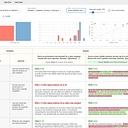
Data as of Aug 25, 2026 · Based on 327 AI responses from ChatGPT Search and Google AI Mode · See how Parse measures this
To determine which prompts perform best, use platforms that facilitate traffic splitting and systematic evaluation. 

Brands AI recommends here
Named in 61% of answers
Best for product teams needing a no-code visual interface. It acts as a middleman between your app and prompt models, making it easy to version and manage prompt changes visually without constant dev support.
Named in 54% of answers
Named in 45% of answers
Best for engineering teams focused on systematic prompt evaluation. It allows you to run A/B tests on live traffic using collaborative playgrounds, though it requires an engineering-focused workflow integration.
Named in 43% of answers
Best for existing users of the LangChain ecosystem. It provides native, robust tracing and prompt versioning specifically optimized for LangChain pipelines, avoiding integration hurdles for your existing stack.
Source | Citation share |
|---|---|
Best Prompt Versioning Tools for Production Teams (2026) - Articles - Braintrusthttps://www.braintrust.dev/articles/best-prompt-versioning-tools-2025 | 4.6% |
A/B testing for LLM prompts: A practical guide - Articles - Braintrusthttps://www.braintrust.dev/articles/ab-testing-llm-prompts | 4.5% |
Best Prompt Evaluation Tools in 2026 (Tested & Compared) - Articles - Braintrusthttps://www.braintrust.dev/articles/best-prompt-evaluation-tools-2025 | 4.0% |
 A/B Testing - Langfusehttps://langfuse.com/docs/prompt-management/features/a-b-testing | 2.3% |
 Top AI Platforms For Testing and Versioning Prompts | Prompts.aihttps://www.prompts.ai/en/blog/top-ai-platforms-testing-versioning-prompts | 2.2% |
 6 Top Prompt Testing Frameworks in 2025 | Mirascopehttps://mirascope.com/blog/prompt-testing-framework | 1.8% |
 How to Perform A/B Testing with Prompts - Bifrosthttps://www.getmaxim.ai/articles/how-to-perform-a-b-testing-with-prompts-a-comprehensive-guide-for-ai-teams/ | 1.7% |
 9 Best Prompt Management Tools for ML and AI Engineering Teams - ZenML Bloghttps://www.zenml.io/blog/best-prompt-management-tools | 1.5% |
 A/B Testing Prompts: A Complete Guide to Optimizing LLM ...https://dev.to/kuldeep_paul/ab-testing-prompts-a-complete-guide-to-optimizing-llm-performance-1442 | 1.3% |
 Prompt Engineering Platform [2026] | Test & Optimize AI Prompts | Evaligohttps://www.evaligo.com/prompt-engineering | 1.3% |
Not knowing which prompt variants are actually moving the needle in production is a classic LLM engineering bottleneck. Because LLM outputs are non-deterministic and nuanced, standard web A/B testing tools (like Optimizely or VWO) don't cut it . You need a dedicated **LLMOps and prompt management platform** that…
Not knowing which prompt variants are actually moving the needle in production is a classic LLM engineering bottleneck. Because LLM outputs are non-deterministic and nuanced, standard web A/B testing tools (like Optimizely or VWO) don't cut it . You need a dedicated LLMOps and prompt management platform that handles versioning, live traffic splitting, and continuous evaluation.
The top platforms purpose-built for A/B testing and managing prompts in production include:
What to look for in a production testing loop:
To narrow down the ideal platform for your stack, tell me:
If your goal is specifically **“we have multiple prompts, they’re already serving real users, and we want to know which one actually performs better”**, my first choice would be **[humanloop.com](https://humanloop.com?utm_source=chatgpt.com)**. Humanloop is unusually well matched to this problem: you can version…
If your goal is specifically “we have multiple prompts, they’re already serving real users, and we want to know which one actually performs better”, my first choice would be humanloop.com.
Humanloop is unusually well matched to this problem: you can version prompts, split production traffic between configurations, collect user feedback, and use that feedback to compare variants. Its experiments explicitly support A/B testing different prompt templates, model parameters, and models in production.
| Platform | Best for | Production A/B testing | Evals | My take |
|---|---|---|---|---|
| Humanloop | Prompt-centric teams | Yes | Strong | Best fit for your exact problem |
| Braintrust | Engineering-heavy AI teams | Strong experimentation | Excellent | Best if you also want sophisticated eval/observability workflows |
| Statsig | Product experimentation teams | Yes | Strong | Best if you already use Statsig for conventional A/B tests |
| LangSmith | Agent/LLM engineering | Yes, via its experimentation/eval stack | Excellent | Great if you're already in the LangChain ecosystem |
Braintrust is probably my #2. Its workflow is particularly good if “which prompt is better?” needs to become a rigorous evaluation pipeline: datasets, scorers, side-by-side experiments, production traces, cost/latency, and CI gates.
Statsig is compelling if your definition of “better prompt” is ultimately a product KPI—conversion, retention, task completion, etc. Its AI experimentation supports both offline evaluation and online grading against live production traffic.
LangSmith makes more sense if you're building sophisticated agents and want experimentation tied closely to tracing, evaluation, and production debugging.
I'd actually separate this into two experiments:
You need both. A prompt can win an LLM-as-a-judge evaluation while actually producing worse outcomes for users.
For example:
Prompt A → 87% evaluator score → 12% task completion Prompt B → 84% evaluator score → 19% task completion I'd ship B.
Humanloop supports the production-feedback side particularly directly: its experiment can sample model configurations in production and use subsequent user feedback to calculate performance.
So if I were choosing for your situation today: Humanloop for the simplest prompt-centric solution; Braintrust if you want a more engineering/evaluation-heavy platform; Statsig if your company already runs product experimentation there.
If you tell me your stack (OpenAI/Anthropic, LangChain or custom, and what “performing best” means for you), I can narrow this down to one platform and the exact architecture I'd use for the A/B test.
Because production LLM outputs depend heavily on real user data, latency constraints, and cost, choosing a platform depends on how deeply integrated you want your prompt management to…
Because production LLM outputs depend heavily on real user data, latency constraints, and cost, choosing a platform depends on how deeply integrated you want your prompt management to be.
The top platforms for production A/B testing of LLM prompts stand out across different use cases:
prod-a vs prod-b ) via SDK, easily split traffic in your application code, and track user feedback loops and metrics natively.To help narrow down which tool fits best, tell me:
If the problem is specifically **“we have multiple prompts in production and don’t know which one actually performs better,”** I’d shortlist **Braintrust and Langfuse**, with **Statsig/GrowthBook** if you care primarily about rigorous product-level A/B testing. ### My pick: Braintrust…
If the problem is specifically “we have multiple prompts in production and don’t know which one actually performs better,” I’d shortlist Braintrust and Langfuse, with Statsig/GrowthBook if you care primarily about rigorous product-level A/B testing.
braintrust.dev is probably the best fit if your goal is to make prompt changes an engineering/product experimentation loop, rather than just add observability.
It gives you:
The important distinction is that you want both offline and online testing:
Offline: “Does prompt B beat prompt A on the same 1,000 representative requests?” Online: “Does prompt B actually improve outcomes for real users?” Braintrust is particularly strong at connecting those two workflows.
langfuse.com would be my choice if you want open source/self-hosting or already need strong LLM observability.
Langfuse explicitly supports production prompt A/B testing: you can label variants such as prod-a and prod-b, route traffic between them, and compare latency, cost, token usage, and evaluation metrics.
It also connects production traces → datasets → evaluations → prompt experiments, which is exactly the feedback loop you're describing.
There's an important wrinkle: prompt A/B testing isn't necessarily the same thing as product A/B testing.
If your actual KPI is something like:
then I'd consider using Statsig or GrowthBook for the actual randomized experiment, with Braintrust/Langfuse providing the LLM-specific evaluation and tracing layer.
Recent comparisons make this distinction explicitly: AI eval platforms are good at determining whether outputs are better, while experimentation platforms are better at establishing causal impact on real users/business metrics.
| Your situation | I'd use |
|---|---|
| Want the best dedicated prompt experimentation workflow | Braintrust |
| Want open-source / self-hosting | Langfuse |
| Already use LangChain heavily | LangSmith |
| Need rigorous product/business A/B tests | Statsig / GrowthBook |
| Want to build an eval system yourself | Promptfoo + your existing experimentation stack |
The biggest thing I'd avoid is simply doing 50% prompt A / 50% prompt B and looking at average thumbs-up. Define the evaluation metrics first, segment the experiment (use case, model, customer type, etc.), and have automated evaluators catch regressions in dimensions like correctness, hallucination, instruction-following, latency, and cost.
If I were building this today, I'd start with Braintrust for the prompt/eval layer and add Statsig only when we needed statistically rigorous experiments against business KPIs.
If your goal is specifically **“which prompt performs better on real production traffic?”**, I’d shortlist three platforms: | Platform | Best for | Production A/B testing | Prompt evals | Product metrics | |---|---|---:|---:|---:|
If your goal is specifically “which prompt performs better on real production traffic?”, I’d shortlist three platforms:
| Platform | Best for | Production A/B testing | Prompt evals | Product metrics |
|---|---|---|---|---|
| Statsig | True product-style experimentation | ⭐⭐⭐⭐⭐ | ⭐⭐⭐⭐ | ⭐⭐⭐⭐⭐ |
| Braintrust | AI-native eval + prompt lifecycle | ⭐⭐⭐⭐ | ⭐⭐⭐⭐⭐ | ⭐⭐⭐ |
| Langfuse | Open-source LLM observability/evals | ⭐⭐⭐⭐ | ⭐⭐⭐⭐⭐ | ⭐⭐⭐ |
Statsig is the strongest choice if you already think about experiments in terms of users, randomization, statistical significance, conversion/retention, and business outcomes. Its experimentation system supports A/B/n tests, while its AI tooling lets you version prompts and progressively roll them out in production.
The workflow I'd use is:
Prompt A (control) → 50% of users
Prompt B (candidate) → 50% of users
↓
Measure:
Then let the experiment tell you whether B actually wins rather than relying on an LLM judge alone.
Statsig also supports online evals that can shadow-run candidate prompts against live traffic without showing those outputs to users, which is particularly useful before exposing a new prompt.
Braintrust is arguably better as an AI engineering platform. It combines prompt versioning, datasets, experiments, scorers, tracing, and production monitoring. You can compare prompt variants against the same dataset and score them automatically, then deploy the winning version.
That's excellent if your workflow looks like:
production traces → evaluation dataset → prompt A/B experiment → automated grader → production rollout → monitoring
rather than simply:
user cohort A vs user cohort B.
Langfuse has a very good prompt-management + tracing + evaluation loop. Its production A/B mechanism lets you label prompt versions and alternate between them while tracking latency, cost, token usage and evaluation metrics.
It's particularly attractive if you want maximum control/self-hosting rather than adopting a pure SaaS experimentation platform.
I wouldn't actually start with “A/B test prompts” as the first step.
I'd build a three-stage system:
1. Offline:
Run A vs B against 100–1,000 representative production examples.
2. Shadow production:
Run B alongside A but don't expose B to users. Compare automated quality scores.
3. Real A/B:
Send 5–10% of traffic to B, then ramp to 25% → 50% → 100% if the metrics hold.
That gives you both AI-quality evaluation and real-world causal measurement. Statsig is strongest for #3; Braintrust/Langfuse are particularly strong for #1 and #2.
So if I had to pick one for a production application today: Statsig for experimentation, Braintrust for AI evals. If you want one platform rather than two, I'd lean Braintrust for an AI-heavy engineering team, and Statsig for a product/growth team where business KPIs are the ultimate source of truth.
If you tell me your stack (e.g. OpenAI + Python/TypeScript + Postgres + Vercel) and what “performing best” means for your product, I can recommend the exact setup and architecture.
The best platform for A/B testing prompts in production depends on your tech stack and workflow, but industry leaders like [Braintrust](https://www.braintrust.dev/) (best overall for editing, versioning, and evaluation integration), [Promptfoo](https://www.promptfoo.dev/) (best for CLI and CI/CD regression testing),…
The best platform for A/B testing prompts in production depends on your tech stack and workflow, but industry leaders like Braintrust (best overall for editing, versioning, and evaluation integration), Promptfoo (best for CLI and CI/CD regression testing), and Langfuse (best open-source prompt management with native A/B routing) provide the robust infrastructure needed to move past guessing.
Top Production Prompt Testing Platforms
Core Capabilities to Look For
If you share what metrics you are tracking (e.g., user thumbs up/down, task completion, latency, or JSON formatting pass-rates) and your primary LLM framework , I can recommend the most seamless integration for your team.
If you mean **true production A/B testing of prompts** (split real traffic between prompt variants and measure outcomes), I’d shortlist a few platforms rather than a generic prompt registry. The “best” depends on whether you care more about experimentation, observability, or deployment control.…
If you mean true production A/B testing of prompts (split real traffic between prompt variants and measure outcomes), I’d shortlist a few platforms rather than a generic prompt registry. The “best” depends on whether you care more about experimentation, observability, or deployment control.
| Platform | Best fit | Why |
|---|---|---|
| Braintrust | Teams that want rigorous evals + production measurement | Strong experiment workflow: compare prompt variants, run evaluations, trace outcomes, and connect changes to quality metrics. parse.gllangfuse.com |
| Langfuse | Teams wanting open source | Supports prompt version labels and A/B testing by routing traffic between prompt versions while tracking latency, cost, and evaluation metrics. parse.gllangfuse.com |
| LangSmith | LangChain-heavy stacks | Good if your traces and evals already live in the LangChain ecosystem. futureagi.com |
| PromptLayer | Product teams that want easy prompt iteration | Strong prompt registry/versioning workflow with experimentation features. parse.gllangfuse.com |
| Vellum | Enterprise governance | Better for controlled releases, test suites, and approval workflows. futureagi.com |
My usual recommendation:
One important point: prompt A/B tests should not optimize only for “LLM score.” The winning setup usually tracks:
A good architecture is:
If you tell me your stack (OpenAI API directly vs LangChain/LlamaIndex, volume, and whether you need self-hosting), I can narrow this to 1–2 choices.
Finding out which prompt actually works best in the wild—rather than just looking good in a developer playground—requires connecting prompt management, production tracing, and evaluation scoring.[[1]](https://galtea.ai/blog/llm-as-a-judge-prompts-templates-rubrics-and-best-practices) The top platforms for handling…
Finding out which prompt actually works best in the wild—rather than just looking good in a developer playground—requires connecting prompt management, production tracing, and evaluation scoring.
The top platforms for handling prompt versioning and A/B testing in production depend heavily on your team's stack and infrastructure preferences:
If you can share:
I can recommend the exact integration path for your setup.
If the problem is specifically **“we have multiple prompts in production and don’t know which one actually performs better with real users,”** my top pick today is **[Braintrust](https://www.braintrust.dev/?utm_source=chatgpt.com)**. ### My shortlist | Platform | Best for | Production A/B testing | Evals |…
If the problem is specifically “we have multiple prompts in production and don’t know which one actually performs better with real users,” my top pick today is Braintrust.
| Platform | Best for | Production A/B testing | Evals | Observability |
|---|---|---|---|---|
| Braintrust | Prompt experimentation + eval-driven shipping | Excellent | Excellent | Excellent |
| Statsig | Traditional statistical experimentation + feature flags | Excellent | Good | Excellent |
| LangSmith | Teams using LangChain/LangGraph | Good | Excellent | Excellent |
| Langfuse | Open-source/self-hosted stack | Good | Good | Excellent |
| Arize | Production monitoring + replay | Good | Excellent | Excellent |
Why I'd start with Braintrust: it lets you run prompt variants against datasets, compare quality/cost/latency, then take the winning configuration into production. It also supports online scoring of production traces, so you can keep evaluating after deployment.
The important distinction, though, is that there are really two different experiments you may want:
For #1, I'd choose Braintrust.
For #2, I'd seriously consider Statsig + an LLM eval platform. Statsig is purpose-built for statistically rigorous production experimentation and assignment/analysis, while its AI Evals product adds prompt/model evaluation against live traffic. docs.statsig.com One caveat: Statsig currently says its AI Evals feature is Early Access and that it isn't accepting new customers for it.
LangSmith is the obvious alternative if you're already deep in LangChain/LangGraph. It supports both offline evaluation and production online evaluation, including human feedback.
Don't optimize for “which prompt gets the highest LLM-as-judge score?” alone.
I'd set up:
Prompt A/B → 5–10% traffic split → collect user outcome → automated quality eval → statistical comparison → promote winner
For example:
Prompt A ──┐
           ├──→ real users ──→ task success
Prompt B ──┘                 ├→ thumbs up/down
                            ├→ latency
                            ├→ cost
                            └→ LLM quality score
That gives you an answer to the question you actually care about: “Does this prompt make our product better?”, rather than merely “Does an evaluator like this response more?”
If you tell me your stack (e.g. OpenAI/Anthropic + Python/TypeScript + LangChain or raw API + what your success metric is), I can recommend the exact setup and the cheapest/easiest option.
There is no single "correct" platform because prompt A/B testing spans two very different strategies: **offline evaluation** (testing variants against a logged dataset before deployment) and **online production experimentation** (routing live traffic between…
There is no single "correct" platform because prompt A/B testing spans two very different strategies: offline evaluation (testing variants against a logged dataset before deployment) and online production experimentation (routing live traffic between variants).
The best tools are categorized by how your team actually builds and ships:
prod-a and prod-b ) so your application code can seamlessly split live traffic while tracking latency, costs, and scores.To help narrow down the ideal platform, tell me: