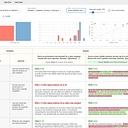
Data as of Aug 25, 2026 · Based on 38 AI responses from ChatGPT Search and Google AI Mode · See how Parse measures this
Your brand can be here too.
Source | Citation share |
|---|---|
 Continuous Evaluations for AI Agents | Best Practices Pt. 3https://www.arthur.ai/blog/best-practices-for-building-agents-part-3-continuous-evaluations | 2.6% |
 Best AI Agent Evaluation Tools for Production Teams (2026)https://www.augmentcode.com/tools/best-ai-agent-evaluation-tools | 2.6% |
 5 best AI evaluation tools for AI systems in production (2026) - Articles - Braintrusthttps://www.braintrust.dev/articles/best-ai-evaluation-tools-2026 | 2.1% |
 8 Best AI Agent Evaluation Platforms in 2026 | Galileohttps://galileo.ai/blog/best-ai-agent-evaluation-platforms | 1.7% |
 Building a Continuous Evaluation Framework for Testing AI ...https://www.youtube.com/watch | 1.7% |
 Top 5 AI Agent Evaluation Platforms in 2026https://www.getmaxim.ai/articles/top-5-ai-agent-evaluation-platforms-in-2026/ | 1.4% |
 Phoenix - Arize AIhttps://arize.com/phoenix | 1.2% |
Evaluating AI Agents in Production: Best Practiceshttps://www.arthur.ai/column/evaluating-ai-agents-in-production | 1.2% |
Best AI agent reliability tools (2026): ship agents that don't fail in production - Articles - Braintrusthttps://www.braintrust.dev/articles/best-ai-agent-reliability-tools-2026 | 1.2% |
 12 Best AI Evaluation Tools for Testing & Improving AI Applications in 2026https://www.confident-ai.com/knowledge-base/compare/best-ai-evaluation-tools-2026 | 1.2% |
Moving from static prompt testing to continuous evaluation for multi-step AI agents means you need to trace execution graphs, judge tool-selection logic, monitor state drift, and turn production logs back into regression tests.
The strongest products on the market fall into a few distinct categories depending on whether you want open-source/self-hosted control or enterprise-grade cloud platforms.
Top Continuous Evaluation & Observability Platforms
- **Best for:** Enterprise teams wanting a polished, end-to-end suite for logging production data and turning it into CI/CD evaluation datasets.
- **Why it's strong for agents:** It handles complex, multi-turn data exceptionally well. You can log agent traces, pull production failures straight into "golden datasets," and run automated evals (using code or LL-as-a-judge) every time you alter your agent’s orchestration logic or prompts. It also features a generous developer tier.[](https://google.com/goto?url=CAESgAEB6zswFflek3M9IJUfaTbCAy2CtKzCxc6km1n41PQOrnjKO_xQjY1QA2_LRXKN-JV2mMvztHeumOxWSwAx4QunX2LQbe6416nETDCBWqa7lgj9-s3epmII7z5Pf_vdvDhE858FaqvYODR3OW47GK_2SZFIsBXrV18e1Su086XoeA) [[1]](https://google.com/goto?url=CAESgAEB6zswFflek3M9IJUfaTbCAy2CtKzCxc6km1n41PQOrnjKO_xQjY1QA2_LRXKN-JV2mMvztHeumOxWSwAx4QunX2LQbe6416nETDCBWqa7lgj9-s3epmII7z5Pf_vdvDhE858FaqvYODR3OW47GK_2SZFIsBXrV18e1Su086XoeA)[[2]](https://google.com/goto?url=CAEScgHrOzAVFlyVbwfD_qhI0o0IuCEBIwLBHrUoQE5-lyVyC_FLe4BXzHWXaZkKJtAi93oawTVFKQl_y3l1fn8T-_qWWJ0X7cBd92HxSyCmZqsNfRXOGlQVe_iY9mC4ujkFK1EzXQyENqdn3nMUpBvNYMuEAw)[[3]](https://google.com/goto?url=CAEScgHrOzAV-7fmyZAp9lkCk15q8IT20PGU_l5qGy4CR00fFiv7JkwjCKqTdTnTBsZKVR38sI2Wke6mtdZbAdant17L4qAqwuBtnQgBE1wMb7WoDJ9SOXdOHCIh11A6rkJqZiGzo_ItwLdzS0P2A6ycpd8WNA)[[4]](https://google.com/goto?url=CAESkwEB6zswFX-e5zumKqRXv78mnKZGq8wA8n7ONdNXZe2Kq-nHNKC1Sym3pCzntyQ01SaijDbpnGOXswCZznw0GOb9ISbCFpuiOFMpkuIUGNNzVS6B8ET--UWaeTHzX0jrj3omJVmxZb96r_TW1J_qhJxlWqlsboxaeLTTz7tg4Ri0tAKKCzeNIIVA2F1OM-uW4KngtfE)

- **Best for:** Open-source-first, developer-centric telemetry and evaluation.
- **Why it's strong for agents:** It provides granular tracing for nested agent loops, tool calls, and sub-agent handoffs. Because it is MIT-licensed and easily self-hosted, privacy-conscious teams can stream massive volumes of continuous production agent telemetry without sending payloads to a third-party SaaS cloud.[](https://google.com/goto?url=CAESbwHrOzAVy2TatIqg2w89l9Tu2xhL-yRpRby2d9NkZbrL3paYuRqR7eCW8y8QRYRDvCQ5QR38gPEs--sKrSBDXzwmlpqustWDJ8I1GOYwYO35G4wZeBv3dPaSZS1FPIkiduaGMl1zXlknd13BvakJqg) [[1]](https://google.com/goto?url=CAESbwHrOzAVy2TatIqg2w89l9Tu2xhL-yRpRby2d9NkZbrL3paYuRqR7eCW8y8QRYRDvCQ5QR38gPEs--sKrSBDXzwmlpqustWDJ8I1GOYwYO35G4wZeBv3dPaSZS1FPIkiduaGMl1zXlknd13BvakJqg)[[2]](https://google.com/goto?url=CAESgAEB6zswFflek3M9IJUfaTbCAy2CtKzCxc6km1n41PQOrnjKO_xQjY1QA2_LRXKN-JV2mMvztHeumOxWSwAx4QunX2LQbe6416nETDCBWqa7lgj9-s3epmII7z5Pf_vdvDhE858FaqvYODR3OW47GK_2SZFIsBXrV18e1Su086XoeA)[[3]](https://google.com/goto?url=CAESkwEB6zswFX-e5zumKqRXv78mnKZGq8wA8n7ONdNXZe2Kq-nHNKC1Sym3pCzntyQ01SaijDbpnGOXswCZznw0GOb9ISbCFpuiOFMpkuIUGNNzVS6B8ET--UWaeTHzX0jrj3omJVmxZb96r_TW1J_qhJxlWqlsboxaeLTTz7tg4Ri0tAKKCzeNIIVA2F1OM-uW4KngtfE)

- **Best for:** Deep OpenTelemetry-native debugging and evaluation.
- **Why it's strong for agents:** Built on OpenInference, Phoenix excels at visualizing agent execution graphs. It handles evaluation at the individual node/span level (crucial for seeing *where* an agent hallucinated a tool argument or entered a recursive loop) and supports evaluation datasets natively.[](https://google.com/goto?url=CAESbwHrOzAVy2TatIqg2w89l9Tu2xhL-yRpRby2d9NkZbrL3paYuRqR7eCW8y8QRYRDvCQ5QR38gPEs--sKrSBDXzwmlpqustWDJ8I1GOYwYO35G4wZeBv3dPaSZS1FPIkiduaGMl1zXlknd13BvakJqg) [[1]](https://google.com/goto?url=CAESbwHrOzAVy2TatIqg2w89l9Tu2xhL-yRpRby2d9NkZbrL3paYuRqR7eCW8y8QRYRDvCQ5QR38gPEs--sKrSBDXzwmlpqustWDJ8I1GOYwYO35G4wZeBv3dPaSZS1FPIkiduaGMl1zXlknd13BvakJqg)

- **Best for:** Teams deeply embedded in the LangChain/LangGraph ecosystem, though functional outside of it.
- **Why it's strong for agents:** Unmatched for native agent step-through debugging. It allows you to replay failed agent runs from production, inject corrections, and set up continuous evaluators that grade whether the final outcome and intermediate tool-usage steps satisfied your constraints.[](https://google.com/goto?url=CAESbwHrOzAVy2TatIqg2w89l9Tu2xhL-yRpRby2d9NkZbrL3paYuRqR7eCW8y8QRYRDvCQ5QR38gPEs--sKrSBDXzwmlpqustWDJ8I1GOYwYO35G4wZeBv3dPaSZS1FPIkiduaGMl1zXlknd13BvakJqg) [[1]](https://google.com/goto?url=CAESbwHrOzAVy2TatIqg2w89l9Tu2xhL-yRpRby2d9NkZbrL3paYuRqR7eCW8y8QRYRDvCQ5QR38gPEs--sKrSBDXzwmlpqustWDJ8I1GOYwYO35G4wZeBv3dPaSZS1FPIkiduaGMl1zXlknd13BvakJqg)

- **Best for:** Python-native, code-first CI/CD pipelines.
- **Why it's strong for agents:** Instead of relying entirely on a hosted dashboard, DeepEval lets you write agent evaluation unit tests directly in your codebase (measuring things like agentic self-correction, tool correctness, and hallucination metrics) and run them continuously inside GitHub Actions or enterprise CI pipelines.[](https://google.com/goto?url=CAESgAEB6zswFflek3M9IJUfaTbCAy2CtKzCxc6km1n41PQOrnjKO_xQjY1QA2_LRXKN-JV2mMvztHeumOxWSwAx4QunX2LQbe6416nETDCBWqa7lgj9-s3epmII7z5Pf_vdvDhE858FaqvYODR3OW47GK_2SZFIsBXrV18e1Su086XoeA) [[1]](https://google.com/goto?url=CAESgAEB6zswFflek3M9IJUfaTbCAy2CtKzCxc6km1n41PQOrnjKO_xQjY1QA2_LRXKN-JV2mMvztHeumOxWSwAx4QunX2LQbe6416nETDCBWqa7lgj9-s3epmII7z5Pf_vdvDhE858FaqvYODR3OW47GK_2SZFIsBXrV18e1Su086XoeA)
Key Capabilities to Look For
When evaluating these platforms for an agentic workload (as opposed to a simple RAG or chatbot), ensure the tool supports:
If you share details on your agent stack (e.g., LangGraph, AutoGen, custom Python) and whether you require a self-hosted or cloud SaaS solution, I can help narrow down the exact tool fit.
If you mean continuous evaluation of production AI agents (not just “does this prompt produce a good answer?”), the strongest products are the ones that close the loop:
production traces → failure discovery → eval datasets → automated scoring → release gates → monitoring
The market is converging around a few leaders, each optimized for a different operating model.
| Product | Strongest at | Best fit |
|---|---|---|
| Braintrust | Continuous evals, experiments, regression gates | Teams treating agent quality like software testing |
| LangSmith | Agent tracing + eval workflow | Teams building with LangChain/LangGraph or needing full agent lifecycle tooling |
| Arize Phoenix | Open-source observability + evaluation | Platform teams wanting control, OpenTelemetry alignment, self-hosting |
| Langfuse | Flexible OSS tracing/evals | Companies avoiding vendor lock-in |
| Galileo | Enterprise AI quality monitoring | Large teams wanting managed evaluation workflows |
ZDNet Inside Augment Code## My ranking by use case
Braintrust is probably the closest match to “CI/CD for agents.”
Strengths:
The mental model is: every agent change should have evidence before shipping.
Weakness:
Best for:
Strengths:
Especially strong if your agents use LangGraph/LangChain.
Weakness:
Best for:
Strengths:
Good choice when AI observability is becoming platform infrastructure rather than an application-team tool.
Weakness:
Best for:
Strengths:
Good default if you want ownership of your telemetry stack.
A common mature architecture would be:
Instrumentation
↓
Tracing + replay
↓
Evaluation system
↓
Release gates
↓
Production monitoring
The key insight: no single product completely replaces the stack. Observability answers “what happened?” Continuous evals answer “is the system improving or degrading?” The strongest teams treat them as separate but connected capabilities.
If I were choosing today:
Yes. If you mean continuous evaluation of real agent behavior—full trajectories, tool calls, regressions, production traces, human feedback, and release gates—rather than “does this prompt produce the right answer?”, the market has separated into a few strong contenders.
| Product | Strongest at | Continuous / production eval | Agent trajectory depth | CI / release gates | Open source |
|---|---|---|---|---|---|
| Braintrust | Eval-first development + production loop | Excellent | Excellent | Excellent | No |
| LangSmith | LangGraph/LangChain agents | Excellent | Excellent | Strong | No |
| Arize AI / Phoenix | Production observability + open eval infrastructure | Excellent | Strong | Strong | Yes (Phoenix) |
| Langfuse | Open-source traces/evals | Strong | Strong | Strong | Yes |
| Maxim AI | Agent simulation / scenario testing | Strong | Excellent | Strong | No |
| **Confident AI / DeepEval | Developer-native evals | Moderate | Strong | Excellent | Yes |
| Promptfoo | CI testing + adversarial/security evals | Moderate | Strong | Excellent | Yes |
This broadly matches the current market: Braintrust is increasingly eval-first, LangSmith is particularly strong for LangGraph, while Phoenix/Langfuse emphasize open, framework-agnostic observability.
If you're building an evaluation system as part of the software-development lifecycle, I'd put Braintrust at the top of the list.
The important architectural idea is:
production trace → interesting failure → dataset → evaluator → regression test → CI gate → deployment → production trace
That's much closer to what you're describing than traditional prompt testing. Braintrust explicitly centers datasets, experiments, scoring, human review, and release gates, and can turn production traces into evaluation datasets.
Best for: a serious AI engineering organization that wants evals to become analogous to automated software tests.
If your agents are built around LangChain/LangGraph, LangSmith is arguably the most natural choice.
Its advantage isn't merely tracing. It has deep visibility into graph execution, tool calls, intermediate steps, datasets and evaluation workflows.
Best for: teams whose agent architecture already lives in the LangChain ecosystem.
I wouldn't choose it just because it's popular, though. For a heterogeneous agent stack, Braintrust or Phoenix can be more compelling.
Phoenix is particularly interesting if you want OpenTelemetry/OpenInference + self-hosting + evals rather than locking the evaluation system tightly to an agent framework.
The distinction is useful:
Phoenix is especially attractive for platform teams that expect multiple agent frameworks and want control over their telemetry.
I'd put Maxim higher if your problem is:
"How do we repeatedly put our agent through realistic situations before and after every change?" rather than:
"How do we continuously score every production trace?" Maxim is more oriented toward simulation/scenario-based agent testing, which becomes important once agents interact with tools, APIs, users and environments rather than simply generating text.
I wouldn't necessarily make these the entire production evaluation platform, but they're very useful pieces.
DeepEval is particularly nice if engineers want evals to feel like pytest: write tests, run them locally/CI, establish metrics and prevent regressions.
Promptfoo is especially compelling for CI-oriented testing and adversarial/security evaluation.
For agents, I'd evaluate vendors against this architecture:
1. Trace the entire trajectory
Not just:
input → output
but:
input → plan → retrieval → tool A → tool B → observation → replanning → tool C → final answer
Recent agent-evaluation research is converging on this distinction: agent quality depends on multi-step behavior, tool use, memory, adaptation and temporal behavior, not merely individual outputs.
2. Score intermediate behavior
You want evaluators for things like:
3. Continuously sample production traffic
The strongest systems let you say something like:
Score 10% of production agent runs for tool-selection correctness and goal completion; send failures above a threshold into the regression dataset. That is the transition from testing to continuous evaluation.
4. Turn failures into permanent tests
This is probably the most important capability I'd look for.
A production failure shouldn't disappear into an observability dashboard. It should become:
trace → reviewed failure → canonical test case → regression suite
5. Evaluate changes before deployment
Every model, prompt, tool, retrieval change, agent-policy change, or framework upgrade should run against a representative suite.
And crucially, don't only compare final-answer accuracy. Compare trajectory-level behavior.
If the requirement is explicitly "continuous evaluation for AI agents, not prompt tests", I'd start POCs in this order:
One caveat: none of these completely solves "what does good mean?" The hard part is building business-specific ground truth and outcome evaluators. A recent survey of the space makes the same point: the industry is moving toward trajectory scoring, tool-selection evaluation and loop detection, but the quality of the evaluation still depends heavily on the ground-truth datasets and definitions supplied by the customer.
If you're evaluating vendors for an actual production stack, I'd narrow this to Braintrust vs. LangSmith vs. Phoenix/Arize vs. Maxim and test all four against the same 100–500 real agent trajectories. That will tell you considerably more than feature matrices.
This is probably the most important capability I'd look for.
A production failure shouldn't disappear into an observability dashboard. It should become:
trace → reviewed failure → canonical test case → regression suite
5. Evaluate changes before deployment
Every model, prompt, tool, retrieval change, agent-policy change, or framework upgrade should run against a representative suite.
And crucially, don't only compare final-answer accuracy. Compare trajectory-level behavior.
If the requirement is explicitly "continuous evaluation for AI agents, not prompt tests", I'd start POCs in this order:
One caveat: none of these completely solves "what does good mean?" The hard part is building business-specific ground truth and outcome evaluators. A recent survey of the space makes the same point: the industry is moving toward trajectory scoring, tool-selection evaluation and loop detection, but the quality of the evaluation still depends heavily on the ground-truth datasets and definitions supplied by the customer.
If you're evaluating vendors for an actual production stack, I'd narrow this to Braintrust vs. LangSmith vs. Phoenix/Arize vs. Maxim and test all four against the same 100–500 real agent trajectories. That will tell you considerably more than feature matrices.
2. Score intermediate behavior
You want evaluators for things like:
The strongest products for continuous AI agent evaluation focus on trajectory tracking, multi-turn tool-call monitoring, and production observability rather than static prompt tests.
Leading platforms specializing in continuous agent evaluation include Confident AI (DeepEval), Arize AI, Galileo AI , and Arthur AI.
Top Products for Continuous Agent Evaluation
| Product | Core Strength | Key Agent Feature |
|---|---|---|
| Confident AI | Step-by-step evaluation | Scores tool calls, planning, and multi-turn reasoning via DeepEval |
| Arize AI | Production tracing & CI/CD | Tracks behavior drift and production traces over time |
| Galileo AI | Real-time observability | Detects hallucinations and traces multi-step workflows |
| Arthur AI | Unsupervised monitoring | Catches agent failures in live production environments |
Why Dedicated Agent Evals Differ from Prompt Testing
If you tell me your agent's primary architecture (e.g., LangChain, LlamaIndex, custom loops) and whether you need CI/CD pipeline gates or live production monitoring , I can recommend the exact platform setup for your stack.
Yes. If by continuous evaluation you mean evaluate the agent before deployment, score real production trajectories, catch regressions, feed failures back into datasets/evals, and gate releases—rather than simply testing prompts—there’s a fairly clear top tier in 2026.
| Product | Best at | Continuous eval strength | My take |
|---|---|---|---|
| Braintrust | Eval + observability + CI/CD | ★★★★★ | Best overall for an eval-centric engineering team |
| LangSmith | Agent traces + offline/online evals | ★★★★★ | Best if you're using LangGraph/LangChain |
| Arize Phoenix | Open-source tracing/evals | ★★★★½ | Best for OTel/self-hosted control |
| Galileo | Production monitoring/guardrails | ★★★★½ | Particularly compelling at high-volume runtime |
| Promptfoo | CI testing/red-teaming | ★★★★ | Excellent complement, less of a production observability platform |
| Confident AI / DeepEval | Agent-specific metrics/testing | ★★★★ | Strong if evaluation methodology is the center of gravity |
The market comparisons I found also consistently put Braintrust, LangSmith, Phoenix, Galileo and Promptfoo among the leading agent-reliability/evaluation options.
Braintrust is probably my first evaluation if you're building a serious agent platform.
The important distinction is that it connects pre-deployment experiments → CI/release checks → production traces → online scoring → regression debugging. Its positioning is explicitly around using the same evaluation machinery before and after deployment.
That maps unusually well to your requirement:
production trajectory fails → capture it → turn it into an eval case → fix agent → run regression suite → deploy → continuously score new traffic.
I'd choose it when: you want evaluation to become part of the software-development lifecycle rather than another dashboard.
LangSmith has become much more than prompt testing. It supports offline datasets/experiments and online evaluators against production traces, including LLM judges, code-based evaluators, human review, conversation-level evaluation and automated feedback loops.
The particularly useful workflow is:
production trace → evaluator → failure → dataset → offline experiment → regression test → redeploy.
That's almost exactly the continuous-evaluation loop you're describing.
I'd choose it when: your agent is built around LangGraph/LangChain, or you want particularly strong trajectory-level debugging.
Arize Phoenix is attractive if you want an OpenTelemetry-native architecture and control over where your traces/evaluation data live.
One major current development: Dynatrace announced a $915M acquisition of Arize, combining Arize's AI observability/evaluation capabilities with Dynatrace's broader production observability.
I'd choose it when: enterprise observability, OTel, and self-hosting/data control matter more than having the most opinionated eval workflow.
Galileo is differentiated by emphasizing production-time scoring and guardrails, including low-latency evaluation. That's valuable when the question isn't merely "did this agent perform well?" but:
"Should we allow this trajectory/action/response to proceed right now?"
That makes it particularly interesting for autonomous agents where evaluation needs to influence runtime behavior.
I wouldn't actually frame the category as "AI evaluation tools."
For agents, the winning architecture is closer to:
Agent execution → trace entire trajectory → evaluate outcome + intermediate decisions + tool calls → sample humans for ambiguous cases → turn failures into permanent eval cases → run regression suite → release gate → monitor production → discover new failures → repeat.
Recent research is converging on the same point: agent quality can't be adequately captured by isolated prompt/response tests because behavior emerges across planning, tool use, memory and multi-step trajectories.
And that's why I would score products on these capabilities:
That last part is becoming particularly important: new agent-evaluation research is explicitly measuring correctness alongside latency, cost, compute and other resource constraints rather than treating accuracy as sufficient.
If you're asking "what should we evaluate as competitors/benchmarks for a continuous agent-evaluation product?", I'd use:
Tier 1: Braintrust, LangSmith
Tier 2: Arize Phoenix, Galileo
Tier 3: Confident AI/DeepEval, Promptfoo, Langfuse
Specialized/complementary: AgentOps, Patronus, W&B Weave
But there's a potentially important gap in the market: most products still organize around observability + evaluators, whereas the harder problem is building a self-improving evaluation loop where production behavior continuously creates, validates, prioritizes and retires evals. Recent work on continuous agent evaluation/evolution is explicitly identifying that gap.
If that's what you're exploring, Braintrust is probably the closest incumbent to study first—but I wouldn't conclude the problem is solved by looking at Braintrust/LangSmith alone.
Moving past basic prompt tests to continuous agent evaluation requires tracking multi-step reasoning, tool-call accuracy, task-completion trajectories, and live production drift.
The strongest products solving this span end-to-end simulation, CI/CD integration, and open-source infrastructure:
To narrow down the right fit, tell me:

Yes. If by continuous evaluation you mean “evaluate real agent behavior continuously in CI and production, including trajectories/tool calls, not just prompt → response pairs”, the market has separated into a few clear leaders.
| Product | Best fit | Why it stands out |
|---|---|---|
| Braintrust | Best general-purpose eval platform | Strong eval/experiment workflow, production traces → test cases, CI/CD gates, regression analysis |
| LangSmith | LangChain/LangGraph-heavy teams | Excellent trace → dataset → eval loop, online + offline evals, human review, conversation-level evaluation |
| Arize Phoenix / AX | OpenTelemetry + observability | Excellent trace-level evaluation, open-source Phoenix, strong production monitoring |
| Maxim AI | Simulation-heavy agent testing | Particularly interesting if you want to generate realistic multi-step scenarios/personas before deployment |
| Langfuse | Open-source / self-hosted | Strong OSS foundation for tracing, datasets and evaluations; attractive when data/control matters |
| Galileo | Enterprise production quality monitoring | Strong production scoring/monitoring and specialized quality evaluators |
| DeepEval / Confident AI | Code-first engineering teams | Pytest-like evaluation workflow with a broad set of agent/LLM metrics |
| Promptfoo | Security/regression testing | Excellent for adversarial testing, red teaming and CI-oriented regression suites |
I wouldn't rank these simply by “number of eval metrics.” For agents, the interesting evaluation loop is:
production traces → identify failures → turn failures into eval cases → run against new agent versions → gate deployment → continue monitoring production
That's substantially more powerful than:
prompt → expected answer → pass/fail
Braintrust is particularly compelling around that first loop, while LangSmith has a very strong version of it for LangChain/LangGraph users. LangSmith explicitly supports both offline dataset evaluation and real-time production evaluation, including human feedback.
Phoenix is especially compelling if you want to own the infrastructure. Its evaluation system can score datasets, experiments and production traces, with both deterministic and LLM-as-judge evaluators.
If I were evaluating vendors today:
1. Braintrust — strongest overall
I'd start here if the goal is specifically continuous quality management. It has the right conceptual model: experiments and datasets before release, CI evaluation gates, production tracing/scoring, and turning production failures back into tests.
2. LangSmith — strongest if you're already in LangChain
Its advantage isn't merely tracing. It connects datasets, experiments, production traces, online evals and human annotation particularly well.
3. Arize Phoenix — strongest open-source/OTel option
I'd seriously consider this if you don't want your eval infrastructure locked into a proprietary platform. Phoenix is OpenTelemetry/OpenInference-oriented and supports evaluation directly against traces and datasets.
4. Maxim — strongest interesting challenger for simulation
If your agents interact with users, tools, APIs and other agents in complex workflows, simulation becomes important. Maxim's differentiation is scenario/persona-based multi-step testing rather than just replaying static datasets.
5. Langfuse — strongest OSS alternative to the commercial platforms
Particularly attractive for teams that want to build their own evaluation methodology while retaining control over data and deployment.
There isn't really a single “Datadog for agent quality” winner yet. The market is still splitting into three layers:
The strongest production architecture often combines two of these rather than buying one product. Recent comparisons similarly find no universal winner because the products optimize different parts of the agent lifecycle.
If you're building a serious agent platform, I'd benchmark Braintrust vs. LangSmith vs. Phoenix + a simulation product. The decisive test isn't “how many evaluators do they have?” It's whether you can take a bad production trajectory from yesterday and automatically make it part of tomorrow's release gate.
If you tell me whether you're evaluating customer-support agents, coding agents, research agents, voice agents, or internal workflow agents, I can narrow this to the 3 strongest products and compare them on trajectory evals, online evals, simulation, CI gates, human review, self-hosting, and pricing.
Moving past static prompt tests to continuous evaluation for AI agents means tracking full execution trajectories (multi-step planning, tool choices, and intermediate loop decisions), not just single-turn inputs and outputs.
The strongest products and platforms specialize in trace-driven, production-integrated evaluation loops:
pytest -native approach. It offers 50+ research-backed metrics and lets engineering teams embed agent unit tests directly into their existing deployment pipelines.If you can share:
I can help you narrow down the ideal stack for your architecture.
Moving beyond isolated prompt tests to continuous evaluation for AI agents means tracking multi-turn reasoning loops, tool-calling sequences, state transitions, and live production traffic.
The strongest products in this space separate into distinct categories depending on whether you need end-to-end lifecycle coverage, CI/CD integration, open-source self-hosting, or ecosystem-native tracing.
To narrow down which tool fits your stack, tell me:
Yes. If the requirement is continuous evaluation of agents in production, rather than “does this prompt produce the right answer?”, I’d narrow the market to a few serious contenders.
I agent evaluation and observability platforms for continuous production evaluation
| Platform | Where it stands out | My take |
|---|---|---|
| Arize Phoenix / Arize AX | Traces, trajectory-level evaluation, online evaluation, OpenTelemetry, production debugging | Strongest overall for agent-centric continuous eval, especially if you want open standards/self-hosting via Phoenix |
| Braintrust | Datasets, experiments, versioning, eval-driven development, CI/CD | Excellent for eval-as-engineering, particularly pre-deployment regression testing |
| LangSmith | Tracing + evaluation + datasets + agent debugging, especially LangChain/LangGraph | Best if you're already in the LangChain ecosystem |
| Galileo | Production monitoring, specialized evaluators, quality/guardrail signals | Strong enterprise production-quality option |
| Maxim | Agent simulation, multi-turn scenarios, offline → online evaluation | Particularly interesting for complex autonomous agents |
| Langfuse | Open-source tracing/evals, broad integrations, self-hosting | Strong OSS infrastructure choice, though more observability-first |
| Promptfoo | Regression tests, CI, security/red-team testing | Great testing layer, but not a complete production continuous-eval platform |
The distinction I'd make is important: agent evaluation is about trajectories, actions, tool choices, state transitions, and eventual task outcomes—not merely the final response. Recent evaluations of the space explicitly call out trajectory-level evaluation, tool use, and long-horizon behavior as the important dimensions.
I'd score them against these capabilities:
Production trace → automatic evaluation
Can every real agent run be scored automatically?
Trajectory evaluation
Can you evaluate how the agent got there—tool calls, intermediate decisions, retries, routing, etc.?
Outcome-based evaluation
Can you say “did the customer-support issue actually get resolved?” rather than “was the answer good?”
Continuous sampling / online evals
Can evaluators run continuously on production traffic?
Human feedback → eval creation
When humans identify failures, can those examples become regression tests automatically?
Regression detection
Can you compare agent/model/tool/prompt versions and gate releases?
Simulation
Can you generate realistic multi-turn tasks and adversarial users before deployment?
Debuggability
When an eval fails, can an engineer replay the exact trajectory?
Framework independence
Can it evaluate agents built with your own orchestration layer rather than forcing you into its framework?
Business metrics
Can you connect agent behavior to task completion, revenue, escalation, CSAT, latency, cost, etc.?
Arize is probably the most compelling choice if your phrase is specifically “continuous evaluation.” Phoenix is open-source and OpenTelemetry/OpenInference-oriented, while Arize's managed offering adds production monitoring and evaluation. Its workflow explicitly connects tracing → annotation/evaluation → datasets/experiments → improvement.
Braintrust is arguably the strongest choice if your mental model is “evals are software tests.” Its strengths are versioned datasets, experiments, evaluators and CI/CD-oriented workflows.
LangSmith remains very compelling for teams already using LangChain/LangGraph because tracing, datasets, experiments and agent debugging live together. I'd be less enthusiastic if you're deliberately building a framework-agnostic agent stack.
Maxim deserves more attention if your agents perform complicated multi-step work. Its differentiator is simulation: generating realistic scenarios/personas and evaluating agents before production, then connecting that with online evaluation.
Langfuse/Phoenix are the options I'd investigate first if open source + self-hosting + OpenTelemetry are strategic requirements. Phoenix in particular is explicitly positioned as an open-source platform for agent development and evaluation.
I wouldn't buy a platform just because it has an impressive list of “100+ eval metrics.”
The strongest architecture is:
production traces → automatic evaluators → failure clustering → human review → new eval cases → regression suite → release gate → production monitoring
That's the continuous loop you're looking for.
And there's an important market limitation right now: even the better platforms still don't completely solve the problem of keeping the evaluation suite representative of real-world agent behavior. Recent discussion of the space points out that static offline suites become stale, while production evaluation needs to account for changing trajectories and user behavior.
If I were doing a serious bake-off today, I'd start with Arize AX/Phoenix, Braintrust, LangSmith, and Maxim, then add Langfuse if self-hosting is important and Promptfoo if security/regression testing is a major requirement.
If you tell me your agent type (coding, customer support, browser, sales, research, etc.) and whether you need self-hosting, I can narrow this to the 2–3 platforms I'd actually pilot.