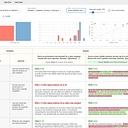
Data as of Aug 25, 2026 · Based on 342 AI responses from ChatGPT Search and Google AI Mode · See how Parse measures this
For general end-to-end agent reliability and multi-step debugging, choose Galileo. If you build on 
 DeepEval
Brands AI recommends here
Named in 46% of answers
Best fit when your agents are built with LangChain — offers deep tracing, multi‑turn evals, and a UI geared to debugging LangChain tool-calling flows.
Named in 36% of answers
Named in 34% of answers
Best when you need python-first, unit-test style checks and CI/CD integration to validate tool calling, planning, and agent outputs during development.
Named in 32% of answers
Best when you need simulation and component-level scenario engines to test retrieval, tool selection accuracy, and multi-turn behavior in controlled environments.
Source | Citation share |
|---|---|
 Top 5 platforms for agent evals in 2025 - Articles - Braintrusthttps://www.braintrust.dev/articles/top-5-platforms-agent-evals-2025 | 3.8% |
 7 Best Agent Evaluation Frameworks | Galileohttps://galileo.ai/blog/best-agent-evaluation-frameworks | 2.5% |
 r/AIQuality on Reddit: Best AI Agent Evaluation Tools in 2025https://www.reddit.com/r/AIQuality/comments/1pv297u/best_ai_agent_evaluation_tools_in_2025_what_i/ | 2.1% |
 How to Test and Evaluate Agentic Systems for Reliabilityhttps://virtuslab.com/blog/ai/testing-evaluating-agentic-systems/ | 1.9% |
 Agent Evaluation Frameworks: Methods, Metrics & Best Practiceshttps://www.leanware.co/insights/agent-evaluation-frameworks-methods-metrics-best-practices | 1.7% |
 Top Agent Evaluation Tools in 2025: Best Platforms for Reliable Enterprise Evalshttps://www.getmaxim.ai/articles/top-agent-evaluation-tools-in-2025-best-platforms-for-reliable-enterprise-evals/ | 1.7% |
AI agent evaluation: A practical framework for testing multi-step agentshttps://www.braintrust.dev/articles/ai-agent-evaluation-framework | 1.6% |
A Survey of Agent Evaluation Frameworks: Benchmarking the ...https://www.getmaxim.ai/blog/llm-agent-evaluation-framework-comparison/ | 1.5% |
 Best Tools for AI Agent Testing and Evaluation (2025 Review)https://fast.io/resources/best-tools-ai-agent-testing/ | 1.3% |
How to Test AI Agents Effectively - Galileo AI: The AI Observability and Evaluation Platformhttps://galileo.ai/learn/test-ai-agents | 1.3% |
There is no single “best” agent evaluation framework—the right choice depends on whether you care most about **CI regression testing, production monitoring, tool-use correctness, safety, or benchmark comparison**. For a production agent, I would usually combine a **test harness + tracing/evaluation platform +…
There is no single “best” agent evaluation framework—the right choice depends on whether you care most about CI regression testing, production monitoring, tool-use correctness, safety, or benchmark comparison. For a production agent, I would usually combine a test harness + tracing/evaluation platform + benchmark suite rather than pick one tool.
| Use case | Strong candidates | Why |
|---|---|---|
| General production agent evaluation | Braintrust | Strong experiment workflows, trace-level scoring, tool-call evaluation, regression comparisons. Braintrust |
| LangChain/LangGraph agents | LangChain LangSmith | Deep integration with agent traces, debugging, datasets, and evaluations. LangChain |
| Open-source / self-hosted | Arize AI Arize Phoenix, DeepEval | Good for owning data, running locally, and integrating into CI. Growth Engineer Morph |
| Research benchmarks | AgentBench, SWE-bench-style environments | Useful for comparing capabilities, less useful for your specific production agent. GitHub arXiv |
| Safety / red teaming | Inspect-style frameworks, custom adversarial suites | Better for robustness and misuse testing than normal quality scoring. The Prompt Bench |
For a serious agent that uses tools (APIs, search, databases, code execution, etc.):
A practical stack many teams would choose:
The biggest mistake is choosing a framework before defining what “reliable” means. A good agent eval system should tell you why an agent failed—not just assign a score.
Testing reliability and tool-use capabilities requires evaluating **agent trajectories** (the sequence of reasoning, tool selection, and argument generation) rather than just single-turn…
Testing reliability and tool-use capabilities requires evaluating agent trajectories (the sequence of reasoning, tool selection, and argument generation) rather than just single-turn outputs.
The top evaluation and testing frameworks stand out depending on your engineering stack and workflow preferences:
To help narrow down the best fit, tell me:
If your goal is specifically **testing agent reliability and tool-use behavior**, I’d pick **Braintrust** as the strongest general-purpose choice today, with **LangSmith** as the best alternative if you’re already using LangChain/LangGraph. The important distinction is that you don't want a framework that only grades…
If your goal is specifically testing agent reliability and tool-use behavior, I’d pick Braintrust as the strongest general-purpose choice today, with LangSmith as the best alternative if you’re already using LangChain/LangGraph.
The important distinction is that you don't want a framework that only grades the final answer. For agents, you need to evaluate the entire trajectory: what the agent decided, which tools it selected, arguments it passed, how it handled tool failures, whether it stopped appropriately, and whether the final state is actually correct.
| Framework | Best for | Tool/trajectory testing | CI/regression | Production |
|---|---|---|---|---|
| Braintrust | Best overall agent eval | ★★★★★ | ★★★★★ | ★★★★★ |
| LangSmith | LangChain/LangGraph + full lifecycle | ★★★★★ | ★★★★★ | ★★★★★ |
| DeepEval | Open-source / pytest-style testing | ★★★★☆ | ★★★★★ | ★★★☆☆ |
| Arize Phoenix | OpenTelemetry/OpenInference stacks | ★★★★☆ | ★★★★☆ | ★★★★★ |
| Inspect AI | Safety, capability & controlled experiments | ★★★★☆ | ★★★★☆ | ★★☆☆☆ |
| OpenAI Evals | OpenAI-centric baseline evals | ★★★☆☆ | ★★★★☆ | ★★☆☆☆ |
Braintrust is particularly well suited to agent reliability testing because it treats individual tool calls and reasoning steps as spans that can be scored, rather than just evaluating the final response. You can score things like:
It also supports multiple trials per test case, custom scorers, CI evaluation, and turning production failures into regression datasets.
That last capability is particularly important: production failures should become tests.
LangSmith has excellent trajectory-level evaluation and is more of an end-to-end agent engineering platform: tracing → datasets → evaluation → human review → production monitoring.
It can evaluate intermediate tool calls as well as final outcomes, and it supports custom Python/TypeScript evaluators and CI gates through pytest/Vitest/GitHub workflows.
I'd choose it over Braintrust if your agent is already heavily based on LangGraph/LangChain.
If you want the evaluation suite to feel like ordinary software testing—something developers can keep directly in the repo and run in CI—DeepEval is worth serious consideration.
It's particularly attractive when you want open-source, code-first evaluation rather than adopting a hosted evaluation platform.
I'd look at Inspect if your testing includes capability, safety, adversarial, or sandboxed agent evaluations, rather than primarily product-quality regression testing.
It's more of an evaluation framework for running controlled experiments than an all-in-one production observability platform.
Don't make the framework itself your evaluation strategy. I'd build a test harness with four layers:
                    AGENT EVAL SUITE

┌────────────────────────────────────────────────────┐
│  1. TASK SUCCESS                                    │
│     Did the agent accomplish the user's objective? │
├────────────────────────────────────────────────────┤
│  2. TOOL CORRECTNESS                                │
│     Tool selection                                  │
│     Arguments                                       │
│     Ordering                                        │
│     Number of calls                                 │
│     Error recovery                                  │
├────────────────────────────────────────────────────┤
│  3. TRAJECTORY / BEHAVIOR                           │
│     Loops                                           │
│     Needless calls                                  │
│     Bad planning                                    │
│     Premature termination                            │
│     Unsafe actions                                  │
├────────────────────────────────────────────────────┤
│  4. SYSTEM PROPERTIES                               │
│     Latency • Cost • Reliability • Safety           │
└────────────────────────────────────────────────────┘
And I'd make the test cases scenario-based, not just prompt/expected-answer pairs.
For example:
name: refund_customer
input:
  customer: "Alice"
  order: "12345"
  request: "Refund my order"

environment:
  order_status: delivered
  refund_eligible: true

expected:
  outcome:
    refund_created: true

  tools:
    required:
      - get_order
      - create_refund

    forbidden:
      - delete_order

  constraints:
    max_tool_calls: 4
    must_confirm_before:
      - create_refund
Then run that scenario 20–50 times, because an agent that succeeds 99% of the time on one run isn't necessarily reliable. Agent trajectories are inherently nondeterministic, so repeated trials give you a much more meaningful reliability estimate.
For a tool-using agent, I would track these separately:
Task success
Did the requested outcome actually happen? Tool selection accuracy
Did it select the right tool? Argument accuracy
Did it provide the right parameters? Tool-call efficiency
How many unnecessary calls did it make? Trajectory success
Was the sequence of actions valid? Recovery rate
When a tool failed, did it recover correctly? Safety/policy compliance
Did it avoid prohibited actions? State correctness
Is the external system/database actually in the expected state? Reliability
successful_trials / total_trialsCost + latency
How expensive and slow was a successful trajectory? I'd put particular emphasis on state correctness. An agent can produce a perfect-looking final response while having made the wrong API calls underneath.
If you're starting from scratch:
Braintrust + your own deterministic environment/simulator + a regression dataset.
Use Braintrust to capture and score trajectories, but make the actual correctness assertions as deterministic as possible. Use LLM-as-judge for fuzzy qualities; use ordinary assertions for things like:
assert refund.created is True
assert tool_calls == ["get_order", "create_refund"]
assert refund.amount == order.total
assert dangerous_tool.was_never_called
Then add LLM judges for things that genuinely require semantic judgment.
If you tell me what kind of agent you're testing (browser agent, coding agent, customer-support agent, API/tool agent, research agent, etc.), I can give you a concrete evaluation architecture + test taxonomy + recommended framework for that particular agent.
When testing agent **reliability** and **tool-use capabilities** , there isn't a single universal winner—the "best" framework depends on whether you are doing unit testing in CI/CD, deep multi-turn tracing, or measuring raw trajectory success.[](https://www.automationanywhere.com/company/blog/ai-agent-benchmarks)…
When testing agent reliability and tool-use capabilities , there isn't a single universal winner—the "best" framework depends on whether you are doing unit testing in CI/CD, deep multi-turn tracing, or measuring raw trajectory success.
The top evaluation and testing frameworks for agentic tool-use are categorized below by their core strengths:
pytest , making it easy to write agent test suites that run automatically in your pipeline. It features 50+ metrics including specific evaluations for tool correctness (whether the agent selected the right tool, formatted arguments correctly, and avoided hallucinated parameters).What to focus on for Tool-Use Reliability
Instead of just checking if the final output is correct, configure your evaluation framework to track trajectory accuracy:
To help narrow down the ideal choice, let me know:
If your goal is specifically **testing an agent’s reliability and tool-use—not merely benchmarking the underlying model—I’d choose [Inspect AI](https://inspect.aisi.org.uk/) as the foundation**, then add specialized benchmarks and your own regression suite. ### My recommendation | Framework / benchmark | Best for | My…
If your goal is specifically testing an agent’s reliability and tool-use—not merely benchmarking the underlying model—I’d choose Inspect AI as the foundation, then add specialized benchmarks and your own regression suite.
| Framework / benchmark | Best for | My take |
|---|---|---|
| Inspect AI | General agent evaluation infrastructure | Best overall foundation |
| τ²-bench | Tool calling + realistic user/API interactions | Best specialized tool-use benchmark |
| AgentBench | Broad academic agent benchmarking | Good for comparative research |
| AgentBench (newer agent-testing project) | CI/regression testing of an actual agent | Interesting, especially for deterministic assertions |
| SWE-bench | Coding agents | Use only if coding is your target domain |
Why Inspect: it is designed as an evaluation framework rather than just a benchmark. It supports custom agents, tools/MCP, multi-agent setups, sandboxing, checkpoints, interventions, limits, tracing, parallel evals, and error recovery. It also has 200+ prebuilt evaluations.
For your stated objective, I'd structure the evaluation stack like this:
                    YOUR AGENT
                        │
             ┌──────────┴──────────┐
             │                     │
        Task suite             Adversarial suite
             │                     │
       ┌─────┴─────┐         ┌─────┴─────┐
       │            │         │           │
   Tool use      Reasoning   Failures   Safety
       │            │         │           │
       └────────────┴─────────┴───────────┘
                        │
                  Inspect AI
                        │
              ┌─────────┴─────────┐
              │                   │
          Assertions          Traces
              │                   │
        pass/fail, score     latency/calls/
        success rate         errors/retries
Don't make the primary metric "LLM judge says this was good." For reliability, instrument the environment and verify outcomes directly.
1. Task success
2. Tool-use correctness
3. Reliability Run each scenario multiple times and report:
A particularly useful metric is:
Pass@k / Pass^k
For example, if an agent succeeds 90% of the time on an individual run, that doesn't mean it's reliable for a workflow requiring repeated success. τ-bench explicitly investigates this sort of repeated interaction reliability and is built around simulated users, domain APIs, and policy constraints. Its newer τ²-bench is the current extension.
4. Efficiency
5. Robustness Deliberately inject:
Then measure whether the agent recovers rather than merely whether it eventually succeeds.
There are really three different things you might be evaluating:
Model: "How capable is GPT/Claude/etc.?"
Agent: "How good is my prompting/planning/tool-selection architecture?"
System: "Will this entire thing reliably accomplish production tasks?"
For your wording—"test the reliability and tool-use capabilities of our agent"—the second and third are what matter.
That's why I wouldn't simply run the academic AgentBench leaderboard. The original AgentBench is a broad benchmark across environments such as OS interaction, databases, knowledge graphs, web shopping and browsing. It's useful for comparative research, but it isn't a replacement for testing your actual agent configuration.
I'd use:
Inspect AI → evaluation harness
τ²-bench → realistic tool/user interaction tests
Your own task suite → production-specific regression tests
Deterministic environment assertions → ground-truth scoring
Trace collection → diagnosis
Then put a subset of the suite into CI so that a model/prompt/tool change can't ship if, say, tool-call success drops from 96% to 91%.
If you want one framework to start with, pick Inspect AI. It gives you the extensibility to build the evaluation suite you actually need rather than locking you into somebody else's benchmark.
Evaluating AI agents requires testing not just the final output, but the **entire trajectory** —did it call the right tools, pass correct parameters, avoid infinite loops, and gracefully recover from API…
Evaluating AI agents requires testing not just the final output, but the entire trajectory —did it call the right tools, pass correct parameters, avoid infinite loops, and gracefully recover from API errors.
There is no single "best" framework, because tools specialize in different parts of the development and production lifecycle. The leading frameworks mapped to their core strengths include:
Recommendation on How to Choose
To narrow this down, tell me:
If your goal is **testing an agent’s reliability, tool selection, multi-step behavior, and regressions**, my top pick in 2026 is **Braintrust** for a hosted workflow, with **Inspect AI** as the strongest choice if you want an open, rigorous evaluation harness. The important distinction is that you don't just want to…
If your goal is testing an agent’s reliability, tool selection, multi-step behavior, and regressions, my top pick in 2026 is Braintrust for a hosted workflow, with Inspect AI as the strongest choice if you want an open, rigorous evaluation harness.
The important distinction is that you don't just want to test answers. Agent evals should test the entire trajectory: task completion, tool choice, tool arguments, intermediate steps, failures/loops, latency/cost, and the final result. A correct final answer can hide a dangerously bad execution path.
| Framework | Best for | My take |
|---|---|---|
| Braintrust | Production agent eval + experiments | Best overall hosted choice |
| Inspect AI | Rigorous agent/safety/capability testing | Best open-source evaluation harness |
| LangSmith | LangChain/LangGraph agents | Best if you're already in that ecosystem |
| DeepEval | Python/pytest-style CI | Excellent for developer-centric regression tests |
| Arize Phoenix | OpenTelemetry/self-hosted observability + eval | Great if you want open infrastructure |
| Promptfoo | Prompt/model regression + red teaming | Very good complementary tool |
| OpenAI Evals | Simple OpenAI-centric evals | Useful, but I wouldn't make it my primary agent harness |
Braintrust is particularly compelling because it records individual tool calls and reasoning steps as trace spans, supports trace-level scoring, experiment comparison, and turning production failures back into evaluation datasets.
Inspect AI is particularly strong if you want to stress an agent in controlled environments. It supports ReAct agents, long-horizon agents with memory/planning/subagents, coding agents, custom agents, external agent frameworks, sandboxes, and custom scorers.
For a serious agent, I'd use a test stack roughly like:
1. Deterministic unit/tool tests
2. Trajectory evals
3. End-to-end task evals
4. Adversarial/safety tests
5. Regression testing in CI Run the suite whenever you change:
6. Production evaluation Capture real traces, identify failures, turn representative failures into permanent regression tests. This feedback loop is one of the strongest features of the modern agent-evaluation platforms.
Braintrust → best default for a team building a production agent and wanting evaluation + tracing + experiment management in one place.
Inspect AI → I'd choose this instead if your priority is deep capability testing, controlled environments, safety evaluation, or reproducible research, rather than primarily a hosted development/observability workflow.
LangSmith → choose this if your agent is heavily based on LangGraph/LangChain; its evaluation model is particularly well integrated with agent trajectories and production traces.
One important point: don't confuse an evaluation framework with a benchmark. Benchmarks such as SWE-bench or τ-bench tell you how a system performs on a standardized task set; your framework should tell you whether your particular agent reliably performs your particular tasks.
If you're building an agent that uses multiple external tools/APIs, I'd lean Braintrust + a custom trajectory scorer + CI regression suite rather than relying on generic LLM-as-judge scores alone.
Testing AI agents requires evaluating **full execution trajectories** (intermediate reasoning steps, planning coherence, and parameter accuracy) rather than just single-turn inputs and outputs.[](https://www.databricks.com/blog/what-is-agent-evaluation)…
Testing AI agents requires evaluating full execution trajectories (intermediate reasoning steps, planning coherence, and parameter accuracy) rather than just single-turn inputs and outputs.
The "best" framework depends heavily on your team's workflow (code-first vs. UI-driven) and existing stack, categorized by their strengths in reliability and tool-use evaluation:
Top Agent Evaluation Frameworks
ToolCorrectnessMetric (for parameter and tool selection accuracy), PlanQualityMetric , and PlanAdherenceMetric.Key Capabilities to Test for Tool-Use & Reliability
When building your evaluation harness (regardless of the tool chosen), ensure your test suite measures:
To help narrow down the ideal choice, tell me:

Testing tool-use reliability and multi-step reasoning in an AI agent requires evaluating entire **trajectories** (the sequence of thoughts, tool choices, arguments passed, and intermediate loops) rather than just a single-turn prompt response.[](https://deepeval.com/guides/guides-ai-agent-evaluation)…
Testing tool-use reliability and multi-step reasoning in an AI agent requires evaluating entire trajectories (the sequence of thoughts, tool choices, arguments passed, and intermediate loops) rather than just a single-turn prompt response.
The "best" framework depends on your tech stack and whether you prefer a code-first unit-testing approach or an end-to-end managed platform.
Top Agent Evaluation & Testing Frameworks
Core Strategies for Testing Tool-Use Reliability
No matter which framework you pick, robust tool-use evaluation relies on three structural practices:
To help narrow down the ideal choice for your team, tell me:
There is no single “best” framework — the right choice depends on whether you are testing **agent capability**, **tool-use reliability**, or **production regressions**. For a serious agent evaluation stack, I would combine a benchmark suite with an observability/evaluation framework. A practical ranking: | Use case |…
There is no single “best” framework — the right choice depends on whether you are testing agent capability, tool-use reliability, or production regressions. For a serious agent evaluation stack, I would combine a benchmark suite with an observability/evaluation framework.
A practical ranking:
| Use case | Best fit | Why |
|---|---|---|
| Production agent regression testing | LangSmith, Braintrust, Arize AI Phoenix | Trace-based evaluation, datasets, LLM judges, CI workflows |
| Open-source/self-hosted evaluation | OpenAI Evals, Langfuse, Confident AI DeepEval | Flexible, reproducible, easier to integrate into internal pipelines |
| Tool-calling reliability | τ-bench, BFCL | Measures whether agents select tools correctly and pass valid arguments |
| General assistant capability | GAIA, AgentBench | Multi-step reasoning, browsing, planning, and tool use |
| Safety/red teaming | AgentHarm and custom adversarial suites | Tests misuse, policy failures, and unsafe actions |
For a tool-using production agent, I would build an evaluation harness around these layers:
Do not only score the final answer. Capture:
Key metrics:
Agent reliability research increasingly emphasizes repeated execution, perturbation testing, and failure injection rather than single-run accuracy.
Create a private benchmark from real workflows:
Examples:
For each task store:
Agents often fail because tools fail, not because the model fails. Test:
ReliabilityBench-style approaches explicitly test these conditions.
Good choices:
A leaderboard-style comparison alone is insufficient because agent performance depends heavily on the scaffold, tools, memory, and orchestration layer.
For most teams building an agent today:
Open-source stack
Enterprise stack
If the goal is specifically “prove this agent is reliable enough for production”, I would prioritize:
pass^k rather than only pass@1),That combination gives a much more realistic picture than any single benchmark score.