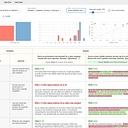
Data as of Aug 25, 2026 · Based on 38 AI responses from ChatGPT Search and Google AI Mode · See how Parse measures this
Your brand can be here too.
Source | Citation share |
|---|---|
 Braintrust Open Source Alternative? LLM Evaluation Platform Comparison | Arize Phoenixhttps://arize.com/docs/phoenix/learn/resources/faqs/braintrust-open-source-alternative-llm-evaluation-platform-comparison | 2.1% |
 LLM Evaluation Tools: The Complete Comparison Guide (2026) | Inference.nethttps://inference.net/content/llm-evaluation-tools-comparison/ | 2.1% |
 Best AI evals products for self-hosted / on-prem enterprise ...https://www.braintrust.dev/articles/best-self-hosted-ai-evals-tools-2026 | 2.1% |
 Closed-source vs. Open-source models: What enterprises should know | Box AI Explainer Series EP 13 - YouTubehttps://www.youtube.com/watch | 1.9% |
 Enterprise Large Language Model Evaluation Benchmarkhttps://arxiv.org/abs/2506.20274 | 1.5% |
 Top 5 AI Evaluation Platforms in 2026 - Maxim AIhttps://www.getmaxim.ai/articles/top-5-ai-evaluation-platforms-in-2026-2/ | 1.5% |
 Langfusehttps://langfuse.com/ | 1.3% |
Braintrust evaluation platformhttps://www.braintrust.dev/ | 1.3% |
8 Best LLM Evaluation Tools in 2026 (Tested & Compared) | Respanhttps://www.respan.ai/articles/best-llm-evaluation-tools | 1.3% |
 Top 5 LLM Evaluation Frameworks in 2026, Comparedhttps://deepeval.com/blog/top-5-llm-evaluation-frameworks | 1.0% |
For an enterprise decision between open-source and proprietary models, you’ll want an evaluation platform that can measure quality, cost, latency, security, governance, and operational fit rather than relying only on benchmark scores. The strongest options usually fall into a few categories: open-source evaluation frameworks, enterprise SaaS platforms, and observability/evaluation hybrids.
For an enterprise bake-off, create a representative test set and score:
| Area | Example measurements |
|---|---|
| Task quality | Accuracy, groundedness, reasoning quality, human preference |
| RAG performance | Retrieval precision, citation correctness, hallucination rate |
| Agent workflows | Tool-use success, task completion rate, recovery from errors |
| Safety | Prompt injection resistance, data leakage, policy compliance |
| Operations | Latency, throughput, uptime, cost per task |
| Governance | Audit logs, explainability, deployment controls |
| Adaptability | Fine-tuning, prompt customization, private deployment options |
A common enterprise setup is:
For a typical enterprise model-selection project, I would shortlist:
The key is to evaluate your workflows, not just the underlying models. A smaller open model can outperform a larger proprietary one after retrieval, fine-tuning, or workflow optimization, while a proprietary model may win on general reasoning and operational simplicity.
To compare and evaluate open-source versus proprietary models for enterprise workflows, organizations use specialized LLM evaluation and testing platforms that benchmark accuracy, cost, latency, and security side-by-side.
| Platform | Best Suited For | Key Enterprise Features |
|---|---|---|
| Promptfoo | Model comparison & security | CLI/YAML-driven, robust red-teaming, fast multi-model diffing |
| DeepEval | CI/CD pipeline & agent testing | Pytest-style assertions, unit-testing LLM outputs, custom criteria |
| Arize Phoenix | Production monitoring & evals | Open-core stack, tracing RAG/agents, deep observability |
| RAGAS | Retrieval-augmented generation (RAG) | Specialized metrics for faithfulness, relevance, and context recall |
| LM Evaluation Harness | Standardized base model benchmarking | Massive library of academic and zero-shot tasks for raw model scoring |
Key Evaluation Criteria to Configure
If you share your primary use case (e.g., customer support chatbot, internal RAG knowledge base, or automated data extraction) and your deployment constraints (on-premise vs. cloud), I can recommend the most relevant platform setup to test your models.
Yes. For an enterprise open-source vs. proprietary model decision, I’d focus on evaluation platforms that let you run the same workload, dataset, and scoring rubric across multiple models rather than relying on generic benchmarks.
| Platform | Best fit | Why it’s useful for your comparison |
|---|---|---|
| Arize Phoenix | Open-source / self-hosted evaluation | Open-source, vendor-neutral, supports experiments, datasets, tracing, and LLM-based or code-based evaluators. It can work across OpenAI, Anthropic, Google, Bedrock and other providers. GitHub Arize AI |
| Braintrust | Evaluation-first enterprise workflows | Particularly good for systematic model/prompt comparisons, datasets, experiments, and regression testing. It is proprietary, so assess data-governance and vendor-lock-in requirements alongside its capabilities. AI Scanner |
| LangSmith | Teams already using LangChain/LangGraph | Strong experiment and tracing workflow for LLM applications, especially when your workflows are agentic or retrieval-heavy. |
| MLflow | Enterprises with an existing ML platform | Attractive if you want model evaluation tied into experiment tracking, model versions, datasets, and the broader ML lifecycle. AI Scanner |
| OpenAI Evals | Building rigorous task-specific benchmarks | Provides an eval framework, existing evals, and private/custom evals based on your own workflow data. It's useful as a component of a broader evaluation stack rather than necessarily your sole platform. GitHub |
I'd shortlist Phoenix + MLflow + Braintrust/LangSmith and build a common evaluation suite containing:
The particularly important metric is cost × quality at the workflow level. An open-source model that costs less per inference but requires substantially more infrastructure or produces more failed/rewritten work may not actually be cheaper.
For a high-control enterprise environment, Phoenix is especially interesting because it is open-source, can be self-hosted, uses OpenTelemetry/OpenInference, and supports experiments across different models and providers—making it well suited to a neutral comparison layer.
If you tell me your workflows (e.g., customer support, coding, document processing, RAG, agents) and approximate scale, I can narrow this to 3 platforms and propose a concrete evaluation matrix with scoring weights.
Choosing between open-source models (like Llama or Mistral variants) and proprietary models (like GPT-4o or Claude 3.5 Sonnet) for enterprise workflows requires rigorous, data-driven evaluation. You need to test for accuracy, latency, cost, and safety using specialized evaluation platforms that can handle both local and cloud-hosted architectures.
Evaluating these options effectively relies on a mix of open-source frameworks and enterprise-grade observability platforms:
If you'd like to narrow this down, tell me:
I can help you design a lightweight evaluation matrix for your team.
Yes. For an enterprise open-source vs. proprietary model decision, I’d evaluate the models through the same workload-specific test suite, rather than relying on public benchmarks. A few platforms are particularly useful:
| Platform | Best fit | Why it’s useful for your decision |
|---|---|---|
| Together Evaluations | Comparing many model families | Explicitly supports side-by-side comparison of commercial APIs, open-source, and fine-tuned models on quality, cost, and performance. www.together.ai |
| Braintrust | Production-grade model/prompt evaluation | Strong for datasets, experiments, custom scorers, regression testing, and CI release gates. www.cipherprojects.comwww.braintrust.dev |
| Arize Phoenix | Open-source/self-hosted evaluation | Particularly attractive when data control and portability matter; it uses OpenTelemetry/OpenInference and supports offline/online evaluation. arize.comwww.together.ai |
| LangSmith | LangChain/LangGraph workflows | Good for turning production traces into evaluation datasets and comparing prompts/models within agent workflows. www.cipherprojects.comwww.together.ai |
| Langfuse | Open-source observability + evals | A strong self-hosted option if you want to avoid putting evaluation data into a proprietary platform. www.cipherprojects.comwww.braintrust.dev |
| Promptfoo / DeepEval | CI-style tests and developer evals | Useful for treating model behavior like software tests, including regression and security testing. www.respan.ai |
| OpenCompass | Broad model benchmarking | Useful for standardized benchmark comparisons across both open and proprietary models, with 100+ datasets. github.com |
1. Together Evaluations or OpenCompass → initial screening
Narrow 20–30 candidate models down to perhaps 5–8.
2. Phoenix, Braintrust, or LangSmith → enterprise workload evaluation
Build a representative dataset from your actual workflows: customer-support cases, document extraction, coding, RAG questions, agent tasks, etc.
3. CI-oriented tooling → regression testing
Every candidate should be evaluated on the same test suite whenever you change the model, prompt, retrieval system, or tool configuration.
Most importantly, score more than answer quality:
For your specific open-source vs. proprietary decision, I'd put Phoenix + Braintrust + Together Evaluations on the shortlist. Together gives you a particularly direct model-to-model comparison, while Phoenix gives you an open/self-hosted evaluation path and Braintrust gives you a mature evaluation-and-release workflow.
One important point: don't let the evaluation platform itself determine the winner. Export the underlying test cases, scores, traces, and cost measurements so that your final decision remains reproducible if you later change evaluation vendors.
Choosing between open-source (open-weight) and proprietary models requires evaluating them against your exact enterprise data, custom workflows, latency requirements, and cost ceilings . Generic leaderboards only tell you half the story—you need a structured evaluation framework to test models on your organization's specific tasks.
Top evaluation platforms and frameworks are categorized below by how they handle enterprise testing:
Open-Source & Open-Core Evaluation Frameworks (Best for Local Control & CI/CD)
pytest ) to run continuous regression tests on RAG, agents, and multi-turn chatbots inside your GitHub Actions or CI/CD pipelines.Enterprise-Grade & Commercial Platforms (Best for Governance & Collaboration)
To help narrow down the right evaluation path, could you share:

Ragas
ragas.io
Langfuse
langfuse.com
When choosing between open-source models (like Llama or Mistral derivatives) and proprietary models (like GPT or Claude variants) for enterprise workflows, generic leaderboards (MMLU, Chatbot Arena) only show general intelligence, not task fit . You need rigorous, repeatable evaluation platforms that test candidate models against your organization's exact prompts, RAG pipelines, data privacy constraints, and latency targets.
Top evaluation platforms span code-first tools, open-source stacks, and comprehensive enterprise suites:
pytest ) directly to LLM and agent evaluation. It offers over 50 metrics for correctness and hallucination detection, with enterprise options via Confident AI for regression tracking.To help narrow down the ideal platform or testing strategy, let me know:
Yes. For an enterprise open-source vs. proprietary model decision, I’d evaluate platforms that let you run the same workload and evaluation suite across many model providers, rather than relying on public leaderboards alone.
| Platform | Best fit | Open/proprietary angle |
|---|---|---|
| Arize Phoenix | Open-source, self-hosted evaluation + observability | Particularly attractive if data sovereignty and avoiding platform lock-in matter. It uses OpenTelemetry/OpenInference and supports offline/online evals. arize.comwww.cipherprojects.comgrowthengineer.ai |
| Braintrust | Evaluation-driven development, experiments, CI/release gates | Proprietary platform with a strong workflow around datasets, scorers, experiments and production traces. www.cipherprojects.comwww.braintrust.dev |
| LangSmith | Teams using LangChain/LangGraph or wanting a polished managed workflow | Proprietary/managed, with strong tracing, evaluation and dataset workflows. arize.comwww.cipherprojects.comgrowthengineer.ai |
| Langfuse | Open-source observability/evaluation with self-hosting | Good option when you want control over infrastructure while retaining an evaluation/trace platform. www.cipherprojects.comwww.braintrust.dev |
| DeepEval / Confident AI | Engineering-led automated testing | Useful when you want evals embedded into Python/CI workflows rather than primarily a hosted observability product. growthengineer.ai |
| MLflow | Organizations already operating a broader ML platform | Particularly interesting for enterprises wanting model/app evaluation alongside conventional ML lifecycle tooling. niteagent.com |
| OpenCompass | Broad model benchmarking | Useful for comparing a large range of open and proprietary models across standardized datasets; less of a complete production-evaluation platform. github.comarize.com |
Don't just ask "Which model scores highest?" Build an internal evaluation suite with:
That last point is especially important: current enterprise adoption is increasingly moving toward hybrid model portfolios, with open-weight models used where control/cost matter and proprietary models retained where frontier capability is worth the dependency.
My shortlist for a serious enterprise PoC: Phoenix + Braintrust + LangSmith, with Langfuse or MLflow added if open-source/self-hosting is a major requirement. Use OpenCompass as a complementary model-benchmarking layer rather than as the sole decision platform.
If you tell me whether you're evaluating LLMs, RAG, or agents, and whether self-hosting/on-prem is mandatory, I can narrow this to 2–3 platforms and give you a concrete evaluation matrix.
Langfuse
langfuse.com
MLflow
mlflow.org
Choosing between open-source and proprietary models requires evaluating them not just on static academic benchmarks (like MMLU or GSM8K), but on your specific enterprise workflows, data privacy constraints, and cost structures.
The evaluation platforms capable of supporting this decision are categorized below by their deployment and operational strengths:
These platforms allow you to run customized "golden datasets" of your actual enterprise queries against both open-source and proprietary models side-by-side.
If your enterprise leans toward open-source models because data cannot leave your virtual private cloud (VPC), you will need tools that can be hosted locally to track inference quality.
Enterprise workflows demand strict adherence to safety frameworks (NIST, EU AI Act) and hallucination prevention.
To help narrow down which platform fits best, could you share:
Yes. For an enterprise decision between open-source and proprietary models, I’d evaluate platforms on two levels: model benchmarking and workflow/production evaluation.
| Platform | Best fit | Open vs. proprietary comparison | Enterprise workflow evals |
|---|---|---|---|
| Arize Phoenix | Open-source observability + evals | Excellent | Strong |
| MLflow | Existing ML platform / self-hosted enterprise stack | Excellent | Strong |
| LangSmith | LangChain/LangGraph applications | Good | Excellent |
| Braintrust | Dedicated LLM testing/evaluation | Excellent | Excellent |
| OpenAI Evals | Custom benchmark development | Good, but ecosystem-oriented | Good |
| OpenCompass | Broad cross-model benchmarking | Excellent | Moderate |
My shortlist:
Don't make the decision based primarily on MMLU-style benchmark scores. For an enterprise workflow, create a representative private evaluation set and run every candidate model through the same workload:
This matters because enterprise-specific research finds meaningful differences between models depending on the actual task, and generic benchmarks can miss those differences.
A particularly strong architecture is: use an evaluation platform that is model-agnostic, keep your evaluation datasets and scoring criteria under your control, and run the same workflow against proprietary APIs and self-hosted open models. That gives you a defensible apples-to-apples comparison rather than a vendor's benchmark.
If you tell me your workflow (e.g. customer support, coding, document processing, RAG, agents, or internal knowledge work), I can narrow this to 3 platforms and a concrete evaluation scorecard.