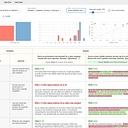
Data as of Aug 25, 2026 · Based on 38 AI responses from ChatGPT Search and Google AI Mode · See how Parse measures this
 Braintrust
Your brand can be here too.
Source | Citation share |
|---|---|
 Open source models are good enough. Stop overpaying for intelligence you don't needhttps://joseparreogarcia.substack.com/p/open-source-models-are-good-enough | 1.5% |
 Navigating the AI Frontier: A Strategic Comparison of Model Providers for June 2025https://medium.com/aidatatools/navigating-the-ai-frontier-a-strategic-comparison-of-model-providers-for-june-2025-24919475d237 | 1.5% |
 Are Frontier LLMs Ready for Cybersecurity? Evidence for Vertical Foundation Models from Dual-Mode Vulnerability Benchmarkshttps://arxiv.org/abs/2605.23243 | 1.3% |
Frontier LLM vs Open-Source: How do you actually decide? - Mediumhttps://medium.com/@paryemalanianuj/frontier-llm-vs-open-source-how-do-you-actually-decide-f675570a8f87 | 1.3% |
 What Are Frontier AI Models and How They Work | NVIDIA Glossaryhttps://www.nvidia.com/en-us/glossary/frontier-models/ | 1.3% |
 Open models vs. frontier models: Which AI coding route is worth the spend?https://www.faros.ai/blog/open-models-vs-frontier-models | 1.0% |
Open-Source LLMs vs Proprietary Models: Which One Should ...https://www.genaimlinstitute.com/blog/open-source-llms-vs-proprietary-models-which-one-should-you-choose-for-enterprise-ai | 1.0% |
 Enterprise AI doesn't need a frontier model: the case for open ...https://levelup.gitconnected.com/your-enterprise-ai-doesnt-need-a-frontier-model-the-case-for-open-weights-7310ea67230e | 0.8% |
 Open source is starting to beat frontier on cost/performancehttps://www.reddit.com/r/LocalLLM/comments/1u9gohq/open_source_is_starting_to_beat_frontier_on/ | 0.8% |
 Together Evaluations now supports comparing top commercial APIs vs. open source modelshttps://www.together.ai/blog/together-evaluations-v2 | 0.8% |
Yes. Companies increasingly use a model-selection stack rather than trying to pick one “best LLM.” The useful tools fall into a few categories:
| Question | Tool/data to use |
|---|---|
| Which models are capable enough? | Independent benchmarks + your eval set |
| Is open-source/open-weight viable? | Quality vs. inference cost + licensing + hardware requirements |
| Does a vertical model actually outperform general models? | Domain-specific evals on your real workload |
| Which option has the best economics? | Cost-per-successful-task analysis |
| Do we need frontier quality for every request? | Router/A-B testing |
| Can we tolerate provider dependency? | Multi-provider gateway + fallback |
| Should we self-host? | GPU/inference economics + privacy/compliance analysis |
| What should production use? | Continuous eval + routing + observability |
The key is not to compare models solely on benchmark scores. A good enterprise evaluation produces a Pareto frontier of quality × cost × latency × reliability × data/control, then determines which model category wins for each workload.
For example, a company might end up with frontier API for complex reasoning, an open-weight model for sensitive/high-volume workloads, and a vertical model for a narrow domain—all in the same application. Current routing systems are specifically moving toward that kind of per-request selection.
Choosing between frontier APIs (like OpenAI or Anthropic), open-source models (like Llama or Mistral), and specialized vertical models (such as legal, medical, or coding fine-tunes) requires a blend of empirical testing, traffic analysis, and cost-latency profiling.
Companies typically rely on four categories of tooling to make and automate these choices:
These tools let organizations run their specific prompt datasets and test suites across multiple candidate models simultaneously to measure accuracy, hallucination rates, and task suitability.
Gateways abstract your model endpoints, making it seamless to switch, fallback, or load-balance traffic between a hosted frontier API and a self-hosted open-source model.
To decide if a specialized or open-source model can replace a frontier model, you have to see how your current architecture performs under real-world user load.
Rather than making an all-or-nothing permanent choice, advanced tooling uses predictive routing to send simple queries to fast, cheap open-source/vertical models and complex reasoning tasks to frontier APIs.
If you're mapping out a selection process for your team, tell me:
I can recommend a tailored evaluation stack to compare your options.
If you mean tools for making the actual buy/build decision, there’s a useful stack rather than one magic product:
| Option | Best when | Main question |
|---|---|---|
| Frontier API | Highest capability, fastest deployment | “Is the quality gain worth the per-token cost and vendor dependency?” |
| Open-source/open-weight model | Privacy, customization, volume, control | “Does owning/hosting it beat the API after infrastructure + engineering costs?” |
| Vertical model | A narrow domain with specialized requirements | “Does domain-specific performance materially beat general models on our workload?” |
| Hybrid/router | Many heterogeneous workloads | “Can we dynamically use the cheapest model that meets our quality bar?” |
The key is not to select models from public benchmark scores alone. A company should measure its own workload, calculate cost per successful task, and then compare that against deployment/control requirements.
A particularly useful architecture is therefore:
Model marketplace/comparison → private company eval set → cost/quality frontier → pilot → production router.
That matters because the model-selection problem is moving from “Which model is smartest?” toward “Which model is good enough for this particular task at the lowest acceptable total cost?”
Choosing between frontier APIs (like OpenAI or Anthropic), open-source/open-weight models (like Llama or Qwen), and specialized vertical models (fintech, legal, or medical-specific models) requires balancing capability, total cost of ownership (TCO), latency, and data privacy.
Companies rely on a specialized stack of evaluation, benchmarking, and cost-modeling tools to make this decision data-driven rather than speculative.
Before testing in-house, companies use independent analytics platforms to filter out which models even qualify for their specific performance thresholds.
To see how models perform specifically on a company's internal prompts and logic rather than public tests, engineering teams use comparative evaluation frameworks.
Sometimes the choice isn't about raw intelligence, but how a model behaves under real user traffic, tracking edge cases and cost creep.
The architectural decision often hinges on volume: running a smaller open-source model on dedicated cloud infrastructure (like AWS/Hugging Face endpoints) becomes cheaper than a frontier API only past a certain high-token threshold. Companies build custom cost-matrix scripts or leverage pricing calculators like the Artificial Analysis Pricing Calculator factoring in:
If you'd like to narrow this down, tell me:
I can suggest a tailored evaluation workflow or recommend which model class fits your profile best.
Choosing between frontier APIs (like OpenAI or Anthropic), open-source/open-weight models (like Llama or DeepSeek), and specialized vertical models (legal, medical, or finance-tuned) requires a mix of benchmarking suites, experimentation platforms, and production-cost/latency modeling tools.
Evaluating these options involves a structured software and operational ecosystem:
If you'd like to narrow this down, let me know:
I can help you outline a tailored evaluation pipeline or recommend a specific tool stack.
Yes. If the question is “Should we buy a frontier API, run an open-weight model, or use a specialized/vertical model?”, there’s a growing tooling stack for answering it empirically rather than by benchmark hype.
| Tool / approach | Best for | What it helps compare |
|---|---|---|
| Together Evaluations | Direct model selection | Proprietary APIs vs. open-source/fine-tuned models on quality, cost, and performance |
| Frontier Benchmarks AI | Benchmark research | Frontier and specialized models across coding, reasoning, knowledge, agents, math, etc. |
| OpenRouter | Rapid multi-model experiments | Many commercial and open models through one API; useful for comparing real-world cost/performance |
| LiteLLM | Building your own comparison layer | Routes across 100+ providers/models, with fallbacks, budgets and usage tracking |
| Portkey / Helicone | Production evaluation | Routing, observability, experiments, latency and cost tracking |
| LLM gateways/model routers generally | Production model choice | Automatically route easy workloads to cheaper/specialized models and difficult workloads to frontier models |
Together's evaluation product is particularly close to your question: it explicitly supports side-by-side comparison of OpenAI, Anthropic, Google, open-source, fine-tuned and proprietary models.
For production, the emerging pattern is model routing rather than choosing one model for everything. For example, Snowflake's current routing approach assigns workloads according to factors such as performance, speed and cost, while Nvidia's NeMo Switchyard similarly routes requests among different models.
If you're evaluating this for a company, I'd combine:
The important distinction is that benchmarks answer “which model is capable?” while evals answer “which model is best for our workload?” And the latter can easily favor a smaller open or vertical model over a frontier API.
If you tell me the industry/use case (e.g. legal, healthcare, customer support, coding, finance), I can research the specific tools/vendors that help companies make this frontier-vs-open-vs-vertical decision, including newer startups in this space.
Yes. The useful category is model-selection / LLMOps platforms: tools that evaluate models on your workloads rather than relying on generic benchmarks, then help route each request to the best option.
These let a company run the same representative prompts/tasks against frontier APIs, open-weight models, and vertical/specialized models, scoring quality, accuracy, safety, latency, and cost.
Examples include ArNa EvalLab, Braintrust, LangSmith, Patronus AI, and Arize Phoenix. Enterprise evaluations increasingly emphasize workload-specific tests because generic benchmarks often don't predict production performance.
A router sits between the application and models and decides dynamically:
“This easy classification → cheap specialized model.
Sensitive data → self-hosted open model.
Difficult reasoning → frontier API.”
That turns model choice into a cost × quality × latency optimization problem.
Examples include Factory Router, TensorZero, and NVIDIA's newer NeMo Switchyard.
These are useful earlier in procurement: compare available models on capabilities, benchmarks, context windows, pricing, access model, and deployment options.
For example, DemandSphere's current frontier-model tracker covers proprietary and open-weight models and exposes benchmark and pricing dimensions.
The best tools combine all three layers:
| Question | What to measure |
|---|---|
| Does it work? | Task-specific accuracy, reasoning, tool use |
| What does it cost? | API/token cost or fully loaded GPU + ops cost |
| How fast is it? | p50/p95 latency, throughput |
| Can we control it? | Data residency, fine-tuning, weights, deployment |
| Is it reliable? | Failure rates, regressions, provider outages |
| Is it portable? | Ease of switching models/providers |
| Does specialization win? | Vertical model performance on the company's actual domain |
The important shift is not choosing one permanent “best model.” Companies can build a portfolio: frontier models for difficult tasks, open-weight models where control/privacy matters, and specialized models where a narrower model delivers better economics or domain performance. Recent enterprise guidance and deployments increasingly point toward this hybrid/routing approach.
If you're evaluating this as a software category/startup opportunity, I can also map the current landscape into model evaluators vs routers vs AI procurement platforms vs vertical-model marketplaces, including who the major vendors are and where the gaps appear.
Choosing the right AI architecture—whether to tap into a proprietary frontier API (like OpenAI or Anthropic), deploy an open-source model (like Llama or Mistral), or fine-tune a specialized vertical model —requires evaluating cost, latency, data privacy, and task performance.
Here are the key tools and platforms companies use to benchmark, orchestrate, and decide between these options:
If you'd like, let me know:
I can help you build a decision framework tailored to your project.

vLLM
vllm.ai
LangSmith
Yes. The most useful tools fall into a few categories:
| Tool type | What it helps decide | Examples |
|---|---|---|
| Model comparison / intelligence benchmarks | Frontier vs open-weight performance, price, speed, context, reasoning | Artificial Analysis compares hundreds of models across intelligence, latency, throughput, and cost. artificialanalysis.ai |
| Open-model leaderboards | Whether an open model is competitive enough to self-host or fine-tune | Hugging Face Leaderboards provides benchmark and community evaluations for open models. huggingface.co |
| Multi-model gateways / routers | Test or dynamically route the same workload among frontier and open models | OpenRouter offers multi-provider routing; its Auto Router can select models based on prompt complexity and requirements. openrouter.zendesk.com |
| Custom eval platforms | Determine which model actually works best on your company's tasks rather than generic benchmarks | Build a golden test set of representative prompts, then score accuracy, hallucination rate, tool use, latency, and cost across candidates. This is particularly important because generic benchmarks can miss substantial differences between models on heterogeneous workloads. arxiv.org |
| Model routers / cascades | Use expensive frontier models only when cheaper/specialized models aren't sufficient | A router can send simple requests to a small/open model and difficult ones to a frontier model. Enterprise adoption is increasingly moving in this direction; AT&T, for example, has reported using a model router to optimize cost and performance. www.wsj.com |
| Vertical/domain benchmarks | Decide whether a specialized model beats a general-purpose frontier model for a particular industry | Use evaluations specific to coding, finance, medicine, legal work, customer support, etc., ideally with your own production-like data. Artificial Analysis, for example, includes task-specific evaluations such as banking, coding, scientific reasoning, and agentic tasks. artificialanalysis.ai |
A leaderboard tells you what a model can do; a custom eval tells you what it can do for your business.
For an actual buy/build decision, I'd use a matrix like:
Candidate → Quality → Cost/task → Latency → Data/privacy → Deployment control → Customization → Reliability → Vendor risk
Then test three tiers:
And don't assume you have to pick one. Routing is often the fourth option: frontier for hard cases, cheap/open models for routine cases, and a vertical model for domain-specific workloads. Current research also suggests that intelligently selecting among multiple models can substantially improve the cost/performance frontier versus always using one model.
If you're evaluating this for a company, the most useful stack is therefore Artificial Analysis + Hugging Face + a model gateway/router + your own task-specific eval harness.
When companies choose between frontier APIs (like GPT-5 or Claude), open-source/open-weight models (like Llama or Qwen), and specialized vertical models (like medical or legal fine-tunes), they rely on a mix of benchmarking suites, evaluation frameworks, performance analytics, and dynamic routing engines.
Instead of relying on generic public leaderboards, mature engineering teams use concrete tooling to test models against their own private "golden datasets".
These developer tools run offline test suites, scoring different model types side-by-side using deterministic assertions and LLM-as-a-judge rubrics.
Before testing locally, companies use analytical platforms to compare raw intelligence, speed (tokens per second), and cost-per-task metrics.
Once models hit staging or production, these platforms track real-world drift, user satisfaction, cost, and latency.
Many organizations realize it is a false dichotomy to pick just one model category. Instead, they use routing libraries and proxies that dynamically delegate simple queries to cheap open-source models and complex queries to frontier APIs.
If you're currently tackling a model selection choice, tell me:
I can recommend a specific evaluation stack or hybrid routing strategy for your project.