Data as of Aug 25, 2026 · Based on 331 AI responses from ChatGPT Search and Google AI Mode · See how Parse measures this
For consultants: read The Pyramid Principle to learn clear, structured communication for presentations; Good Strategy/Bad Strategy to frame strategic problems; and 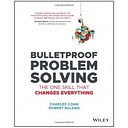
Brands AI recommends here
Best when you need to structure arguments and client presentations: Pyramid Principle teaches a repeatable top-down logic and clear writing for recommendations, though it focuses on communication technique rather than firm-specific cases.
Best for framing and diagnosing strategic problems: Good Strategy/Bad Strategy gives clarity on what makes an effective strategy and how to identify weak approaches, though it’s a high-level framing tool rather than a step-by-step project guide.
Best when you need robust, repeatable problem-solving frameworks for client work: Bulletproof offers structured methods to decompose problems and build analyses, though you may still want practice-focused books like Case in Point for interview-style case drills.
 McKinsey & Company
Source | Citation share |
|---|---|
 The 5 Best Business Strategy Books for MBA Studentshttps://www.seattleu.edu/business/online/albers/blog/best-business-strategy-books | 3.6% |
 Consulting MBA 101: Great Books, Magazines, and Websiteshttps://managementconsulted.com/must-read-books-and-periodicals-for-management-consultants/ | 3.6% |
 Top Consulting Books You Should Read - 4Degreeshttps://www.4degrees.ai/blog/top-consulting-books-you-should-read | 2.9% |
 8 Books Every Consultant Should Read at Least Once | The Muse | The Musehttps://www.themuse.com/advice/8-books-every-consultant-should-read-at-least-once | 2.8% |
 Top 22 Consulting Books You Should Read – and Whyhttps://consultport.com/succeed-as-consultant/top-22-consulting-books-you-should-read-and-why/ | 2.7% |
 Ten books every consultant should read - LinkedInhttps://www.linkedin.com/pulse/ten-books-every-consultant-should-read-deri-hughes-iey7e | 2.5% |
 Management Consulting Bookshttps://www.goodreads.com/shelf/show/management-consulting | 2.1% |
Five books I wish I'd read before I started in management ...https://www.linkedin.com/pulse/five-books-i-wish-id-read-before-started-management-consulting-mclay | 2.1% |
 8 Books Every Consultant Should Read at Least Once – Career Design Lab | Columbia University – School of Professional Studieshttps://careerdesignlab.sps.columbia.edu/blog/2021/09/07/8-books-every-consultant-should-read-at-least-once/ | 2.1% |
 Any modern Consulting book recommendations? - Reddithttps://www.reddit.com/r/consulting/comments/v981s2/any_modern_consulting_book_recommendations/ | 1.9% |
If your goal is to become excellent at management consulting—not merely well-read in business—I’d build your bookshelf around five capabilities: strategic thinking, competitive analysis, problem solving, financial/business acumen, and influence.
There’s a lot of overlap among “best business books” lists, but a relatively small core is genuinely worth your time. McKinsey’s own 2026 reading program, for example, emphasizes critical thinking, adaptation, leadership, and understanding how institutions evolve, while HBR’s strategy collection highlights books such as Playing to Win, The Innovator’s Dilemma, and Blue Ocean Strategy.
Priority: ★★★★★
If you read only one strategy book, make it this one.
Rumelt teaches you to distinguish actual strategy from goals, aspirations, buzzwords, and laundry lists of initiatives. His core idea is that good strategy starts with a diagnosis of the critical challenge, followed by a guiding policy and coherent actions.
Consulting skill: Turning an ambiguous client problem into a sharp strategic problem.
Priority: ★★★★★
The foundation for thinking about industries and competition.
Master:
Porter's ideas underpin an enormous amount of corporate strategy work. I'd read this before accumulating dozens of newer strategy frameworks.
Consulting skill: Industry and competitive analysis.
Priority: ★★★★★
Probably the most practical strategy book on this list. HBR itself describes it as a guide to the strategic approach Lafley used at P&G.
The key questions are:
Consulting skill: Converting analysis into strategic choices.
Priority: ★★★★★
This is arguably more important for a consultant than many strategy books.
It teaches you how to structure thinking and communicate conclusions:
In consulting, a brilliant analysis poorly communicated is often a failed analysis.
Consulting skill: Executive communication, decks, memos, and structured thinking.
Priority: ★★★★★
A more modern framework for understanding competitive advantage.
Helmer identifies seven mechanisms through which companies can create persistent power, including:
Consulting skill: Answering the question: “Why will this company continue to win?”
Priority: ★★★★☆
Essential for understanding disruption and why successful companies can nevertheless lose their position.
Christensen's central insight is that established companies can make perfectly rational decisions based on existing customers and economics—and still miss disruptive technologies. HBR considers it one of the influential classics of business strategy.
Consulting skill: Thinking about disruption, innovation, and industry transformation.
Priority: ★★★★★
Consultants spend their careers making judgments with incomplete information.
Kahneman helps you recognize:
The important lesson isn't simply “humans are biased.” It's learning to design your decision-making process so that biases have less influence.
Consulting skill: Better judgment.
Priority: ★★★★☆
Don't read this because McKinsey has magical secrets. Read it because it provides a useful introduction to the mechanics of consulting: problem definition, hypothesis-driven work, structured analysis, client interaction, and communication.
It's particularly useful early in your consulting career. Contemporary consulting reading lists continue to recommend it for precisely these problem-solving fundamentals.
Consulting skill: Understanding how consulting work actually gets done.
Priority: ★★★★☆
A fascinating history of modern corporate strategy and the consulting industry.
It helps explain how ideas associated with:
came together to create modern strategy consulting.
Consulting skill: Understanding where your profession came from—and why its frameworks look the way they do.
Priority: ★★★★☆
Every consultant needs to be comfortable talking about:
You don't need to become an accountant. You need to be able to look at financial statements and understand what the business is actually doing.
HBR includes Financial Intelligence alongside The Innovator's Dilemma, Playing to Win, Blue Ocean Strategy, and Leading Change in its leadership/strategy classics collection.
Priority: ★★★★☆
Useful for thinking about growth beyond simply “beating competitors.”
The central question is:
Can we change the value proposition and economics of the market rather than simply compete harder within its existing boundaries? HBR identifies it as one of its major strategy classics.
Consulting skill: Growth strategy and business-model innovation.
Priority: ★★★★☆
An accessible introduction to game theory.
This becomes extremely useful when your client's success depends on what competitors, suppliers, customers, regulators, or partners will do in response.
Think:
“If we make this move, what will they do next?” Consulting skill: Competitive dynamics and strategic interaction.
Priority: ★★★★☆
Consulting isn't just analysis. It's getting people to believe, agree, decide, and act.
Cialdini's principles help explain persuasion, authority, social proof, reciprocity, commitment, scarcity, etc.
Consulting skill: Stakeholder management and persuasion.
Priority: ★★★★☆
Particularly useful for:
A consulting engagement involves far more negotiation than junior consultants initially expect. Some consulting reading lists specifically recommend it for client contracting and handling pushback.
Consulting skill: Influence under pressure.
Priority: ★★★☆☆
Less about strategy itself and more about organizational leadership and execution.
It becomes especially valuable when you're advising executives on:
It's also one of HBR's perennial business bestsellers.
Don't read these randomly. I'd do this:
Phase 1 — Learn to think like a consultant
Phase 2 — Learn strategy
Phase 3 — Learn business
Phase 4 — Learn to influence
Phase 5 — Understand the profession
If you're becoming a management consultant, I wouldn't try to read 50 strategy books.
I'd rather see you deeply understand these 10 concepts:
| Concept | Book |
|---|---|
| What strategy actually is | Good Strategy/Bad Strategy |
| Competitive advantage | 7 Powers |
| Industry structure | Competitive Strategy |
| Strategic choices | Playing to Win |
| Strategic interaction | The Art of Strategy |
| Disruption | The Innovator's Dilemma |
| Business economics | Financial Intelligence |
| Structured thinking | The Pyramid Principle |
| Decision-making | Thinking, Fast and Slow |
| Persuasion | Influence |
That's a much stronger consultant's foundation than having read 50 airport-business books.
And there's a nice reason for that combination: Rumelt teaches you what strategy is; Porter teaches you how to analyze competition; Lafley/Martin teach you to make choices; Helmer teaches you to think about durable advantage; Minto teaches you how to communicate the answer.
Together, those five give you a surprisingly complete foundation for strategy consulting.
If you're specifically targeting McKinsey, BCG, Bain, Big Four strategy, or a boutique strategy firm, I can also give you a “Consultant's 20-book curriculum” ranked from Analyst → Consultant → Manager → Partner, including the books that teach case solving, Excel/financial modeling, PowerPoint/storylining, executive communication, organizational behavior, and client management.
And there's a nice reason for that combination: Rumelt teaches you what strategy is; Porter teaches you how to analyze competition; Lafley/Martin teach you to make choices; Helmer teaches you to think about durable advantage; Minto teaches you how to communicate the answer.
Together, those five give you a surprisingly complete foundation for strategy consulting.
A consulting engagement involves far more negotiation than junior consultants initially expect. Some consulting reading lists specifically recommend it for client contracting and handling pushback.
Consulting skill: Influence under pressure.
Priority: ★★★☆☆
Every management consultant needs a strong foundation in core competitive strategy, structured problem-solving, and practical business execution.
Essential Books for Management Consultants
| Book Title | Author | Core Focus & Value for Consultants |
|---|---|---|
| Competitive Strategy | Michael E. Porter | Teaches industry analysis, the five forces, and how firms achieve sustainable competitive advantage. |
| The Minto Pyramid Principle | Barbara Minto | The gold standard for structured thinking, logical communication, and top-down slide design. |
| Good to Great | Jim Collins | Explains why certain companies make the leap to superior long-term performance while others fail. |
| Blue Ocean Strategy | W. Chan Kim & Renée Mauborgne | Guides clients on how to stop competing in crowded markets and instead create uncontested market space. |
| The Strategy Book | Max McKeown | A tactical field guide on how to think and act strategically under real-world business uncertainty. |
If you'd like, I can:
To excel in management consulting, you need more than just a firm grasp of Excel and a structured mindset—you need a deep fluency in the core frameworks that govern how businesses compete, scale, and transform.
The essential reading list for a management consultant is divided below into foundational strategy, practical problem-solving, and client/firm dynamics.
Competitive Strategy: Techniques for Analyzing Industries and Competitors by Michael E. Porter
Competitive Advantage: Creating and Sustaining Superior Performance by Michael E. Porter
Good Strategy/Bad Strategy: The Difference and Why It Matters by Richard Rumelt
Blue Ocean Strategy: How to Create Uncontested Market Space and Make the Competition Irrelevant by W. Chan Kim and Renée Mauborgne
Good to Great: Why Some Companies Make the Leap... and Others Don't by Jim Collins
The Innovator's Dilemma: When New Technologies Cause Great Firms to Fail by Clayton M. Christensen
Measure What Matters: OKRs—The Simple Idea That Drives Big Success by John Doerr
The McKinsey Way by Ethan M. Rasiel
The Trusted Advisor by Charles H. Green and Robert H. Galford
If you'd like to narrow this down, let me know:
No sources cited
If you want to become an excellent management consultant, rather than simply someone who knows consulting frameworks, I’d build your reading around five capabilities:
Here’s the reading list I’d use.
The single book I’d most recommend.
Rumelt teaches you to distinguish genuine strategy from slogans, goals, vision statements, and corporate fluff. His idea of the “kernel of strategy” — diagnosis, guiding policy, coherent action — is extremely useful in consulting.
Consulting lesson: A strategy isn't a collection of initiatives. It's a coherent response to a specific challenge.
The foundational book for understanding industry structure and competitive advantage.
Learn Porter's:
Some of it feels dated because the book was originally published in 1980, but the underlying strategic logic remains fundamental.
I'd also read Porter's article “What Is Strategy?” afterward. The updated HBR's 10 Must Reads on Strategy collection includes it alongside the Five Forces article and other foundational pieces.
Probably the best book for learning how to turn strategic thinking into actual choices.
The central framework asks:
What is our winning aspiration? Where will we play? How will we win? What capabilities must we have? What management systems are required? This is particularly useful for consultants because it forces you to move from analysis → choice → action. HBR Press continues to position it as a core strategy framework, including an updated 2025 edition.
This one is especially valuable if you want to understand management consulting itself.
It tells the history of the strategy-consulting industry and the development of ideas associated with firms such as BCG, Bain, and McKinsey.
You'll understand where concepts like:
actually came from.
Consulting lesson: Strategy consulting has a history—and knowing that history helps you recognize which "new" framework is actually an old idea with a new label.
One of the best modern books on competitive advantage.
Helmer's seven powers give you a rigorous way to ask:
Why should this company's superior economics persist? The seven are:
This is particularly useful when you're evaluating whether a company's competitive advantage is real, defensible, and durable.
Essential for understanding disruption and technological change.
More importantly, it teaches a consulting habit: don't simply ask “What is the market doing?” Ask:
What structural forces could make today's successful business model obsolete? HBR's own leadership/strategy collection includes The Innovator's Dilemma alongside Playing to Win, Blue Ocean Strategy, Leading Change, and Financial Intelligence.
Useful for thinking beyond conventional competitive analysis.
The key idea is to ask whether a company can change the basis of competition, rather than simply compete harder within the existing industry structure.
It's particularly useful for:
HBR identifies it as one of its major strategy classics and notes that it has sold more than four million copies.
Not technically a business book—but extremely important for consultants.
Consulting is fundamentally a decision-making profession. You need to understand:
The book will make you more skeptical of both your client's reasoning and your own.
Read this for the mechanics of consulting.
It's not the deepest strategy book, but it provides useful exposure to:
I'd treat it as a consulting operating manual, not as a strategy bible.
A consultant who doesn't understand financial statements is severely handicapped.
You should be comfortable discussing:
This is especially important because strategy ultimately has to translate into economic consequences.
Once you've read the core ten, I'd move into these.
The Goal is particularly underrated for consultants. It's a great way to develop intuition around constraints, throughput, bottlenecks, and operational systems.
If you're going into strategy, private equity, corporate finance, or M&A consulting, I'd move Valuation much higher on the list.
A consultant can produce a brilliant strategy and still fail because the organization can't—or won't—execute it.
That's why implementation and organizational behavior deserve almost as much attention as strategy.
HBR's current business-book recommendations likewise emphasize areas such as transition management, change leadership, strategy, and organizational performance—not strategy in isolation.
I'd make your consultant's core curriculum:
--- | --- | --- 1 | Good Strategy/Bad Strategy | Strategic thinking 2 | Competitive Strategy | Competitive analysis 3 | Playing to Win | Strategic choices 4 | 7 Powers | Competitive advantage 5 | Understanding Michael Porter | Strategy fundamentals 6 | The Innovator's Dilemma | Disruption 7 | Thinking, Fast and Slow | Decision-making 8 | Financial Intelligence | Business economics 9 | Valuation | Value creation 10 | The McKinsey Way | Consulting mechanics 11 | Influence | Persuasion 12 | Leading Change | Implementation
And I'd add HBR's 10 Must Reads on Strategy as a reference volume. The updated 2025 edition specifically combines classic and newer material around competitive dynamics, strategic advantage, value creation, decision-making, purpose, and emerging opportunities such as AI.
Don't read these randomly. I'd go:
Phase 1 — Learn to think
Phase 2 — Learn strategy 4. Competitive Strategy 5. Understanding Michael Porter 6. Playing to Win 7. 7 Powers
Phase 3 — Understand businesses 8. Financial Intelligence 9. Valuation 10. The Goal
Phase 4 — Understand disruption and growth 11. The Innovator's Dilemma 12. Blue Ocean Strategy 13. Your Strategy Needs a Strategy
Phase 5 — Learn to make change happen 14. Influence 15. Leading Change 16. The First 90 Days
Don't fall into the trap of becoming “framework fluent” but commercially weak.
The best consultants don't win because they can recite Porter's Five Forces or draw an issue tree. They win because they can look at a messy business and figure out:
What actually matters? → Why is it happening? → What choices does the client have? → Which choice creates the most value? → What would have to be true for it to work? → How do we make it happen?
If you can internalize that sequence, these books become dramatically more valuable.
Phase 2 — Learn strategy 4. Competitive Strategy 5. Understanding Michael Porter 6. Playing to Win 7. 7 Powers
Here are top web results for exploring this topic:
LinkedIn·https://www.linkedin.com Five books I wish I'd read before I started in management consulting This will be key for early career consultants. The ability to quickly generate charts that effectively draw the ... Career · Productivity · Finance · Soft Skills & Emotional Intelligence · Project Man
Management Consulted·https://managementconsulted.com Consulting MBA 101: Great Books , Magazines, and Websites It's a good read - and very useful for understanding broader strategy frameworks and, to a lesser extent, the evolution of the consulting industry itself in which Boston Consulting Group played a larg
Reddit·https://www.reddit.com**Any** modern Consulting book recommendations? - Reddit Best books to read if interested in consulting/business strategy in general? (Not case prep). 49 upvotes · 36 comments ... Management/Strategy Consulting Learning Resources or Recommended Books - for
Amazon.com·https://www.amazon.com Amazon Best Sellers: Best Consulting Discover the best books in Amazon Best Sellers. Find the top 100 most popular Amazon books. Six Paths Consulting·https://www.sixpathsconsulting.com**Top** 7 Book on Management Consulting to Read in 2026 For consultants facing complex business challenges, Bulletproof Problem Solving is a vital book on management consulting. Priced around $30, the latest editions offer advanced frameworks and practical
Medium·https://medium.com The Consultant's Reading List: Essential Books for Your Success This post will explore five essential books that every business consultant must read. Let's delve in! The Importance of Reading for Consultants Staying updated with the latest trends, methodologies, a
Goodreads·https://www.goodreads.com Popular Management Consulting Books - Goodreads Flawless Consulting: A Guide to Getting Your Expertise Used Peter Block. Flawless Consulting: A Guide to Getting Your Expertise Used. Want to Read. Good Strategy Bad Strategy: The Difference and Why I
David A. Fields Consulting Group·https://davidafields.com 5 Unexpected Books Every Consultant Should Read 5 Unexpected Books Every Consultant Should Read ; How to Talk So Kids Will Listen & Listen So Kids Will Talk. by Adele Faber, Elaine Mazlish. The origins of Right-Side Up Thinking are in the pages of
Consultport·https://consultport.com**Top** 22 Consulting Books You Should Read – and Why - Consultport Fortunately, many books describe models and techniques and provide practical examples of how to use them. Here are some of my favorites: Gerben Van den Berg, Paul Pietersma: Key Management Models: The
Melisa Liberman·https://www.melisaliberman.com The Best Books Every Independent Consultant Should Read 1. The Irresistible Consultant's Guide to Winning Clients: 6 Steps to Unlimited Clients & Financial Freedom by David A. Fields. This book lays out all the fundamentals of running a consulting business
If you want to become an excellent management consultant—not merely pass case interviews—I’d build your reading around six capabilities: strategy, competitive advantage, economics, problem solving, decision-making, and organizational execution.
I’d prioritize the books below rather than trying to read every famous business book.
Priority: ★★★★★
If you read only one strategy book, make it this one.
Rumelt's central lesson is that strategy isn't a vision statement, aspiration, list of initiatives, or financial target. Good strategy starts with a diagnosis, establishes a guiding policy, and specifies coherent actions.
Consulting skill: Separating the real problem from management's description of the problem.
Priority: ★★★★★
Probably the most useful book for actually constructing a strategy.
Its framework forces five questions:
It's particularly valuable because it connects strategic choices to actual business decisions rather than treating strategy as abstract analysis.
Consulting skill: Turning analysis into choices.
Priority: ★★★★★
The foundation for understanding industry economics and competitive positioning.
Learn:
You don't need to memorize Porter's frameworks mechanically. You need to understand the underlying economic logic: why does this industry make money, and why does one company make more money than another?
McKinsey similarly emphasizes understanding industry structure and sources of competitive advantage when evaluating strategy.
Priority: ★★★★★
One of the best modern additions to the strategy canon.
Helmer focuses on persistent competitive advantage, identifying seven potential sources of "Power," including scale economies, network economies, switching costs, counter-positioning, branding, cornered resources, and process power.
Consulting skill: Answering the question, "What's actually defensible here?"
This is especially useful for technology, private equity, SaaS, and growth strategy work.
Priority: ★★★★★
This is arguably the most consultant-specific book on the list.
It teaches structured communication: start with the answer, organize supporting arguments logically, and make the structure of your thinking immediately apparent.
McKinsey's own books collection describes Minto's work as covering deductive and inductive reasoning and the logical presentation of business communications.
Consulting skill: Turning 30 pages of analysis into a 10-slide executive story.
If you work at a strategy firm, read this early.
Priority: ★★★★☆
A useful introduction to the mechanics and culture of traditional top-tier consulting: hypothesis-driven problem solving, structuring, data gathering, client interaction, and team dynamics.
It's less intellectually important than Rumelt or Porter, but very relevant if you're early in your consulting career.
Priority: ★★★★☆
Essential for understanding disruption.
The important lesson isn't simply "disruptive innovation is good." It's understanding why successful companies can rationally make decisions that eventually undermine their position.
Consulting skill: Understanding why incumbents struggle to respond to structural changes.
Priority: ★★★★☆
Useful complement to Porter.
Porter teaches you to understand competition; Blue Ocean teaches you to ask:
Can we change the basis on which competition occurs? Particularly useful for growth strategy, customer segmentation, product strategy, and innovation.
Priority: ★★★★★ for strategy consultants
Don't underestimate this one.
A consultant who understands strategy but can't connect it to cash flows, ROIC, capital allocation, and enterprise value is incomplete.
McKinsey describes valuation as sitting at the intersection of corporate strategy and finance.
You don't necessarily need to read every page. Master:
Priority: ★★★★☆
Consultants often analyze problems as linear chains:
Cause → effect → recommendation
Real businesses are usually systems involving feedback loops, incentives, delays, unintended consequences, and nonlinear effects.
This book dramatically improves your ability to see the system behind the problem.
Priority: ★★★★☆
Consulting involves enormous amounts of judgment under uncertainty.
Learn about:
The important application isn't trivia about cognitive biases. It's learning to ask:
"What might be systematically wrong with our analysis?"
Priority: ★★★☆☆
Worth reading, but don't treat its conclusions as scientific laws.
Its value for consultants is learning how to think about:
Use it as a source of hypotheses, not gospel.
Priority: ★★★★☆
An unusually good book for learning operations thinking through a novel.
It teaches the Theory of Constraints and gets you thinking about:
What is actually constraining the system?
That's an extremely useful consulting question.
Priority: ★★★★☆
Consulting isn't just analysis.
You have to persuade:
Understanding persuasion, social proof, authority, reciprocity, commitment, etc. is therefore highly practical.
Priority: ★★★★☆
A very accessible introduction to game theory.
You'll start thinking about:
This is particularly valuable for competitive strategy, M&A, pricing, and negotiations.
I wouldn't read these randomly. I'd go in this order:
These four give you an exceptionally strong strategy foundation.
Now you're learning how to structure, analyze, and communicate problems.
This gives you a much better understanding of how businesses actually make money, grow, compete, and fail.
This improves your decision-making and your ability to move organizations.
Then supplement with books on leadership, organizational design, transformation, and specific industries as your career develops.
If you told me you only had time for seven books, I'd choose:
| Rank | Book | What it teaches |
|---|---|---|
| 🥇 | Good Strategy/Bad Strategy | What strategy actually is |
| 🥈 | Playing to Win | How to formulate strategy |
| 🥉 | Competitive Strategy | How industries and competition work |
| 4 | 7 Powers | How competitive advantage becomes durable |
| 5 | The Pyramid Principle | How consultants structure & communicate |
| 6 | Valuation | How strategy creates financial value |
| 7 | Thinking in Systems | How complex organizations actually behave |
That combination is far more valuable than reading 30 generic "business success" books.
McKinsey's current book resources likewise span strategy, valuation, leadership, transformation, and problem-solving rather than treating "business" as a single discipline.
I'd separate "books consultants should read" from "books consultants should know."
You don't necessarily need to read all of Porter's Competitive Strategy cover-to-cover. But you should know:
Industry structure → competitive position → economics → sources of advantage → strategic choices → financial consequences. Likewise, you don't need to memorize every framework in Playing to Win. You should be able to walk into a client situation and ask:
Where should we play, how should we win, and what would have to be true for that strategy to work? That's the level at which these books become useful.
If your goal is specifically to become a top-tier strategy consultant (McKinsey/BCG/Bain/Strategy& level), I can also give you a 30-book "consultant MBA" curriculum, organized by case solving → corporate strategy → private equity → M&A → pricing → operations → digital/AI → leadership, with the exact chapters worth reading from each book.
Influence
Here are the foundational books on strategy, problem-solving, and business execution that form the core curriculum for management consultants.
Problem Solving & Consulting Foundations
Core Business Strategy
Execution & Operations
To help tailor this list, let me know if you are preparing for consulting interviews , looking to sharpen your industry-specific knowledge , or seeking books on client relationship management.
If you're aiming to become an excellent management consultant, I'd separate the bookshelf into four capabilities: strategy, business acumen, problem-solving, and communication/influence.
There are hundreds of business books worth reading, but I would prioritize the following.
| # | Book | Author | Why a consultant should read it |
|---|---|---|---|
| 1 | Good Strategy/Bad Strategy | Richard Rumelt | Probably the best antidote to vague corporate "strategy." Teaches you to identify the real problem, establish a guiding policy, and concentrate action. www.penguinrandomhouse.comwww.mckinsey.com |
| 2 | Competitive Strategy | Michael Porter | The foundation for understanding industry structure, competitive positioning, Five Forces, and competitive advantage. Porter's frameworks remain fundamental to strategy consulting. www.isc.hbs.edu |
| 3 | Playing to Win | A.G. Lafley & Roger Martin | Extremely practical. Forces you to answer where to play and how to win, rather than producing a generic strategy deck. hbr.org |
| 4 | The Pyramid Principle | Barbara Minto | Essential consulting skill: structuring your thinking and communicating conclusions clearly from the top down. |
| 5 | The Innovator's Dilemma | Clayton Christensen | Teaches you how disruptive innovation can undermine successful incumbents—and why good management can sometimes make companies less capable of responding to disruption. store.hbr.org |
| 6 | 7 Powers | Hamilton Helmer | A powerful framework for understanding why a company can sustainably make money and where competitive advantage actually comes from. |
| 7 | Blue Ocean Strategy | W. Chan Kim & Renée Mauborgne | Useful for thinking beyond "beat the competitor" toward changing the economics and boundaries of competition. HBR describes it as one of the iconic strategy books, with more than 4 million copies sold. store.hbr.org |
| 8 | The McKinsey Way | Ethan Rasiel | A good introduction to the mechanics and culture of classic management consulting: problem solving, client relationships, teams, and hypothesis-driven work. |
| 9 | The First 90 Days | Michael Watkins | Particularly useful once you're advising executives—or entering a new role yourself. It provides a framework for navigating organizational transitions. store.hbr.org |
| 10 | The Lords of Strategy | Walter Kiechel | The history of modern corporate strategy and the rise of firms such as McKinsey, BCG, and Bain. Great for understanding where consulting's intellectual toolkit came from. |
I'd make these your consultant's essential five:
1. Good Strategy/Bad Strategy → What strategy actually is
2. Competitive Strategy → How competition works
3. Playing to Win → How to make strategic choices
4. The Pyramid Principle → How to structure and communicate thinking
5. 7 Powers → How competitive advantage becomes economically durable
That combination is much more valuable than reading 20 generic "leadership" books.
Good Strategy/Bad Strategy — Richard Rumelt
Read this first. Rumelt's central idea is that strategy is fundamentally problem solving, not a collection of aspirations, financial targets, and buzzwords. McKinsey's own discussion with Rumelt makes the same distinction particularly clearly.
Competitive Strategy — Michael Porter
The classic. Learn Five Forces, positioning, industry economics, and competitive advantage. Porter's own institute identifies Five Forces, strategic positioning, and the value chain among his key frameworks.
Competitive Advantage — Michael Porter
Read after Competitive Strategy. It gets deeper into how activities within a company create—or destroy—advantage.
Playing to Win — Lafley & Martin
Probably the most immediately usable strategy book on this list. HBR describes its central approach around the fundamental choices of where to play and how to win.
7 Powers — Hamilton Helmer
Excellent once you've learned the basics. It pushes you to ask: What prevents competitors from copying this company's economics?
A consultant needs to understand how businesses actually make money—not merely how to make PowerPoint slides.
The Goal — Eliyahu Goldratt
A surprisingly good introduction to operations, constraints, throughput, and systems thinking.
Good to Great — Jim Collins
Worth reading critically. Don't treat every finding as gospel, but learn how to think about organizational performance and comparative research.
My Years with General Motors — Alfred Sloan
An underrated classic. Richard Rumelt himself includes it in his strategist's basic bookshelf and highlights Sloan's thinking around corporate management and decentralized operating divisions.
Financial Intelligence — Karen Berman & Joe Knight
Very useful if you don't have a finance/accounting background. A consultant should be comfortable moving from a strategic recommendation to P&L, cash flow, margins, ROIC, working capital and valuation.
The Innovator's Dilemma — Clayton Christensen
Essential for understanding disruption. It explains why established companies can lose to entrants even while making rational decisions based on their existing customers and economics.
Crossing the Chasm — Geoffrey Moore
Particularly useful for technology strategy and B2B.
The Lean Startup — Eric Ries
Useful for product strategy, experimentation, uncertainty, and innovation.
Blue Ocean Strategy — Kim & Mauborgne
Good for market creation and value innovation.
The Pyramid Principle — Barbara Minto
This is arguably the book that most directly teaches you to think like a consultant.
You want to develop the instinct:
Answer → supporting arguments → evidence.
Rather than:
Here's everything I found → here's some analysis → here's another chart → oh, and here's my conclusion.
The McKinsey Way — Ethan Rasiel
Useful for understanding the classic consulting approach to problem solving, hypothesis development, client interaction, and team working.
Case in Point — Marc Cosentino
More relevant if you're preparing for consulting interviews than if you're already consulting.
Once you've finished the core:
For a strategy consultant specifically, Your Strategy Needs a Strategy is particularly interesting because it challenges the idea that one strategic framework works everywhere; HBR currently lists it among its strategy titles.
If I were starting consulting from scratch, I'd do:
Phase 1 — Learn to think
Phase 2 — Learn to make strategic choices 4. Playing to Win 5. 7 Powers 6. Competitive Advantage
Phase 3 — Learn business 7. Financial Intelligence 8. The Goal 9. My Years with General Motors
Phase 4 — Understand disruption 10. The Innovator's Dilemma 11. Blue Ocean Strategy 12. Crossing the Chasm
Phase 5 — Become a better advisor 13. The First 90 Days 14. Influence 15. Never Split the Difference
This also lines up reasonably well with the broader strategy canon: HBR's current strategy reading collection prominently includes Porter, and its updated 10 Must Reads on Strategy brings together Porter, Kim & Mauborgne, Martin, and other major strategy thinkers.
Don't read these as a collection of frameworks to put into PowerPoint.
The best consultants use frameworks as mental models, not as answers. Rumelt's criticism of "template-style planning" is especially relevant here: strategy requires identifying the critical challenge and making choices about where to concentrate effort.
The real progression is:
Frameworks → business intuition → judgment → synthesis.
And the last two are what ultimately distinguish a great consultant from someone who simply knows every consulting framework.
If you tell me whether you're an undergraduate/MBА, aspiring consultant, Big 4 consultant, MBB consultant, or experienced consultant, I can also give you a much tighter "25 books to become exceptional at consulting" curriculum, ordered by year/level rather than just topic.
Influence
Here are the foundational books on strategy, problem-solving, and business execution that form the core curriculum for management consultants.
Problem Solving & Consulting Foundations
Core Business Strategy
Execution & Operations
To help tailor this list, let me know if you are preparing for consulting interviews , looking to sharpen your industry-specific knowledge , or seeking books on client relationship management.
If you're aiming to become an excellent management consultant, rather than simply accumulate business-book knowledge, I'd build your reading around five capabilities:
Here’s the reading list I'd recommend.
| Priority | Book | What it teaches a consultant |
|---|---|---|
| ⭐⭐⭐⭐⭐ | Good Strategy Bad Strategy — Richard Rumelt | How to diagnose a real strategic problem and turn it into coherent action |
| ⭐⭐⭐⭐⭐ | Competitive Strategy — Michael Porter | Industry structure, Five Forces, competitive positioning |
| ⭐⭐⭐⭐⭐ | Playing to Win — A.G. Lafley & Roger Martin | How to make explicit strategic choices |
| ⭐⭐⭐⭐⭐ | The Pyramid Principle — Barbara Minto | How to structure analysis and communicate recommendations |
| ⭐⭐⭐⭐⭐ | Understanding Michael Porter — Joan Magretta | The clearest practical explanation of Porter's thinking |
| ⭐⭐⭐⭐ | The Innovator's Dilemma — Clayton Christensen | Disruption and why successful companies can lose |
| ⭐⭐⭐⭐ | The Art of Strategy — Avinash Dixit & Barry Nalebuff | Game theory and thinking several moves ahead |
| ⭐⭐⭐⭐ | Thinking, Fast and Slow — Daniel Kahneman | Cognitive biases and decision-making |
| ⭐⭐⭐⭐ | Blue Ocean Strategy — W. Chan Kim & Renée Mauborgne | Finding new sources of demand rather than simply fighting competitors |
| ⭐⭐⭐⭐ | Good to Great — Jim Collins | Organizational performance and leadership patterns |
| ⭐⭐⭐⭐ | The Hard Thing About Hard Things — Ben Horowitz | What management actually looks like when the textbook answers don't work |
| ⭐⭐⭐⭐ | Measure What Matters — John Doerr | Translating strategy into objectives and measurable execution |
| ⭐⭐⭐ | The Goal — Eliyahu Goldratt | Operations, bottlenecks and systems thinking |
| ⭐⭐⭐ | The Lean Startup — Eric Ries | Experimentation, iteration and business-model uncertainty |
| ⭐⭐⭐ | Strategy Safari — Henry Mintzberg et al. | Understanding the different schools of strategic thought |
If I could give an aspiring consultant only one strategy book, this would probably be it.
Rumelt makes an important distinction between a strategy and a collection of goals, aspirations and buzzwords. His "kernel" of strategy—diagnosis → guiding policy → coherent action—is remarkably close to how good consulting work should operate.
The consultant's skill you're developing is:
"What is really going on here, and what should the client actually do about it?"
That's much more valuable than memorizing frameworks.
This is foundational.
You should be extremely comfortable with:
Porter's work remains one of the foundations of modern competitive strategy; Harvard's Institute for Strategy and Competitiveness specifically highlights Five Forces, the Value Chain and strategic positioning as core frameworks.
Consulting payoff: You'll learn to analyze why an industry makes money, not merely whether a company is growing.
If the original Porter feels dense, read Understanding Michael Porter by Joan Magretta first.
This is one of my favorites for consultants because it turns strategy into choices.
The central questions are essentially:
It complements Rumelt beautifully.
Rumelt: What is the fundamental challenge?
Lafley/Martin: Given that challenge, what choices will we make?
This one is arguably more important for a consultant than many famous business books.
It teaches you to structure communication as:
Answer → supporting arguments → evidence
rather than:
Here's everything I found → maybe there's a conclusion somewhere near the end.
That distinction is enormous in consulting.
It improves:
If you want to work at McKinsey, BCG, Bain, Big Four strategy practices, etc., read this early.
Consultants constantly deal with situations where your outcome depends on what another party does.
Competitors. Suppliers. Regulators. Customers. Acquirers. Employees.
Game theory gives you a better mental model for those situations.
The important skill isn't doing mathematical game theory; it's learning to ask:
"If I do X, what will the other player do—and what will they expect me to do?"
I'd add this even though it isn't usually on "greatest strategy books" lists.
A consultant needs to understand:
You don't need to become an investment banker. But you should be able to look at a company's financials and quickly understand where the economics are coming from.
A surprisingly useful consulting book.
It's essentially a lesson in systems thinking and constraints disguised as a business novel.
It teaches you to ask:
"What is the constraint preventing the entire system from performing better?"
That's an extraordinarily useful question in operations, supply chain and organizational transformation.
Essential for understanding why incumbents can be extraordinarily well-managed and still lose.
You'll learn about:
Useful for thinking about growth from a different angle: rather than beating competitors in an existing market, can you change the basis of competition or create new demand?
It remains one of the major strategy classics and has sold more than four million copies; it also won the Carl S. Sloane Award for Excellence in Management Consulting.
I would read it after Porter and Rumelt, not before. Otherwise it's easy to turn its frameworks into mechanical exercises.
Consultants are supposed to be analytical—but clients, consultants and executives are all susceptible to cognitive biases.
This book helps you recognize:
The important takeaway isn't "humans are irrational."
It's:
Your analysis can be perfectly logical while the assumptions going into it are badly biased.
Strategy ultimately has to be executed by people.
I'd therefore add:
Good to Great — Jim Collins
Useful for thinking about leadership, organizational discipline and sustained performance.
The Hard Thing About Hard Things — Ben Horowitz
A useful counterweight to polished strategy theory. Real executives have to make ugly decisions with incomplete information.
Measure What Matters — John Doerr
Useful for understanding OKRs and translating strategic priorities into organizational execution.
If you don't want to read 15 books, I'd narrow it down to these 10:
That combination gives you a surprisingly complete foundation.
The McKinsey Way — Ethan Rasiel
I'd treat this differently from the books above. It isn't really a strategy textbook. It's more about how consulting work gets done: problem structuring, hypothesis-driven analysis, client interactions, presentations and team dynamics.
But don't confuse consulting methodology with strategic thinking. The best consultants don't just know frameworks—they know when not to use one.
Don't read them like a normal bookshelf.
For every book, create a one-page note with four sections:
1. Core idea
What is the author's fundamental argument?
2. Frameworks
What analytical tools did they introduce?
3. Examples
What real businesses illustrate the concepts?
4. Consulting application
"When would I use this on a client problem?"
For example, after Porter:
Client: "Our margins are collapsing. What should we do?"
Don't immediately reach for Five Forces.
First ask:
Where in the value chain is value being created and captured?
What has changed in industry economics?
Which competitive force has strengthened?
Is the problem structural or company-specific?
That's the difference between knowing a framework and thinking like a consultant.
There's also an excellent shortcut: HBR's 10 Must Reads on Strategy, Updated and Expanded (2025 edition). It brings together classic and newer strategy thinking, including Porter, Blue Ocean Strategy, strategic choice, AI-era competition, transient advantage and strategy execution.
HBR's Strategy reading list is also a good ongoing source rather than relying exclusively on books.
If your goal is specifically to become a top-tier strategy consultant, I'd prioritize the first five above before reading anything else. They will improve your actual consulting thinking far more than reading 50 generic "business books."