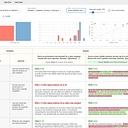
Data as of Aug 16, 2026 · Based on 344 AI responses from ChatGPT Search and Google AI Mode · See how Parse measures this
For secure LLM feature design, combine tactical threat-focused resources with broader organizational risk management frameworks. Use the 
Brands AI recommends here
Best for granular, design-level requirements. It provides a prioritized list of specific threats like prompt injection and data poisoning to map directly to your feature tests and security controls.
Best for managing AI risks across the full development lifecycle. Use it to create a high-level governance structure, though it is less focused on specific feature-level code security than OWASP.
Best for evaluating adversarial risks. It helps teams understand and map specific tactics attackers use, such as model evasion, to better defend LLM features against sophisticated exploits.
OWASPSource | Citation share |
|---|---|
OWASP Top 10 for Large Language Model Applications | OWASP Foundationhttps://owasp.org/www-project-top-10-for-large-language-model-applications/ | 3.6% |
OWASP Large Language Model Security Verification Standardhttps://owasp.org/www-project-llm-verification-standard/ | 3.1% |
 What Are LLMs? Top 10 Risks | Exabeamhttps://www.exabeam.com/explainers/ai-cyber-security/llm-security-top-10-risks-and-7-security-best-practices/ | 2.4% |
 Security planning for LLM-based applications | Microsoft Learnhttps://learn.microsoft.com/en-us/ai/playbook/technology-guidance/generative-ai/mlops-in-openai/security/security-plan-llm-application | 2.3% |
 Best Practices for Securing LLM-Enabled Applicationshttps://developer.nvidia.com/blog/best-practices-for-securing-llm-enabled-applications/ | 2.1% |
 LLM Security Frameworks: A CISO’s Guide to ISO, NIST & Emerging AI Regulation - Hackenhttps://hacken.io/discover/llm-security-frameworks/ | 2.0% |
 LLM Security in 2025: Risks, Examples, and Best Practiceshttps://www.oligo.security/academy/llm-security-in-2025-risks-examples-and-best-practices | 1.9% |
 Building Secure AI Applications | DryRun Securityhttps://www.dryrun.security/resources/owasp-top-10-llm-building-secure-applications | 1.7% |
 Enterprise LLM Security: 6 Best Practices to Reduce Riskhttps://www.superblocks.com/blog/enterprise-llm-security | 1.5% |
 LLM Security: Risks, Safety Measures & Best Practices - F5https://www.f5.com/glossary/llm-security | 1.4% |
If by “requirements pack” you mean a reusable set of security requirements that product/engineering teams can apply when designing an LLM feature, my pick is:
The strongest practical combination I found is:
OWASP Large Language Model Security Verification Standard (LLMSVS) v2.0 — the requirements backbone.
This is explicitly designed as a set of concrete security requirements/tests for architects, developers, testers and security teams. Its coverage includes prompt/input security, model memory, LLM integration, agents/plugins, dependencies, and monitoring.
OWASP GenAI LLM Top 10 2026 — the threat/risk checklist.
Use it to make sure the feature design addresses the current LLM-specific attack surface. The 2026 edition was published August 4, 2026, so I'd use this rather than older Top-10 versions.
NIST AI RMF: Generative AI Profile — the governance/risk layer.
It gives you the broader lifecycle structure—risk identification, measurement, management and trustworthy-AI considerations—rather than just application vulnerabilities.
NIST SP 800-218A (SSDF for GenAI) — the SDLC layer.
Add this when the requirement pack needs to govern development, supply chain, model/data handling, testing and release processes, not merely the feature's runtime architecture.
I'd turn those sources into a one-page feature security requirements template with these sections:
| Area | Requirements to capture |
|---|---|
| Data | Data classification, PII/secrets, retention, residency, training/telemetry use |
| Trust boundaries | User input, retrieved documents, memory, tool results and model output treated as untrusted |
| Prompt security | Direct/indirect prompt injection, system-prompt protection, instruction hierarchy |
| RAG | Retrieval authorization, tenant isolation, document provenance, poisoning, vector-store security |
| Output | Schema validation, encoding, DLP, safe rendering, downstream injection protection |
| Tools/agents | Least privilege, tool allowlists, scoped credentials, action limits, approval gates |
| Agency | Explicit limits on autonomous actions; human approval for high-impact actions |
| Availability/cost | Token/request limits, rate limiting, abuse controls, runaway-agent protection |
| Supply chain | Model/provider provenance, dependencies, datasets, plugins, version/change control |
| Privacy | Logging minimization, redaction, access controls, retention and deletion |
| Testing | Abuse cases, adversarial testing, prompt-injection tests, data-exfiltration tests |
| Monitoring | Security telemetry, anomalous behavior, policy violations, incident response |
| Release gates | Security review, risk acceptance, red-team results, rollback/kill switch |
That structure is particularly important because modern guidance treats prompts, retrieved content, memory and tool results as potentially untrusted, rather than assuming the model will distinguish trusted instructions from hostile content.
Bottom line: if you want one artifact to hand engineers, start with LLMSVS v2.0. If you want a genuinely enterprise-grade requirements pack, make LLMSVS the control/requirement catalog, OWASP GenAI Top 10 the threat taxonomy, and NIST AI RMF + SP 800-218A the governance/SDLC framework.
OWASP LLM Applications Cybersecurity & Governance Checklist is also worth adding for the product/security/legal review layer.
When designing secure Large Language Model (LLM) features, relying on traditional web application checklists leaves critical gaps (like prompt injection, excessive agency, or data poisoning).
The gold standard "requirements pack" is a composite framework built by mapping the OWASP Top 10 for LLMs and the OWASP LLM Security Verification Standard (LLMSVS) to the lifecycle controls of the NIST AI Risk Management Framework (AI RMF).
An actionable, enterprise-ready requirements pack for secure LLM feature design is organized into five core pillars:
If you'd like, let me know:
I can tailor these requirements into a ready-to-use user story acceptance criteria format for your backlog.
For secure LLM feature design, the strongest approach is usually not one requirements document, but a requirements pack combining product requirements, threat modeling, security controls, and verification criteria.
A solid pack looks like this:
Defines what the LLM feature is allowed to do.
Include:
Example requirements:
Use a threat model specific to LLMs, not only traditional application security. NIST recommends incorporating AI-specific threat modeling, including risks such as prompt injection, data leakage, supply-chain attacks, and model misuse.
Cover:
Map requirements to controls. A good baseline is the OWASP LLM security guidance, including secure configuration, model lifecycle controls, memory/storage protection, secure integrations, and monitoring.
Typical requirements:
Include diagrams showing:
Key questions:
Use a framework such as the National Institute of Standards and Technology AI Risk Management Framework (AI RMF), which organizes AI risk work around Govern, Map, Measure, and Manage.
Capture:
Define security tests before launch.
Include:
For third-party models:
Require:
For internal models:
Before release:
A practical “gold standard” pack is:
PRD + AI threat model + architecture diagram + data flow map + security requirements + risk assessment + adversarial test plan + production checklist
For enterprise environments, I would align it with:
That combination gives product teams something they can build from and security teams something they can audit against.
The gold standard for a secure LLM requirements pack relies heavily on the OWASP Top 10 for LLM Applications (expanded for multi-step agentic workflows and persistent memory), combined with the OWASP Top 10 for Agentic Applications if your feature executes external actions or tools.
Rather than trying to build a model that cannot be fooled, a robust requirements pack focuses on blast-radius control : ensuring that when the model inevitably misinterprets an input, nothing critical breaks downstream.
An actionable, production-ready requirements pack for secure LLM feature design is structured around five core security domains:
To help tailor these requirements specifically to your project, tell me:

When designing secure LLM features, there isn’t a single vendor product labeled "the best requirements pack." Instead, the gold standard is a hybrid requirements framework built by merging application-layer threat taxonomies with risk governance standards.
The industry consensus points to a combination of the OWASP Top 10 for LLM Applications and the NIST AI Risk Management Framework (AI RMF) as the foundation for a comprehensive secure requirements pack.
Core Components of a Secure LLM Requirements Pack
To build your internal specification or user story acceptance criteria, organize your requirements into these foundational pillars:
Recommended Reference Frameworks to Adapt
If you tell me what specific feature you are building (e.g., an internal RAG knowledge assistant, a customer-facing support chatbot, or an autonomous agent with database access), I can help you draft a specific set of user story requirements for it.
If you mean a requirements pack you can hand to product, engineering, architecture, and security, my pick in 2026 is:
OWASP LLM Security Verification Standard v2.0 is probably the best security-specific requirements baseline for an LLM feature. It is explicitly written as a set of requirements/tests for designing, building, testing, and verifying LLM applications, and v2.0 covers configuration, model lifecycle, RAG/memory, tool/agent integration, dependencies, and monitoring.
I would not use the OWASP Top 10 alone. The Top 10 is excellent for threat awareness and threat modeling, but LLMSVS is much closer to an actual requirements/verification pack.
| Layer | Standard | Purpose |
|---|---|---|
| Security requirements | OWASP LLMSVS 2.0 | Concrete, testable LLM security controls |
| AI risk requirements | NIST AI RMF + GenAI Profile (AI 600-1) | Safety, privacy, reliability, governance, risk acceptance |
| General application security | OWASP ASVS 5.x | Auth, authorization, APIs, secrets, sessions, infrastructure |
| AI security testing | OWASP AI Testing Guide | Repeatable adversarial/security/trustworthiness tests |
| Threat catalog | OWASP Top 10 for LLMs 2025 | Prompt injection, disclosure, supply chain, excessive agency, etc. |
| Agent-specific controls | OWASP Agent Security guidance | Tool permissions, privilege escalation, memory poisoning, exfiltration |
NIST's GenAI Profile is particularly useful for turning "secure AI" into organizational requirements and risk-management decisions rather than just technical controls. www.nist.gov The OWASP AI Testing Guide then gives you a methodology for actually validating those requirements.
Feature/use-case boundary
Data requirements
LLM requirements
Security requirements
Agent/tool requirements
Testing requirements
Observability
Release gates
The key design principle is: write requirements as verifiable controls, not aspirations. For example, "the LLM must not leak secrets" is weak; "LLM-generated responses must pass a sensitive-data detection/policy check before being returned to an untrusted user, with defined false-negative/false-positive acceptance criteria" is something engineering and security can actually test.
For a production system, I'd therefore use LLMSVS 2.0 as the core requirements catalog + NIST AI RMF/AI 600-1 for governance + ASVS for everything surrounding the LLM. That gives you a considerably stronger pack than any single LLM checklist.
If you tell me whether this is RAG, a chatbot, or an agent that can take actions, I can narrow this into the ~30–50 requirements that are actually worth putting into a feature security review.
When designing a secure LLM feature, there isn’t a single vendor product that serves as a "requirements pack"—instead, security architects use a composite baseline combining community risk standards, verification checklists, and threat-modeling taxonomies.
The industry consensus points to a four-part framework stack that covers everything from data ingress to autonomous agent behavior.
For day-to-day feature design, user stories, and engineering acceptance criteria, the OWASP Top 10 for Large Language Model Applications is the primary baseline.
To turn high-level risks into concrete, testable requirements, use the OWASP Large Language Model Security Verification Standard (LLMSVS).
To understand how an adversary will actively try to subvert your specific LLM feature, map your architecture against MITRE ATLAS (Adversarial Threat Landscape for Artificial Intelligence Systems).
To satisfy organizational risk compliance, continuous logging, and audit requirements, align your design with the NIST AI Risk Management Framework (AI RMF).
Recommended Action Plan for Your Requirements Pack
If you are assembling a definition-of-done checklist for an upcoming sprint, structure your security requirements into these four functional pillars:
If you tell me what specific feature you are building (e.g., an internal RAG knowledge chatbot, a customer-facing agent with API tool access, or a code-generation assistant), I can help you draft a tailored user story and acceptance criteria checklist using these frameworks.
For secure LLM feature design, the best “requirements pack” is usually not a single document—it is a layered pack that combines product requirements, threat modeling, security controls, and verification tests. A strong baseline maps well to NIST AI RMF for governance and OWASP Foundation LLM security guidance for application-level threats.
A practical pack I’d recommend:
Purpose: Define what the feature is allowed to do.
Include:
Document:
Use this as the security design centerpiece.
Cover:
| Threat | Requirement example |
|---|---|
| Prompt injection | System instructions must not be overridden by user or retrieved content |
| Data leakage | Model must not reveal secrets, hidden prompts, or unauthorized documents |
| Excessive agency | Tools require explicit authorization and least privilege |
| Retrieval poisoning | Retrieved documents must be validated and attributed |
| Model/output abuse | Outputs must pass policy and security checks |
| Supply chain risk | Track model, embeddings, libraries, and prompt versions |
OWASP’s LLM security materials and verification standards are designed specifically to turn these risks into requirements and tests.
Require design decisions for:
Define release gates.
Minimum tests:
Include:
Before launch:
✅ Threat model approved
✅ Security review completed
✅ Privacy review completed
✅ Red-team/adversarial tests passed
✅ Logging enabled
✅ Monitoring dashboards ready
✅ Rollback plan documented
✅ Model/prompt versions tracked
/LLM-Security-Requirements-Pack

01_Product_Requirements.md
02_Data_Classification.md
03_AI_Threat_Model.md
04_Architecture_Diagram.md
05_Security_Control_Requirements.md
06_Prompt_and_Model_Governance.md
07_Test_Plan_and_Attack_Cases.md
08_Privacy_Assessment.md
09_Production_Readiness_Checklist.md
10_Incident_Response_Playbook.md
For most enterprise teams, I would start with:
If you are designing this for an enterprise feature, SaaS product, internal copilot, or agentic workflow, the pack should be adjusted because the highest-risk requirements differ significantly.
When designing secure LLM features, there isn’t a single vendor product labeled "the requirements pack"—instead, industry maturity has converged around a hybrid requirements framework combining threat taxonomies, verification standards, and operational guardrails.
The gold standard for building a comprehensive requirements pack involves mapping your feature specifications against these core, universally adopted pillars:
Suggested Structure for an Enterprise LLM Requirements Pack
When assembling your internal Confluence or PRD requirements template, structure it into these 5 mandatory gates:
If you'd like, let me know:
I can help draft a tailored set of user stories and acceptance criteria for your specific architecture.
For secure LLM feature design, the strongest requirements pack is usually a combined product-security requirements package, not a single checklist. A good pack ties together threat modeling, functional requirements, security controls, testing, and operational governance.
A practical “gold standard” pack looks like this:
Purpose: Decide what level of security rigor is required.
Include:
Purpose: Make trust boundaries explicit.
Document:
Required decisions:
Use an LLM-specific threat model rather than only traditional application security.
Cover:
The OWASP Foundation LLM security guidance and verification standards are commonly used references for this section.
Examples:
Prompt security
Data security
Tool/agent security
Output security
OWASP’s LLM risk categories explicitly include issues such as prompt injection, sensitive information disclosure, insecure output handling, supply-chain vulnerabilities, and excessive agency.
Include:
Before production:
Security testing
Quality testing
The OWASP AISVS is designed around testable AI security requirements across the lifecycle, which makes it useful for turning requirements into verification gates.
Include:
Define:
Specify:
Example gates:
| Gate | Pass criteria |
|---|---|
| Threat model | Completed and reviewed |
| Data review | Approved data flows |
| Security tests | No critical findings |
| Prompt tests | Regression suite passing |
| Access control | Least privilege verified |
| Monitoring | Alerts configured |
| Rollback | Tested |
A mature team would typically map the pack against:
For most enterprise teams, the ideal deliverable is a 10–20 page “LLM Feature Security Requirements Specification” plus threat model plus test plan. That becomes the reusable template for every new AI feature.