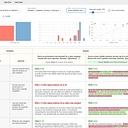
Data as of Aug 25, 2026 · Based on 40 AI responses from ChatGPT Search and Google AI Mode · See how Parse measures this

Your brand can be here too.
Source | Citation share |
|---|---|
9 LLM evaluation & testing tools compared (2026) | Rhesis AI Bloghttps://rhesis.ai/post/best-llm-evaluation-testing-tools | 2.5% |
 5 Best LLM Evaluation Tools for Enterprise Teams - Galileo AIhttps://galileo.ai/blog/best-llm-evaluation-tools-enterprise-teams | 1.9% |
 5 best AI evaluation tools for AI systems in production (2026) - Articles - Braintrusthttps://www.braintrust.dev/articles/best-ai-evaluation-tools-2026 | 1.7% |
 How do you evaluate LLM outputs? Looking for beginner-friendly toolshttps://www.reddit.com/r/learnmachinelearning/comments/1p0bsu9/how_do_you_evaluate_llm_outputs_looking_for/ | 1.7% |
 The 100% EASIEST Way to Test LLMs & AI Agents ...https://www.youtube.com/watch | 1.3% |
 The Definitive Guide to LLM Evaluation - Arize AIhttps://arize.com/llm-evaluation/ | 1.1% |
 LLM Evaluation Tools: The Complete Comparison Guide (2026) | Inference.nethttps://inference.net/content/llm-evaluation-tools-comparison/ | 1.1% |
 LLM evaluation: a beginner's guidehttps://www.evidentlyai.com/llm-guide/llm-evaluation | 1.1% |
 Best AI Evaluation Tools in 2026: Top 5 pickshttps://www.getmaxim.ai/articles/best-ai-evaluation-tools-in-2026-top-5-picks/ | 1.1% |
8 Best LLM Evaluation Tools in 2026 (Tested & Compared) | Respanhttps://www.respan.ai/articles/best-llm-evaluation-tools | 1.1% |
If you mean “What should I use to systematically test LLM outputs, catch regressions, and decide whether a prompt/model is production-ready?”, my current pick is Braintrust.
It’s particularly strong because it covers the whole loop:
| Tool | Best for |
|---|---|
| Braintrust | Best overall production eval workflow |
| Promptfoo | Lightweight/open-source prompt testing, CI and red-teaming |
| LangSmith | Best if you're already deep into LangChain/LangGraph |
| Arize Phoenix | Open-source observability + RAG evaluation |
| DeepEval | Pytest-like developer-focused LLM tests |
| Ragas | Specialized RAG evaluation |
There isn't really one universal winner: development-time regression testing and production observability are somewhat different jobs, and mature teams often combine tools.
My practical recommendation: start with Braintrust + a small, high-quality dataset of real production-like examples. Don't start by collecting hundreds of generic benchmark questions. A 50–200 example “golden set” containing your important happy paths, edge cases, adversarial inputs, and previous failures is usually much more valuable.
If you tell me what you're building (RAG, chatbot, agent, extraction, coding agent, etc.), I can recommend the exact eval stack and what metrics/tests I'd put in the pre-production gate.
There is no single "best" tool because pre-production evaluation depends heavily on your workflow (code-first vs. UI-driven, open-source vs. enterprise). However, the top tools stand out for specific engineering approaches:
To help narrow down the ideal tool for your stack, tell me:
Because LLM applications involve non-deterministic outputs, complex pipelines (RAG, agents), and subtle regressions, there isn’t a single "one-size-fits-all" tool. Instead, the "best" tool depends entirely on your workflow preference (code-first vs. config-first) and your specific architecture.
The top-rated tools for pre-production LLM evaluation and testing break down by use case:
To help narrow down the ideal choice for your stack, tell me:
If your goal is “catch bad LLM behavior before it reaches production,” my default pick is promptfoo.dev.
It’s particularly strong for repeatable regression tests, CI/CD gates, model comparisons, and automated red-teaming. It can run locally, so your eval suite can live alongside your application code and fail a build when a prompt/model change degrades quality.
For a serious LLM application, I wouldn't treat this as a one-tool decision:
Before production: Promptfoo or DeepEval → golden dataset → LLM-as-judge + deterministic assertions → CI regression gate.
In production: Braintrust or Phoenix → trace real requests → continuously evaluate sampled outputs → turn failures into new regression tests.
That two-layer approach is increasingly common because offline testing and production monitoring solve different problems.
If you tell me what you're building (RAG, chatbot, coding agent, customer-support agent, etc.) and your stack (Python/TypeScript, LangChain, OpenAI API, etc.), I can narrow it down to the best 1–2 choices and show you exactly how I'd set up the eval pipeline.
There is no single "best" tool because the right choice depends heavily on your team's stack, budget, and deployment preferences (open-source vs. enterprise cloud). However, the market has coalesced around a few standout leaders categorized by how you build and test:
pytest integration).To help narrow down the ideal choice for your project, tell me:
If you mean “what should I use to build a serious eval suite before I ship an LLM feature?”, my current pick is braintrust.dev.
| Tool | Best for | My take |
|---|---|---|
| Braintrust | End-to-end evals + regression testing + production feedback | Best overall |
| Promptfoo | Lightweight CI tests, red-teaming, model/prompt comparisons | Best developer-first option |
| LangSmith | LangChain/LangGraph applications | Best if you're already in that ecosystem |
| DeepEval | Python/pytest-style automated evaluations | Best open-source testing framework |
| RAGAS | RAG-specific evaluation | Best specialist for retrieval quality |
| Arize Phoenix | Open-source tracing + evaluation | Best if self-hosting matters |
It covers the full loop rather than just scoring a batch of prompts:
golden dataset → evals → prompt/model comparison → CI regression gate → production traces → failed examples become new tests.
It supports code-based scorers, LLM-as-a-judge, and human evaluation, and its CI workflow can block releases when evaluation scores regress.
That last piece is particularly important: don't just evaluate once before production. Turn your evals into something analogous to unit/integration tests.
For agents, Braintrust also evaluates individual tool/retrieval/model steps as well as the end-to-end result, which is useful when an apparently bad answer is actually caused by retrieval or a tool call.
For a new production LLM app, I'd probably use:
Braintrust + a small golden dataset + deterministic assertions + LLM-as-judge + human review of edge cases.
Then continuously add real production failures to the dataset. That gives you a growing regression suite rather than an eval benchmark that becomes stale.
If you tell me whether you're testing RAG, chatbots, agents, structured extraction, or general prompts, I can give you a much more specific recommendation—and a concrete eval stack.
The best tool for evaluating and testing LLM outputs before production depends heavily on your team's stack and workflow, but LangSmith, Braintrust , and the open-source DeepEval are widely considered the top industry standards . Rather than relying on a single universal tool, engineering teams select their pre-production evaluation platforms based on specific architecture and CI/CD requirements.
| Tool | Best For | Standout Feature |
|---|---|---|
| LangSmith | LangChain/LangGraph & complex agent workflows | Seamless auto-tracing and dataset generation from logs |
| Braintrust | CI/CD-integrated experiment tracking & collaboration | Polished logging UI with rapid score histories and diff views |
| DeepEval | Open-source unit testing and pipeline gates | Pytest integration and custom G-Eval metric builder |
| Arize Phoenix | OpenTelemetry-native tracing and embedding drift analysis | Local notebook evaluation scaling smoothly to production monitoring |
Key Strategies for Pre-Production LLM Testing
If you share your specific use case (e.g., RAG pipeline, multi-step AI agent, or customer-facing chatbot) and your preferred coding language or framework , I can recommend the exact evaluation approach and metrics you should prioritize.
If you mean “what should I use to evaluate an LLM/agent systematically before I ship it?”, my top pick is LangSmith.
| Tool | Best for | My take |
|---|---|---|
| LangSmith | End-to-end LLM/agent evaluation | Best overall |
| Braintrust | Eval-driven development + production feedback | Excellent alternative |
| Promptfoo | CI tests, prompt/model comparisons, red teaming | Great if you want a developer-first testing tool |
| Arize Phoenix | Open-source observability + evals | Strong choice if self-hosting matters |
| OpenAI Evals | Simple/custom benchmark suites | Good foundation, but less of a complete evaluation platform |
Why I'd choose LangSmith: it combines offline regression testing, LLM-as-judge and code-based evaluators, human review, dataset management, and online evaluation of production traces. You can run the same suite against different prompts/models and fail CI when quality drops.
The bigger point is that the tool isn't the most important part. I'd build an eval harness with:
If you're building a serious LLM product today: I'd start with LangSmith + pytest. The pytest integration gives you familiar software-testing semantics while LangSmith provides the datasets, evaluators, comparisons, and tracing.
If you tell me whether you're testing a RAG chatbot, agent, structured-output API, or plain prompt/model, I can narrow this down to the best 1–2 choices and show you what the eval setup should look like.
There is no single "best" tool because pre-production evaluation depends heavily on your team's workflow, whether you are testing raw prompts, complex RAG pipelines, or multi-step AI agents . Instead, the market is divided into top-tier platforms optimized for specific engineering needs.
The leading tools for evaluating and testing LLM outputs before production are categorized below by their primary strengths:
To help narrow down the ideal tool for your stack, tell me:
If your goal is evaluating LLM outputs before they reach production, my default pick in 2026 is Braintrust.
It’s particularly strong for the workflow that matters most in production: build a golden dataset → run experiments → compare prompts/models → score outputs → turn failures into regression tests → gate releases. Recent comparisons also put it ahead when evaluation and CI/release gates are the primary concern.
| Tool | Best for | My take |
|---|---|---|
| Braintrust | End-to-end eval + regression testing | Best overall |
| Promptfoo | CI tests, prompt/model comparison, red teaming | Best developer/CLI option |
| DeepEval | Python/pytest-style automated tests | Best open-source testing framework |
| LangSmith | LangChain/LangGraph applications | Best if you're already in LangChain |
| Arize Phoenix | OpenTelemetry + self-hosted observability/evals | Best OSS observability choice |
| Ragas | RAG-specific evaluation | Best for retrieval quality |
Promptfoo is especially compelling if you want evaluations expressed as code/config and executed in CI; DeepEval is similarly suited to engineering teams treating LLM evaluation like unit/integration testing.
For a typical production LLM application:
Braintrust + a small custom eval suite.
Your eval suite should test more than "is this answer good?" I'd include:
And don't rely entirely on an LLM-as-a-judge. Combine automated judges with deterministic assertions and a curated set of human-reviewed examples. Evaluation research consistently emphasizes that LLM assessment is multidimensional rather than reducible to a single score.
If you tell me whether you're testing a chatbot, RAG app, coding model, or agent—and whether you want Python/CI or a hosted UI—I can narrow this to 1–2 tools and suggest an eval architecture.