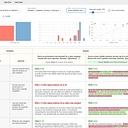
Data as of Aug 25, 2026 · Based on 42 AI responses from ChatGPT Search and Google AI Mode · See how Parse measures this
Your brand can be here too.
Source | Citation share |
|---|---|
 Synthetic Users — User research at the speed of AIhttps://www.syntheticusers.com/ | 4.1% |
Synthetic Usershttps://syntheticusers.io/ | 2.8% |
Crowdihttps://www.crowdi.org/ | 2.1% |
 Salesforce reveals digital twin for business ops so your business can test AI agents before deploymenthttps://www.techradar.com/pro/salesforce-reveals-digital-twin-for-business-ops-so-your-business-can-test-ai-agents-before-deployment | 2.1% |
 How Synthetic Customers Bring Companies Closer to the ...https://www.bain.com/insights/how-synthetic-customers-bring-companies-closer-to-the-real-ones/ | 1.9% |
 Synthetic Users Explained: Top 7 AI User Research Tools - AIMultiplehttps://aimultiple.com/synthetic-users | 1.7% |
Crowdihttps://www.crowdi.org/ | 1.5% |
 From training to trust: Why CX needs an AI simulation layerhttps://www.liveperson.com/blog/why-cx-needs-ai-simulation/ | 1.5% |
Synthetic Users — User research at the speed of AIhttps://www.syntheticusers.com/ | 1.5% |
 Testing AI Agents With Synthetic Datahttps://www.youtube.com/watch | 1.5% |
Companies providing synthetic users and simulated workflows to evaluate digital products, marketing, and customer experience (CX) systems before launching include specialized AI startups, established customer service software companies, and product analytics platforms.
These solutions fall into three main categories based on whether you are testing digital products, customer service bots, or complex consumer behaviors.
These platforms simulate individual user personas interacting with websites, mobile applications, or draft user flows to flag bugs and user experience issues.
If your "agents" are customer service bots, voice assistants, or automated chat agents, these platforms simulate thousands of customer interactions to look for hallucination, tone issues, or workflow failures.
For massive multi-user workflows, enterprise deployments, or macro-level testing, these companies build interconnected agent networks.
Are you looking to test AI customer-service agents processing text/voice inputs, or are you looking to test human user journeys through a new software interface? Let me know so I can suggest the exact architecture or platform category for your deployment.
Yes. There’s a rapidly emerging category around synthetic users, agent simulation, and pre-production workflow testing. The companies differ in whether they simulate the user, the environment/tools, or both.
| If you want to… | Look at |
|---|---|
| Simulate thousands of realistic users | Toyon |
| Test an agent doing a real business workflow end-to-end | Veris |
| Test customer-support conversations | Lorikeet, AgentBrains, Syntrix |
| Test a website/product with browser-based users | Synthetic Users, Moveo One |
| Test voice agents | Quraite, Toyon, Synthflow |
| Simulate APIs/tools/systems around the agent | Veris, Arga Labs, AWS ToolSimulator |
| Have a major cloud/enterprise platform do it | Google Cloud, IBM |
The key distinction is that "synthetic users" is actually two markets: synthetic research participants who tell you whether a product is usable, and synthetic adversarial/goal-directed users who actively operate an agent and try to make its workflow fail. The latter is much closer to what I think you're describing.
If you're evaluating this as a competitive landscape for a startup/product idea, I can also map ~20 companies by synthetic user → environment simulation → agent eval → observability, including funding, customers, pricing, and what each one actually simulates.
Testing AI agents before launch requires moving beyond static, manually written test cases. Because agents handle multi-turn conversations, make tool calls, and exhibit complex reasoning, platforms use LLM-powered synthetic users and dynamic workflow simulations to stress-test them.
Key companies and platforms providing synthetic user simulation and agent-testing infrastructure include:
If you'd like to narrow this down, let me know:
I can help recommend the best fit for your stack.
Yes. There’s a growing category around synthetic users, simulated customers, and agent simulation/evaluation. The important distinction is whether the company is simulating your end users interacting with your agent versus simply testing the agent’s output.
| Company | What it simulates | Particularly useful for |
|---|---|---|
| syntheticusers.io | AI personas that operate your product in a real browser | Pre-launch UX/workflow testing |
| marketrix.ai | Large populations of AI personas using real products and flows | Simulated users, QA, A/B testing, pre-launch validation |
| agent-brains.com | Synthetic users that interact with AI agents | Testing conversational/support agents before and after launch |
| mimiqai.com | Synthetic users navigating sites and workflows in browsers | Developer-oriented workflow testing; particularly interesting because it exposes an MCP integration |
| langwatch.ai | Simulated multi-turn users interacting with agents | Agent evals, regression testing, tool-call/trajectory analysis |
| getmaxim.ai | Simulated conversations and evaluation scenarios | Enterprise agent testing and observability |
| cekura.ai | Simulated callers/users for voice agents | Voice/contact-center agents |
| moveo.ai | Synthetic users calibrated against behavioral cohorts | Testing agent/product changes against modeled real-user behavior |
Synthetic Users explicitly runs AI agents as fake users against a staging URL, with personas pursuing goals through real Chromium sessions and returning reports/screenshots.
Marketrix is broader: it describes millions of AI personas operating real products in browsers, and combines simulated-user research with simulated A/B testing and self-operating QA.
For AI-agent-specific testing, the emerging distinction is important: platforms such as LangWatch and Maxim simulate users talking to your agent and score the resulting trajectories, while synthetic-user products such as Synthetic Users and Marketrix can actually drive the surrounding product/workflow.
I'd divide the market into three buckets:
The interesting opportunity is #3 combined with #1: rather than testing an agent with a fixed set of scripted evals, generate diverse synthetic customers, give each a goal, let them interact with the agent and the actual application, and evaluate whether they successfully accomplish the goal. That gets much closer to "Would this agent actually work in production?"
One caveat: synthetic users are still best treated as a pre-launch signal rather than a substitute for real users. Independent reviews of the category note that the strongest current use is hypothesis generation and early testing, with limited independent validation of how well synthetic behavior predicts real people.
For AI-agent-specific testing, the emerging distinction is important: platforms such as LangWatch and Maxim simulate users talking to your agent and score the resulting trajectories, while synthetic-user products such as Synthetic Users and Marketrix can actually drive the surrounding product/workflow.
I'd divide the market into three buckets:
Testing AI agents and LLM workflows via synthetic user simulation has become a standard pre-launch practice . Companies and open-source ecosystems providing simulation engines, evaluation platforms, and synthetic user generators generally fall into a few clear categories:
If you're looking to integrate one of these into your stack, tell me:
I can help you narrow down the best fit.
Yes. There’s a growing category here, but it splits into three somewhat different approaches: synthetic end-users testing your product, simulated users testing an AI agent, and full environment simulation/digital twins.
| Company | What it simulates | Best fit |
|---|---|---|
| Synthetic Users | AI personas operating a real browser against staging/live products | Pre-launch UX and workflow testing |
| Marketrix | Large populations of AI users with different personalities/behaviors | Testing product flows at synthetic-user scale |
| AgentBrains | Synthetic users that interact with and stress-test AI agents | Specifically testing agents before/after launch |
| Crowdi | Thousands of autonomous AI users exploring an application | Broad product/workflow coverage before launch |
| Mimiq AI | Synthetic personas navigating flows; can be invoked by coding agents | Agent-built products and automated pre-launch testing |
| Moveo One | Behavioral models calibrated against real user cohorts | Predicting how existing users will behave after a change |
| Veris AI | Simulated copies of systems, APIs, data and users | Enterprise agent benchmarking and end-to-end simulation |
| LivePerson Syntrix | Simulated customer interactions across channels and systems | Contact-center/customer-service agents |
| IBM watsonx Orchestrate | LLM-based simulated users having multi-turn conversations with an agent | Enterprise conversational-agent evaluation |
| Google Cloud Gemini Enterprise Agent Platform | Generated scenarios + LLM role-playing as users | Building agent eval suites without production data |
A particularly interesting distinction is Veris: rather than merely inventing personas, it describes a simulated copy of your systems, data, APIs and users, allowing agents to operate against a production-like environment before touching production.
For a simpler “pretend to be 100 different customers and actually use my product” model, Synthetic Users and Marketrix are probably the closest matches. Synthetic Users explicitly runs AI agents in real Chromium sessions against staging URLs, with personas and user goals, then returns transcripts, screenshots and qualitative reports. docs.syntheticusers.io Marketrix similarly positions itself around millions of synthetic users exploring real products in real browsers before launch.
For testing the agent itself, rather than the UX around it, AgentBrains, IBM, Google and LivePerson are more directly relevant. IBM, for example, lets an AI-powered user simulator interact with a draft agent through multi-turn test cases before deployment. www.ibm.com Google has recently added a similar simulation workflow that automatically generates test scenarios and role-plays users to stress-test multi-turn agent logic.
OpenAI's Deployment Simulation research is also highly relevant conceptually. OpenAI describes replaying realistic historical conversations against a candidate model before deployment and extending the approach to agentic trajectories involving tool use. That's more of a pre-deployment evaluation methodology than a standalone commercial synthetic-user product.
I'd divide the market roughly like this:
Synthetic end-users → Synthetic Users, Marketrix, Crowdi, Mimiq
Synthetic users specifically for agents → AgentBrains, IBM, Google, LivePerson
Behavioral/digital twins → Moveo One, Veris
General agent-evaluation platforms → LangWatch, Maxim, Galileo, Braintrust, etc.
The interesting whitespace is “synthetic users that execute realistic business workflows against an agent's tools and backend—not just browser UX or chat conversations.” Veris is especially close to that direction.
If you tell me whether you're researching this as a buyer, competitor, or startup opportunity, I can also build a more detailed 15–30 company landscape with funding, pricing, customers, underlying simulation approach, and what each one actually tests.
Maxim
Testing AI agents and multi-turn conversational workflows using simulated users (often called "user simulators" or "synthetic customers") is a fast-growing area in AI engineering . Instead of relying solely on static test sets, these platforms spin up LLM-powered agents to roleplay as users, stress-test tool calls, and run automated evaluations.
The top platforms and companies providing synthetic user simulation and workflow testing for AI agents include:
simulated-user provider designed for multi-turn conversation testing. It is optimized for evaluating complex function-calling agents, virtual assistants, and chat interfaces against realistic, dynamic user paths.ActorSimulator within its evaluation suites to facilitate multi-turn, goal-driven user simulations that interact adaptively with deployed conversational agents to calculate success rates.syntheticusers.com), Uxia , and Brox.ai specialize in simulating broader target audience behavior, UX navigation, and qualitative interviews to catch design or workflow friction early.Are you looking to test a text/chat assistant , a voice agent , or an autonomous agent with tool/API access ? Let me know so I can recommend the most relevant integration setup.

Uxia
uxia.app

Maxim AI
getmaxim.ai

Yes. There’s a growing category around pre-deployment agent simulation: synthetic users, simulated customers, and simulated environments that exercise an agent before real users do.
| Company | What it simulates | Best fit |
|---|---|---|
| Converra | Personas derived from production conversations; multi-turn conversations against agent variants | Customer-support / conversational agents |
| Arato | Dynamic synthetic users with goals and characteristics mapped to business workflows | Enterprise agent testing |
| Pipelines | Simulated real-world environments for agents, including tool use and operational workflows | General-purpose agent readiness |
| Arklex / ArkSim | Synthetic users conducting multi-turn conversations and evaluating each turn | Framework-agnostic agent testing |
| Agent Scrimmage | Thousands of simulated customer scenarios, including edge cases and multi-step workflows | Stress-testing customer-facing agents |
| LivePerson / Syntrix | Synthetic customers interacting with AI/live agents across channels | Contact centers / CX |
| IBM watsonx Orchestrate | AI-powered user simulator that interacts with draft agents using predefined test cases | Enterprise agent QA |
| Google Cloud Agent Platform | LLM-generated scenarios + simulated users to stress-test multi-turn agents | Developers already on Google Cloud |
| Synthflow | Simulated conversations and automated test suites for voice agents | Voice AI |
| Synthetic Users | Autonomous synthetic users navigating actual product flows | Product/UX + agentic workflows |
| Moveo One | Behavior-calibrated synthetic users based on real user cohorts | Testing whether users will actually complete a workflow |
| Crowdi | Large populations of AI users exploring staging/prototype environments | End-to-end product testing |
A few are particularly close to what I'd call "synthetic users for agents" rather than conventional LLM evals.
Converra explicitly creates personas from production data and runs full multi-turn conversations against agent changes, with regression detection before deployment.
Arato generates scenarios based on the organization's workflows and business goals, then creates simulated users with different characteristics, intents, and goals.
Pipelines is positioning itself specifically as a pre-deployment simulation layer: agents operate in simulated real-world environments so teams can determine where they fail before production.
ArkSim is interesting if you want something more infrastructure/framework-oriented: it generates the test users and multi-turn conversations rather than requiring you to assemble a large test dataset yourself.
And LivePerson's Syntrix is one of the more mature enterprise/CX examples: it simulates customer interactions, handoffs, guardrails, and edge cases in a pre-production environment.
I'd separate the market into:
Synthetic-user testing of the actual product
Synthetic customers testing conversational agents
Simulated environments for autonomous/tool-using agents
The market is moving beyond traditional LLM evals (e.g. "did the agent give the right answer?") toward trajectory/workflow simulation:
synthetic user → agent → tools → environment → outcome
That's important because an agent can pass hundreds of prompt-level evaluations while still failing when a user changes their mind on turn 7, a tool returns an unexpected result, or the workflow gets into an unusual state. Google explicitly describes its simulation approach as generating scenarios and role-playing users to stress-test multi-turn logic.
OpenAI is also using a related approach internally: its 2026 Deployment Simulation work replays realistic contexts and extends the technique to agentic coding deployments with simulated tools and trajectories.
If you're evaluating this as a market/category, I'd put Pipelines, Converra, Arato, ArkSim, Agent Scrimmage, Syntrix, and Moveo One on the first competitive landscape, then treat Google/IBM/Microsoft as platform competitors rather than startups. Microsoft, for example, now explicitly supports Agent → Full conversations → Simulated data as a pre-deployment evaluation mode.
If you tell me whether you're looking at this as a buyer, founder, or investor, I can narrow this to the 5–10 most relevant companies and compare funding, customers, pricing, simulation depth, integrations, and differentiation.
Sentia Labs
Testing AI agents and multi-step workflows before launch relies on specialized simulation and evaluation platforms that generate synthetic user personas, inject adversarial edge cases, and run automated multi-turn dialogues.
The key companies and platforms providing synthetic user simulation and workflow testing for AI agents include:
If you share what type of agent you are building (e.g., customer support, data analyst, voice assistant, or code copilot) and your preferred tech stack , I can recommend which of these platforms best matches your testing requirements.
Yes. There’s a rapidly forming market around synthetic users, agent simulation, and pre-production workflow environments. The important distinction is whether you want to test the agent itself, or test your product/workflow with simulated users.
| Company | What it simulates | Best fit |
|---|---|---|
| Converra | Synthetic personas generated from production conversations; multi-turn agent interactions | Testing customer-facing agents before deployment |
| Arklex / ArkSim | Synthetic users conducting multi-turn conversations and evaluating every turn | General-purpose agent readiness / CI testing |
| Agent Scrimmage | Thousands of realistic scenarios, including angry users, edge cases, compliance traps and multi-step tasks | Stress testing / red teaming |
| Noveum / NovaSynth | Synthetic voice/text users with personas and scripted/adversarial scenarios | Voice + chat agents |
| LivePerson Syntrix | Simulated customer interactions across channels, including handoffs and edge cases | Enterprise contact-center agents |
| Synthflow | Automated simulated conversations against voice agents | Voice-agent regression testing |
| Microsoft Foundry | LLM-generated simulated users/test scenarios for full agent conversations | Enterprise agent evaluation |
| Google Gemini Enterprise Agent Platform | Generates scenarios and roleplays users to stress-test multi-turn agents | Developer/enterprise agent evaluation |
Microsoft explicitly recommends Agent → Full conversations → Simulated data for testing end-to-end behavior before deployment. Google's platform similarly generates test specs and has an LLM roleplay the user.
AgentGYM is particularly interesting. Rather than merely generating fake prompts, it creates production-faithful sandbox copies of SaaS applications—Gmail, Salesforce, Slack, GitHub, Zendesk, Linear, Notion, etc.—so agents can execute workflows against realistic state and edge cases without touching production.
Similarly, BrowserGym Foundry provides reproducible browser environments where agent actions are tracked and evaluated, with an emphasis on long-horizon web-agent tasks.
If by "synthetic users" you mean AI users that actually navigate your product, rather than users talking to an agent:
There are roughly four categories emerging:
Synthetic-user conversation testing
Converra, ArkSim, Noveum, Syntrix, Agent Scrimmage
Agent/workflow simulation environments
AgentGYM, BrowserGym Foundry
Synthetic users navigating actual products
Synthetic Users, agentiQu, Moveo One
Large-platform agent evaluation
Microsoft Foundry, Google Gemini Enterprise Agent Platform
The interesting gap is #2 + #3 combined: a system where you give it an agent, realistic users/personas, and a complete sandbox of the tools the agent can operate—then it autonomously generates and executes thousands of realistic end-to-end workflows, including adversarial and unexpected behavior, before launch. AgentGYM is closest to the workflow-environment side; Converra/ArkSim are closer to the synthetic-user/evaluation side.
If you're evaluating this market for a startup/product idea, I can also give you a competitive landscape of ~20 companies, with funding, customers, pricing, simulation depth, and what each one is missing.