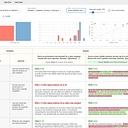
Data as of Aug 25, 2026 · Based on 38 AI responses from ChatGPT Search and Google AI Mode · See how Parse measures this

Your brand can be here too.
Source | Citation share |
|---|---|
 5 best AI evaluation tools for AI systems in production (2026) - Articles - Braintrusthttps://www.braintrust.dev/articles/best-ai-evaluation-tools-2026 | 3.9% |
 Evaluation best practices | OpenAI APIhttps://developers.openai.com/api/docs/guides/evaluation-best-practices | 2.8% |
 Top 5 Agent Evaluation Tools in 2026 - MLflowhttps://mlflow.org/top-5-agent-evaluation-frameworks/ | 2.0% |
9 LLM evaluation & testing tools compared (2026) | Rhesis AI Bloghttps://rhesis.ai/post/best-llm-evaluation-testing-tools | 2.0% |
8 best human-in-the-loop LLM evaluation platforms in 2026https://www.braintrust.dev/articles/best-human-in-the-loop-llm-evaluation-platforms-2026 | 2.0% |
 LangSmith: AI Agent & LLM Model Evaluation Platformhttps://www.langchain.com/langsmith/evaluation | 1.7% |
 What are the best platforms for AI evaluations? (agent, model, voice, ...https://www.reddit.com/r/LLMDevs/comments/1nofqco/what_are_the_best_platforms_for_ai_evaluations/ | 1.7% |
 Top 5 LLM Evaluation Frameworks in 2026, Comparedhttps://deepeval.com/blog/top-5-llm-evaluation-frameworks | 1.4% |
 7 Best LLM Eval Platforms Compared | Galileohttps://galileo.ai/blog/best-llm-eval-platforms-compared | 1.4% |
 Best AI Agent Evaluation Tools for Production Teams (2026)https://www.augmentcode.com/tools/best-ai-agent-evaluation-tools | 1.4% |
If your main job is building eval datasets + scoring model/app quality, my default pick is Braintrust.
| Platform | Best for | Dataset workflow | Scoring/evals | Production |
|---|---|---|---|---|
| Braintrust | Eval-first teams | ⭐⭐⭐⭐⭐ | ⭐⭐⭐⭐⭐ | ⭐⭐⭐⭐⭐ |
| LangSmith | LangChain/LangGraph teams | ⭐⭐⭐⭐⭐ | ⭐⭐⭐⭐⭐ | ⭐⭐⭐⭐⭐ |
| Arize Phoenix | Open-source / observability | ⭐⭐⭐⭐ | ⭐⭐⭐⭐ | ⭐⭐⭐⭐⭐ |
| Langfuse | Open-source, broad stack | ⭐⭐⭐⭐ | ⭐⭐⭐⭐ | ⭐⭐⭐⭐ |
| Humanloop | Human feedback + eval workflows | ⭐⭐⭐⭐⭐ | ⭐⭐⭐⭐ | ⭐⭐⭐⭐ |
Braintrust treats the evaluation itself as the central object: dataset → task → scorers → experiment → comparison. You can create datasets in the UI or import CSV/JSON, build scorers, run experiments, compare model/prompt versions, and run repeated trials to measure variance.
It also has a particularly nice loop for production AI:
production traces → interesting failures → dataset → eval → CI regression test → production monitoring
That makes it strong if you're trying to build a serious evaluation system rather than simply inspect LLM traces.
Pick LangSmith if you're already heavily invested in LangChain/LangGraph. Its dataset/eval workflow is excellent: datasets can come from curated cases, production traces, or synthetic data; evaluators can be human, deterministic code, LLM-as-judge, or pairwise; and production failures can be fed back into datasets.
It's probably the better all-in-one agent development + tracing + evaluation platform.
I'd frame it this way:
One important caveat: the platform matters less than the quality of your eval set and graders. A 200-example dataset with well-defined failure modes and calibrated graders will generally tell you more than a sophisticated platform running 10 vague examples. LangSmith's own guidance, for example, recommends starting with manually curated examples of what "good" looks like for each critical component.
If you tell me what you're evaluating—e.g. RAG, agents, chatbots, coding models, or model-vs-model benchmarks—I can give you a much more specific recommendation and a suggested eval-stack architecture.
It also has a particularly nice loop for production AI:
production traces → interesting failures → dataset → eval → CI regression test → production monitoring
That makes it strong if you're trying to build a serious evaluation system rather than simply inspect LLM traces.
Pick LangSmith if you're already heavily invested in LangChain/LangGraph. Its dataset/eval workflow is excellent: datasets can come from curated cases, production traces, or synthetic data; evaluators can be human, deterministic code, LLM-as-judge, or pairwise; and production failures can be fed back into datasets.
It's probably the better all-in-one agent development + tracing + evaluation platform.
There is no single "best" platform, as the right choice depends on your team's workflow, data privacy requirements, and whether you prefer an open-source or enterprise SaaS solution. Braintrust and LangSmith lead for collaborative dataset building and rapid iteration, while open-source tools like Arize Phoenix and MLflow excel at tracing and scoring complex agentic systems.
| Platform | Best For | Core Strengths |
|---|---|---|
| Braintrust | Collaborative dataset curation & enterprise scaling | Production trace-to-eval workflows, fast UI, flexible self-hosting/hybrid options |
| LangSmith | Tightly integrated LLM app development loops | Seamless debugging, prompt playground, and robust LLM-as-a-judge scoring |
| Arize Phoenix | Open-source RAG & embedding evaluation | Deep integration with Phoenix for local/enterprise tracing, evaluation metrics, and visualization |
| MLflow | Full execution trace and multi-step agent evaluation | Evaluating complex reasoning chains, tool calls, and governance in open-source setups |
Key Platforms Breakdown
To help narrow down the ideal platform, tell me:
If your core job is building eval datasets and using them to score/compare model quality, my pick is braintrust.dev.
It is unusually eval-first: versioned datasets, custom/LLM/human scorers, side-by-side experiments, production examples feeding back into datasets, and quality gates. Its current product positioning explicitly centers on running experiments against real datasets and scoring outputs with code, LLMs, or humans.
| Platform | Best for | My take |
|---|---|---|
| Braintrust | Eval datasets → experiments → scoring → CI gates | Best overall for your use case |
| LangSmith | LangChain/LangGraph apps + evals | Best if you're already deep in that ecosystem |
| Langfuse | Open-source/self-hosted eval + observability | Best if data control matters |
| Arize Phoenix | OpenTelemetry + production observability + eval primitives | Great platform-oriented choice |
| DeepEval | Code-first/pytest-style evals | Best if you want evals primarily in your repo |
The important distinction is evaluation workflow vs. observability.
For model quality, you want something like:
golden dataset → model/prompt version → scorers → experiment → slice results → human review → regression test → CI gate
Braintrust is designed around essentially that loop.
LangSmith is a very close second. It has excellent dataset management, offline evaluations, LLM-as-judge, human review, pairwise comparisons, and production traces that can be turned back into datasets. Docs by LangChain LangChain If you're using LangChain/LangGraph, I'd probably choose it over Braintrust.
Langfuse is the one I'd investigate if you want an open-source/self-hostable stack; current comparisons consistently position it as the strongest open/self-hosted alternative.
The platform matters less than your dataset and evaluator design. A sophisticated dashboard with a bad eval set will give you very convincing nonsense. I'd prioritize:
LangSmith's evaluation docs make the same basic architecture explicit: dataset + target application + evaluators, followed by experiments and comparison.
Bottom line: If you tell me whether you're evaluating base models, RAG, agents, or a production LLM application, I can give you a much more specific recommendation—including Braintrust vs LangSmith vs Langfuse vs DeepEval and what I'd actually build.
The important distinction is evaluation workflow vs. observability.
For model quality, you want something like:
golden dataset → model/prompt version → scorers → experiment → slice results → human review → regression test → CI gate
Braintrust is designed around essentially that loop.
LangSmith is a very close second. It has excellent dataset management, offline evaluations, LLM-as-judge, human review, pairwise comparisons, and production traces that can be turned back into datasets. If you're using LangChain/LangGraph, I'd probably choose it over Braintrust.
Langfuse is the one I'd investigate if you want an open-source/self-hostable stack; current comparisons consistently position it as the strongest open/self-hosted alternative.
Choosing the "best" platform for building evaluation datasets and scoring model quality depends heavily on your team's workflow, whether you prefer open-source flexibility or enterprise-grade CI/CD integration, and how much you rely on human-in-the-loop validation.
The top platforms are categorized below by their primary strengths:
If you share your primary use case (e.g., RAG, complex agents, or creative generation) and whether you prefer an open-source or managed enterprise tool , I can recommend the exact platform that fits your stack.
There is no single "best" platform for building evaluation datasets and scoring model quality because different tools are optimized for distinct workflows, team sizes, and tech stacks . The top platforms excel in specific areas:
To help narrow down the ideal platform, tell me:
If your goal is specifically “build eval datasets + score model quality + compare models/prompts over time,” my top pick is Braintrust.
| Platform | Best for | Dataset workflow | Scoring | My take |
|---|---|---|---|---|
| Braintrust | Dedicated eval engineering | ⭐⭐⭐⭐⭐ | ⭐⭐⭐⭐⭐ | Best overall |
| LangSmith | Agent/app teams already in LangChain ecosystem | ⭐⭐⭐⭐⭐ | ⭐⭐⭐⭐⭐ | Best for agents + tracing |
| Arize Phoenix | Open-source / observability-heavy teams | ⭐⭐⭐⭐½ | ⭐⭐⭐⭐⭐ | Best OSS option |
| DeepEval | Code-first Python evals | ⭐⭐⭐⭐ | ⭐⭐⭐⭐⭐ | Best developer-centric framework |
Braintrust has a particularly clean mental model: dataset → task → scorers → experiment. Datasets are versioned, can be populated from production data, user feedback, or manual curation, and can be pinned to specific versions for reproducible evaluations.
Its scoring system supports three useful levels:
The really important part is the experiment workflow: runs are immutable snapshots, so you can compare model/prompt versions and identify exactly which test cases improved or regressed. It also supports CI/CD regression checks.
That makes it feel more like “unit testing for AI” than merely an observability dashboard.
LangSmith — I'd choose this if you're building agents, especially with LangGraph/LangChain. It combines offline evals against curated datasets, production/online evals, human annotation, LLM judges, pairwise comparison, and trace-level debugging. It's also framework-agnostic despite its LangChain roots.
Arize Phoenix — strongest choice if open source/self-hosting and observability matter. Phoenix supports datasets from CSV/JSONL/production spans, code and LLM judges, experiments, repetitions, and dataset-level evaluators.
One caveat: the platform is less important than your eval design. A beautifully instrumented platform with weak test cases and an unreliable LLM judge will produce misleading scores. I'd prioritize a platform that lets you build a versioned golden dataset, deterministic checks, LLM judges, human review, and regression comparisons—Braintrust is particularly strong across that whole loop.
If you tell me what you're evaluating (RAG, chatbot, coding model, agents, fine-tuned model, etc.), I can give you a more specific recommendation and a suggested eval-stack architecture.
If your goal is specifically building eval datasets + scoring model quality, my default pick in 2026 is Braintrust.
It is unusually focused on the full eval loop: curate datasets, define/customize scorers, run experiments across models/prompts, compare score deltas, add human review, and put evals into CI. It also lets production failures become new test cases.
| Platform | Best for | My take |
|---|---|---|
| Braintrust | Dedicated evals, datasets, model/prompt comparison | Best overall |
| LangSmith | LangChain/LangGraph + tracing → datasets → evals | Best if you're already in LangChain |
| Arize Phoenix | Open-source/self-hosted eval + observability | Best OSS/enterprise-control option |
| Langfuse | Open-source observability + annotation/evals | Best if self-hosting matters |
| DeepEval | Code-first eval tests / CI | Best developer framework rather than full platform |
| RAGAS | RAG-specific evaluation | Best specialist for retrieval/groundedness |
LangSmith is particularly compelling if you're building agents with LangGraph: it supports curated offline datasets, online production evals, expert feedback, and calibration of LLM-as-judge evaluators.
For a startup/product team: Braintrust
For a LangChain/LangGraph team: LangSmith
For an OSS/self-hosting requirement: Arize Phoenix or Langfuse
For a Python-heavy ML team wanting evals as tests: DeepEval
For RAG: RAGAS + one of the above
One important distinction: don't optimize for the platform's built-in score. The valuable capability is making your own quality definition measurable—e.g. correctness, groundedness, instruction following, tool-call accuracy, safety, and task completion—and validating your LLM judges against human labels.
For that reason, I'd probably start with Braintrust + a 100–500 example “golden” dataset, then add production failures back into the dataset continuously. Recent comparisons also consistently identify Braintrust as particularly strong for eval-first workflows, while LangSmith wins when the workflow is deeply tied to LangChain/LangGraph.
If you tell me what you're evaluating (chatbot, RAG, agents, extraction, coding model, etc.) and your stack, I can give you a much more opinionated choice—including Braintrust vs. LangSmith vs. Arize vs. custom.
There is no single "best" platform because the ideal tool depends heavily on your team's workflow, whether you prefer open-source vs. managed SaaS, and how complex your AI system is (e.g., simple RAG vs. multi-turn autonomous agents).
The top platforms for building evaluation datasets and scoring model quality fall into distinct categories based on your primary needs:
To help narrow down the right choice, tell me:
There is no single "best" platform because the top tools optimize for different workflows (e.g., code-first unit testing vs. production-driven data curation). Selecting the right platform depends on your team's architecture, deployment constraints, and development culture.
The leading platforms for building evaluation datasets and scoring model quality are categorized below by their primary strengths:
To help narrow down the ideal choice, let me know:
If your main goal is building eval datasets and reliably scoring model quality, my current shortlist is:
| Platform | Best for | My take |
|---|---|---|
| Braintrust | Eval-first development, model/prompt comparisons, regression testing | Best overall |
| LangSmith | Agents + LangChain/LangGraph + production tracing | Best if you're in the LangChain ecosystem |
| Arize Phoenix | Open/self-hosted eval + observability | Best if you want control/self-hosting |
| Confident AI / DeepEval | Evaluation-first testing and metric development | Excellent for rigorous test suites |
| Langfuse | Open-source tracing + evals | Strong general-purpose alternative |
For the specific question “I want to create datasets, run models against them, score the outputs, compare versions, and catch regressions”, I'd start with Braintrust.
Its core abstraction is unusually clean:
Dataset → Task → Scorers → Experiment
You can build datasets from manually curated cases, production logs, or user feedback; use LLM-as-judge, built-in evaluators, or custom code; and run experiments that are immutable/comparable. It also supports CI/CD regression testing and production/online scoring.
That's exactly the workflow I'd want for model-quality engineering.
LangSmith — choose this if you're building sophisticated agents, particularly with LangGraph. It has strong dataset management, offline experiments, online evaluation, human review, LLM judges, pairwise comparison, and conversation/multimodal evals.
Phoenix — choose this if self-hosting and observability matter. It combines datasets/experiments with OpenTelemetry tracing, LLM-as-judge, code evaluators, human labels, and production traces.
DeepEval/Confident AI — I'd investigate this if your priority is evaluation methodology itself: defining metrics, regression tests, and systematically finding failure modes. It's particularly attractive if you want the evals to remain close to your code rather than becoming entirely platform-managed.
If by "model quality" you mean benchmarking foundation models—e.g. GPT-5.6 vs Claude vs Gemini on our 2,000 proprietary examples—I'd favor Braintrust or DeepEval/Confident AI.
If you mean evaluating an entire production AI system—retrieval + model + tools + agent behavior + latency + traces—I'd lean LangSmith or Phoenix.
And if you're starting from scratch, I would not optimize primarily for the prettiest dashboard. The important capability is making your eval set a versioned, living regression suite: every production failure should be easy to turn into a test case, and every model/prompt change should be evaluated against the same canonical set.
If you tell me what you're evaluating (chatbot, RAG, coding model, agents, fine-tune, etc.) and roughly how many examples you have, I can give you a much more specific recommendation—and a suggested eval architecture.