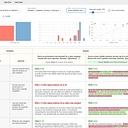
Data as of Aug 25, 2026 · Based on 346 AI responses from ChatGPT Search and Google AI Mode · See how Parse measures this


Brands AI recommends here
Named in 49% of answers
DeepEval — best when you lack labeled data: it synthesizes datasets, provides many built-in scoring metrics for unit/CI testing, and is developer-focused; caveat: requires engineering to integrate into pipelines.
Named in 35% of answers
Named in 34% of answers
Named in 32% of answers
Source | Citation share |
|---|---|
 LLM-as-a-judge: a complete guide to using LLMs for evaluationshttps://www.evidentlyai.com/llm-guide/llm-as-a-judge | 4.3% |
 Best LLM Evaluation Tools: Top 9 Frameworks for Testing AI Models - ZenML Bloghttps://www.zenml.io/blog/best-llm-evaluation-tools | 2.8% |
 LLM as a Judge - Primer and Pre-Built Evaluatorshttps://arize.com/llm-as-a-judge/ | 2.6% |
 LLM as a Judge, What platforms to use? : r/LLMDevshttps://www.reddit.com/r/LLMDevs/comments/1hxkey0/llm_as_a_judge_what_platforms_to_use/ | 2.4% |
 LLM evaluation platform | LLM-as-a-judge testing | Openlayerhttps://www.openlayer.com/products/llm-evaluation | 2.3% |
 LLM-as-a-Judge - Langfusehttps://langfuse.com/docs/evaluation/evaluation-methods/llm-as-a-judge | 1.7% |
 Top 5 Open-Source LLM Evaluation Platforms - KDnuggetshttps://www.kdnuggets.com/top-5-open-source-llm-evaluation-platforms | 1.7% |
Best LLM evaluation platforms 2025 - Articles - Braintrusthttps://www.braintrust.dev/articles/best-llm-evaluation-platforms-2025 | 1.6% |
Top LLM Evaluation Platforms: In Depth Comparison - Reddithttps://www.reddit.com/r/AI_Agents/comments/1pa02zc/top_llm_evaluation_platforms_in_depth_comparison/ | 1.4% |
 7 Best LLM Eval Platforms Compared | Galileohttps://galileo.ai/blog/best-llm-eval-platforms-compared | 1.3% |
The best overall platform for implementing an LLM-as-a-judge when you lack good evaluation data is **[Langfuse](https://langfuse.com/docs/evaluation/evaluation-methods/llm-as-a-judge)** or **[Braintrust](https://www.braintrust.dev/articles/llm-as-a-judge-vs-human-in-the-loop-evals)** . These tools are highly regarded…
The best overall platform for implementing an LLM-as-a-judge when you lack good evaluation data is Langfuse or Braintrust . These tools are highly regarded because they excel at referenceless evaluation —meaning they can evaluate your production logs for semantic relevance, helpfulness, and safety without needing a pre-labeled "ground truth" dataset.
Here is a breakdown of the top platforms tailored specifically to solving your lack of data:
Top Platforms for Referenceless LLM Judges
Comparison of Top Evaluation Platforms
| Platform | Core Strength | Open Source? | Bias Mitigation Built-In? |
|---|---|---|---|
| Langfuse | End-to-end tracing + fully custom rubrics | Yes (Open-core) | Manual configuration required |
| Braintrust | Fast playground iteration & UI scoring | No | Yes |
| Arize Phoenix | Deeply optimized built-in semantic metrics | Yes | Yes |
| DeepEval | Running evaluations inside CI/CD pipelines | Yes | Yes (G-Eval / Arena) |
| Openlayer | Automated bias mitigation (position & length bias) | No | Yes (Automated) |
How to Bootstrap Evals When You Have No Data
To help narrow this down, what type of LLM application are you building (e.g., a RAG chatbot, text summarizer, autonomous agent)? Knowing your tech stack or if you prefer a UI-hosted platform vs. a purely programmatic Python library would also help select the absolute best fit.
If your **main problem is “I don’t have enough labeled evaluation data,”** I’d pick **LangSmith** as the best overall starting point. [smith.langchain.com](https://smith.langchain.com/?utm_source=chatgpt.com) has a particularly good workflow for your situation because it lets you start with **LLM-as-a-judge rather…
If your main problem is “I don’t have enough labeled evaluation data,” I’d pick LangSmith as the best overall starting point.
smith.langchain.com has a particularly good workflow for your situation because it lets you start with LLM-as-a-judge rather than requiring a large ground-truth dataset. You can define a rubric, have an LLM score outputs, inspect failures, and then use human corrections to improve the judge.
| Platform | Best for | Your situation |
|---|---|---|
| LangSmith | Building an eval dataset iteratively | ⭐ Best choice |
| Braintrust | Eval-first teams, experiments + CI/release gates | ⭐⭐⭐ Excellent |
| Arize Phoenix | Open-source/self-hosted + observability | ⭐⭐⭐ Good |
| Langfuse | Open-source, flexible tracing/evals | ⭐⭐⭐ Good |
| Humanloop | Human feedback + eval workflows | Good if humans are central |
The important distinction is that LLM-as-a-judge doesn't magically solve the lack of evaluation data. You still need some notion of what “good” means. But you can bootstrap that much more cheaply than creating thousands of labeled examples.
Start with maybe 50–100 representative real examples, not thousands.
For each example:
LangSmith explicitly supports this human-correction → few-shot-example workflow.
It also supports reference-free judging, which is particularly useful when you don't have ground-truth answers.
I'd not start by asking the judge:
“Is this answer good? Give it a score from 1–10.” That's surprisingly unreliable.
Instead, make the judge evaluate specific dimensions, e.g.:
Then periodically compare the judge against human ratings. The goal isn't merely to get an LLM-generated number; it's to establish that the number correlates with what you actually care about. LangSmith has tooling specifically for auditing and aligning judge scores with human feedback.
If you tell me what you're evaluating (RAG, chatbot, coding agent, customer-support agent, extraction, etc.), I can recommend the specific platform and show you exactly how I'd build the eval when you have almost no labeled data.
Then periodically compare the judge against human ratings. The goal isn't merely to get an LLM-generated number; it's to establish that the number correlates with what you actually care about. LangSmith has tooling specifically for auditing and aligning judge scores with human feedback.
If your main problem is **“I don’t have good evaluation data / ground truth”**, I’d pick **Braintrust** as the best overall platform right now. The important distinction is that you don't actually need a perfect labeled dataset to get started. The better platforms let you: 1. collect real production examples,
If your main problem is “I don’t have good evaluation data / ground truth”, I’d pick Braintrust as the best overall platform right now.
The important distinction is that you don't actually need a perfect labeled dataset to get started. The better platforms let you:
| Platform | Best for | Fit for your problem |
|---|---|---|
| Braintrust | Eval-first workflow + LLM judges + datasets | ⭐⭐⭐⭐⭐ |
| LangSmith | LangChain/LangGraph apps | ⭐⭐⭐⭐⭐ if you're in that ecosystem |
| DeepEval / Confident AI | Code-first/pytest-style evals | ⭐⭐⭐⭐ |
| Arize Phoenix | Open-source + observability | ⭐⭐⭐⭐ |
| Langfuse | Open-source tracing + gradually building evals | ⭐⭐⭐⭐ |
| Galileo | Enterprise-scale specialized evaluation | ⭐⭐⭐½ |
Braintrust is unusually well aligned with the “I don't have evaluation data yet” problem.
Its workflow is essentially:
production traffic → interesting examples → dataset → LLM-as-judge → human review → better dataset → regression evals
It supports LLM-as-a-judge scorers where you define natural-language criteria such as factuality, helpfulness, correctness, etc. You can create them in the UI or code, and then use them against experiments and production traces.
It also supports human review alongside automated evaluation, which is particularly important when you're building your ground truth rather than starting with it.
LangChain's LangSmith is probably the strongest alternative.
Its LLM-as-a-judge system lets you define rubrics, use reference answers when available, and—crucially for your situation—collect human corrections to judge scores and automatically use those corrections as few-shot examples to improve the evaluator.
That's a very nice answer to:
“How do I make an LLM judge reliable when I don't have a good labeled dataset?”
LangSmith also supports production/online evaluation, so you can evaluate real user interactions and turn those into an increasingly useful evaluation corpus.
I wouldn't just throw your application at an LLM judge and trust its score.
If you have no evaluation data, I'd use a small human-calibrated seed set:
The goal isn't to magically eliminate human labeling. It's to make 50 good human judgments leverage into thousands of automated evaluations.
If you tell me what you're evaluating (RAG, chatbot, coding agent, voice agent, extraction, autonomous agent, etc.), I can narrow this down to the 2–3 platforms I'd actually shortlist for your specific case, including which one is best when you have almost zero labeled data.
When you lack a golden dataset, **LLM-as-a-judge** is the standard workaround. Instead of comparing outputs against hard ground truth, you use a robust model (like Claude 3.5 Sonnet or GPT-4o) to grade qualitative dimensions like tone, helpfulness, instruction-following, and factual…
When you lack a golden dataset, LLM-as-a-judge is the standard workaround. Instead of comparing outputs against hard ground truth, you use a robust model (like Claude 3.5 Sonnet or GPT-4o) to grade qualitative dimensions like tone, helpfulness, instruction-following, and factual grounding.
The top evaluation platforms that excel at LLM-as-a-judge workflows and dataset bootstrapping include:
To help narrow down the best fit, tell me:
When you lack good evaluation data, **LLM-as-a-judge** is the standard approach because it allows you to score, rank, and critique open-ended model outputs without needing thousands of pre-labeled "golden" ground truth answers.[](https://www.youtube.com/watch?v=trfUBIDeI1Y)…
When you lack good evaluation data, LLM-as-a-judge is the standard approach because it allows you to score, rank, and critique open-ended model outputs without needing thousands of pre-labeled "golden" ground truth answers.
The "best" platform depends heavily on your workflow—whether you want a code-first Python testing library, an open-source self-hosted stack, or an all-in-one enterprise dashboard.
Top LLM-as-a-Judge Platforms
Pro-Tips for LLM-as-a-Judge When You Have No Data
Since you don't have good baseline evaluation data, your LLM judge needs extra structural help to avoid becoming noisy or biased:
To help narrow down the ideal choice, let me know:
If your main problem is **“I don't have enough labeled evaluation data”**, I’d pick **Braintrust** as the best overall platform right now. ### My ranking 1. **[braintrust.dev](https://www.braintrust.dev/?utm_source=chatgpt.com) — best overall for your situation**
If your main problem is “I don't have enough labeled evaluation data”, I’d pick Braintrust as the best overall platform right now.
An LLM-as-a-judge doesn't solve the “no evaluation data” problem by itself.
The really valuable capability is:
Production data → sample representative cases → LLM judge → human review of a subset → calibrated judge → growing gold dataset That's the loop I'd optimize for.
For example, suppose you have 10,000 historical customer conversations but only 50 manually labeled examples. You can:
10,000 production examples
          ↓
   sample 500 cases
          ↓
    LLM-as-a-judge
          ↓
   50–100 human reviews
          ↓
 compare judge vs humans
          ↓
 refine judge criteria/prompt
          ↓
    automated evaluation
          ↓
 continuously add difficult cases
This is much more useful than simply buying a platform with 50 different evaluation metrics.
For your specific problem, I'd probably start with Braintrust and LangSmith head-to-head. Current comparisons also put Braintrust ahead when the primary workflow is structured evaluation/experimentation, while LangSmith has an advantage when production traces, agent debugging, and human calibration are central.
If you tell me what you're evaluating (chatbot, RAG, coding agent, customer support, extraction, etc.) and roughly how many production examples you have, I can tell you which one I'd choose and how I'd bootstrap the eval dataset.
If your core problem is **“I don’t have enough labeled evaluation data,”** I’d look first at **LangSmith**. [LangSmith](https://www.langchain.com/langsmith/evaluation?utm_source=chatgpt.com) is particularly well suited because it lets you use an **LLM-as-a-judge to bootstrap evaluation**, while also giving you a path…
If your core problem is “I don’t have enough labeled evaluation data,” I’d look first at LangSmith.
LangSmith is particularly well suited because it lets you use an LLM-as-a-judge to bootstrap evaluation, while also giving you a path toward collecting the human labels you’re currently missing. It supports both offline evaluations on datasets and online evaluation of production traces.
The important distinction is that you don't need a gold-standard answer for every example.
You can define a rubric such as:
“Score the response 1–5 for factual correctness, completeness, and usefulness. Explain the score.”
LangSmith can then have an LLM judge your outputs according to that rubric. It supports reference-free judges for things like helpfulness, clarity, tone, and coherence, as well as reference-based judges when you eventually have ground truth.
More importantly, you can create a human → judge feedback loop:
LangSmith explicitly supports this alignment workflow, including annotation queues and using human corrections to improve the judge. Their docs recommend starting with roughly 20 diverse human-labeled examples rather than needing thousands.
| Platform | My take for your problem |
|---|---|
| LangSmith | ⭐ Best overall if you need to bootstrap eval data with LLM judges + gradually add human labels |
| Braintrust | Excellent alternative; particularly attractive if you want an eval-first developer workflow |
| Arize Phoenix | Great if observability/tracing and open-source infrastructure are priorities |
| Humanloop | Strong for human feedback + LLM evaluation, especially if non-engineers will manage evaluations |
| Patronus AI | Interesting if you want more specialized/prebuilt evaluation capabilities |
| Confident AI / DeepEval | Very good if you want an eval framework you can control programmatically rather than primarily a platform |
The key thing I'd optimize for isn't “which platform has the best LLM judge?” It's “which platform makes it easiest to turn a tiny amount of human feedback into a trustworthy automated evaluator.”
That's why I'd put LangSmith at #1 for your particular problem. It has explicit tooling for auditing judge scores and correcting them, rather than treating the LLM judge as ground truth.
One caveat: don't just run an LLM judge over 10,000 examples and assume the resulting scores are your evaluation dataset. LLM judges have systematic biases. The useful setup is LLM judge → small human sample → measure judge/human agreement → calibrate → scale.
If you tell me what you're evaluating (RAG, agents, customer-support answers, coding agents, extraction, etc.) and roughly how many unlabeled examples you have, I can recommend the platform/workflow much more specifically.
When you don’t have a labeled ground-truth dataset, **LLM-as-a-judge** is the industry-standard way to bootstrap your evaluations. Rather than looking for a single tool, you should pick a platform based on your workflow (code-first vs. UI-driven, open-source vs. managed…
When you don’t have a labeled ground-truth dataset, LLM-as-a-judge is the industry-standard way to bootstrap your evaluations. Rather than looking for a single tool, you should pick a platform based on your workflow (code-first vs. UI-driven, open-source vs. managed enterprise).
The top platforms featuring robust, out-of-the-box LLM-as-a-judge capabilities are categorized below by their strengths:
pytest suite for LLMs. It includes 50+ research-backed, ready-to-use LLM-as-a-judge metrics (such as G-Eval for custom rubrics and GEval/Arena for pairwise comparisons) that run locally or in your CI/CD pipeline.To help narrow down the right choice, tell me:
If your main problem is **“I don't have good evaluation data”**, I’d pick **[Braintrust](https://www.braintrust.dev?utm_source=chatgpt.com)** as the first platform I’d try. The key distinction is that you don't just need an LLM-as-a-judge—you need a platform that helps you **turn messy production examples into an…
If your main problem is “I don't have good evaluation data”, I’d pick Braintrust as the first platform I’d try.
The key distinction is that you don't just need an LLM-as-a-judge—you need a platform that helps you turn messy production examples into an evaluation dataset, then continuously improve that dataset.
| Platform | Best for | Your situation |
|---|---|---|
| Braintrust | Fast eval development + turning production failures into tests | ⭐ Best fit |
| LangSmith | Evals + tracing, especially LangChain/LangGraph | ⭐⭐⭐⭐ |
| Langfuse | Open-source/self-hosted eval + observability | ⭐⭐⭐⭐ |
| Arize Phoenix | Observability + technically sophisticated evals | ⭐⭐⭐ |
| Confident AI / DeepEval | Code-first evaluation framework | ⭐⭐⭐ |
The workflow you want is roughly:
real user interactions → identify bad/good examples → LLM judge → dataset → regression tests → iterate
That's more valuable than simply having a library that says:
“Here's an LLM judge. Give it a prompt and some examples.”
Braintrust is particularly oriented around closing that loop between production traces, datasets, experiments, and evaluations. Its current positioning explicitly emphasizes turning production traces into test cases and using them for regression testing.
So if you currently have little or no labeled eval data, I'd do something like:
That's much better than waiting until you have a pristine human-labeled dataset.
If you're already using LangChain or LangGraph, I'd probably choose LangSmith instead.
LangSmith lets you create datasets from curated examples, historical production traces, or synthetic data, and supports LLM-as-a-judge, human review, code evaluators, and pairwise comparisons.
It also has a nice mechanism for calibrating LLM judges against human feedback, which is especially relevant to your problem.
I'd actually challenge the premise that you need to find an evaluation dataset first.
For most LLM applications, the best evaluation data is your own application's traffic. Public benchmarks often aren't representative of what your users actually ask.
And LLM-as-a-judge isn't magic: judges have biases and can disagree with humans. Research has shown issues such as position, verbosity, and self-enhancement bias, which is why a small amount of human calibration is important.
So I'd optimize for a platform that makes this loop easy:
production data → judge → human calibration → curated eval set → automated regression testing
If you tell me what you're building (e.g. RAG chatbot, coding agent, customer support agent, extraction/classification, etc.), I can tell you which of Braintrust vs. LangSmith vs. Langfuse I'd pick and exactly how I'd bootstrap the first 100 eval cases.
When you don't have good evaluation data (golden datasets), **LLM-as-a-judge** is the exact right strategy to bootstrap your quality loop.[](https://arize.com/guides/llm-as-a-judge/) [[1]](https://arize.com/guides/llm-as-a-judge/) Instead of naming a single "best" platform, the industry has crystallized around a few…
When you don't have good evaluation data (golden datasets), LLM-as-a-judge is the exact right strategy to bootstrap your quality loop.
Instead of naming a single "best" platform, the industry has crystallized around a few category leaders depending on your workflow, budget, and data privacy needs.
The top platforms for LLM-as-a-judge evaluation fall into these distinct categories:
pytest suite for LLMs, letting you script complex LLM-as-a-judge metrics right into your GitHub Actions to block regressions before code merges.A Quick Reality Check on LLM-as-a-Judge
If you lack evaluation data, remember these rules to keep your automated judge honest:
yes/no/insufficient_evidence).To help narrow down which platform fits your situation best, tell me: