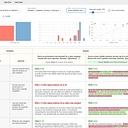
Data as of Aug 25, 2026 · Based on 355 AI responses from ChatGPT Search and Google AI Mode · See how Parse measures this
If your priority is blocking prompt injections and stopping toxic inputs in real time, choose 


Brands AI recommends here
Named in 58% of answers
Best for engineering teams wanting open-source traceability: Langfuse offers traces, session-level observability, and prompt management for debugging, though it’s not a security-only prevention layer.
Named in 35% of answers
Best when you need real-time protection: Lakera Guard focuses on blocking prompt injections, PII leaks, and toxic content, but it’s specialized for security rather than deep evaluation workflows.
Named in 34% of answers
Named in 30% of answers
Best for bias and hallucination testing: Galileo uses targeted, data‑centric evaluations to flag relevance, hallucinations, and demographic bias, but it’s more evaluation-focused than a runtime guard.
Source | Citation share |
|---|---|
LLM Monitoring: The Beginner’s Guide | Lakera – Protecting AI teams that disrupt the world.https://www.lakera.ai/blog/llm-monitoring | 4.8% |
Best LLM monitoring tools in 2026 (tested & reviewed) - Articles - Braintrusthttps://www.braintrust.dev/articles/best-llm-monitoring-tools-2026 | 4.5% |
 10 Best LLM Observability Tools in 2026https://www.truefoundry.com/blog/llm-observability-tools | 4.4% |
 Top 9 LLM Observability Tools in 2025https://logz.io/blog/top-llm-observability-tools/ | 3.3% |
 Datadog vs. Galileo: Best LLM Monitoring Solutionhttps://galileo.ai/blog/datadog-vs-galileo-choosing-the-best-monitoring-solution-for-llms | 2.9% |
 10 Best LLM Monitoring Tools to Use in 2025 (Ranked & Reviewed) - ZenML Bloghttps://www.zenml.io/blog/best-llm-monitoring-tools | 2.7% |
 10 LLM Security Tools to Know in 2025https://www.pynt.io/learning-hub/llm-security/10-llm-security-tools-to-know | 2.6% |
 10 best LLM security tools to use in 2026https://nexos.ai/blog/llm-security-tools/ | 2.3% |
 AI Security Tools: 11 Best for LLM & GenAI in 2026 - Mindgardhttps://mindgard.ai/blog/best-ai-security-tools-for-llm-and-genai | 2.0% |
 10 LLM Observability Tools to Know in 2025 - Coralogixhttps://coralogix.com/guides/llm-observability-tools/ | 2.0% |
Monitoring Large Language Model (LLM) outputs in production for **toxicity, bias, and prompt injection** requires a defense-in-depth strategy. Because these risks span both **input threats** (prompt injections/jailbreaks) and **output liabilities** (toxicity, bias, hallucinations), no single tool does everything…
Monitoring Large Language Model (LLM) outputs in production for toxicity, bias, and prompt injection requires a defense-in-depth strategy. Because these risks span both input threats (prompt injections/jailbreaks) and output liabilities (toxicity, bias, hallucinations), no single tool does everything magically out-of-the-box.
The industry splits these capabilities into Inline Guardrails (which block attacks in real time) and LLM Observability/Evaluation Platforms (which log, trace, and score behavior asynchronously or in production dashboards).
If your primary concern is actively intercepting and blocking prompt injections, toxicity, and bias before they hit the model or reach the user, these are the top contenders:
If you need deep observability to track quality drift, run continuous evaluations, and alert your team when toxic or biased outputs slip past your perimeter:
Which should you choose?
To help narrow down the ideal stack, tell me:
If you want **one tool covering production monitoring + toxicity/bias + prompt-injection detection**, my pick is **Arize Phoenix/Arize** for the observability layer, with **Lakera Guard** added if prompt injection is a serious security concern. ### My ranking Tool | Toxicity | Bias | Prompt injection | Production…
If you want one tool covering production monitoring + toxicity/bias + prompt-injection detection, my pick is Arize Phoenix/Arize for the observability layer, with Lakera Guard added if prompt injection is a serious security concern.
| Tool | Toxicity | Bias | Prompt injection | Production monitoring | Best for |
|---|---|---|---|---|---|
| Arize Phoenix / Arize | ✅ | ✅ custom evals | ✅ guards | ⭐⭐⭐⭐⭐ | Best overall |
| Lakera Guard | ✅ | ◐ | ⭐⭐⭐⭐⭐ | ⭐⭐⭐⭐ | Security/injection |
| Fiddler | ✅ | ✅ | ✅ | ⭐⭐⭐⭐⭐ | Enterprise governance |
| Langfuse | Custom | Custom | Custom | ⭐⭐⭐⭐⭐ | Open-source/self-hosted observability |
| Promptfoo | ✅ | ✅ | ⭐⭐⭐⭐⭐ | ◐ | Red-teaming/testing |
Phoenix is particularly strong because it combines OpenTelemetry-based production tracing with evaluations, experiments, and replay/debugging.
For your exact requirements, I'd architect it as:
User input → prompt-injection guard → LLM → toxicity/bias/output safety evaluators → observability + alerts
The reason I'd separate these is that prompt injection is a runtime security problem, while toxicity/bias are primarily output-quality/safety monitoring problems. Dedicated injection tools such as Lakera are stronger at actively blocking attacks, while observability platforms are better at understanding trends and regressions across production traffic.
Bottom line:
If you tell me whether you're using OpenAI/Anthropic, LangChain, AWS, or Kubernetes, I can give you a concrete recommendation and architecture.
Phoenix is particularly strong because it combines OpenTelemetry-based production tracing with evaluations, experiments, and replay/debugging.
For your exact requirements, I'd architect it as:
User input → prompt-injection guard → LLM → toxicity/bias/output safety evaluators → observability + alerts
If your priority is **production-time monitoring and blocking of toxicity, bias, and prompt-injection attacks**, I’d pick **[galileo.ai](https://galileo.ai/protect?utm_source=chatgpt.com)** as the strongest single tool. ### Why Galileo Protect - **Prompt injection:** detects and blocks prompt attacks before they reach…
If your priority is production-time monitoring and blocking of toxicity, bias, and prompt-injection attacks, I’d pick galileo.ai as the strongest single tool.
| Tool | Best for | My take |
|---|---|---|
| Galileo Protect | Runtime safety + observability | Best single choice for your requirements |
| Lakera Guard | Prompt injection / AI security | Excellent if security is the primary concern |
| Arize Phoenix | Open-source observability + evaluation | Great for tracing and custom evaluators, but you'll likely need a separate runtime security layer |
| Promptfoo | Red teaming / security testing | Excellent for finding vulnerabilities before deployment |
| Braintrust | Evals + production monitoring | Strong general-purpose reliability platform |
Lakera is particularly compelling if prompt injection is your #1 threat: its current Guard offering explicitly covers direct/indirect injection, jailbreaks, malicious documents/URLs, and input/output scanning.
Phoenix is the better choice if your main requirement is open-source observability. It provides OpenTelemetry-based tracing, evaluations, datasets, and production debugging, but it isn't primarily a runtime security firewall.
Bottom line: for “watch every production interaction and intervene when the LLM produces something toxic/biased or an attacker tries prompt injection”, I'd start with Galileo Protect. If you already have a mature observability stack, I'd consider Lakera Guard + your existing observability platform instead.
If you tell me your stack (OpenAI/Anthropic, LangChain/LangGraph, AWS/Azure/GCP, etc.), I can narrow this down to the best 2–3 options and compare price, latency, deployment, and detection coverage.
There is no single "best" tool because production LLM monitoring is split into two distinct operational layers: **Runtime Guardrails** (which actively block threats in real time) and **Observability/Evaluation Platforms** (which trace, log, and audit outputs…
There is no single "best" tool because production LLM monitoring is split into two distinct operational layers: Runtime Guardrails (which actively block threats in real time) and Observability/Evaluation Platforms (which trace, log, and audit outputs asynchronously).
The industry consensus favors a defense-in-depth approach , combining a real-time firewall with an observability backend. Top-tier tools categorized by their strengths include:
If your primary concern is intercepting malicious payloads, PII leaks, and toxic model outputs before they execute or reach the end user, use dedicated security layers:
If your goal is to log production data, track drift, run LLM-as-a-judge evaluations for bias/toxicity, and debug multi-turn chains:
Recommendation Summary
To help narrow down the ideal stack, could you share:
If your requirements are specifically **production monitoring for toxicity + bias + prompt-injection attacks**, I’d pick **[Fiddler AI](https://www.fiddler.ai/?utm_source=chatgpt.com)** as the best *single platform*. ### Why Fiddler - **Toxicity/safety:** Built-in production metrics for toxicity and other safety…
If your requirements are specifically production monitoring for toxicity + bias + prompt-injection attacks, I’d pick Fiddler AI as the best single platform.
| Tool | Toxicity | Bias | Prompt injection | Production monitoring | Best use |
|---|---|---|---|---|---|
| Fiddler | ★★★★★ | ★★★★☆ | ★★★★★ | ★★★★★ | Best all-in-one |
| Arize Phoenix | ★★★★☆ | ★★★★☆ | ★★☆☆☆ | ★★★★★ | Observability/evals |
| Lakera Guard | ★★★★☆ | ★★★☆☆ | ★★★★★ | ★★★★☆ | Security/runtime protection |
| Langfuse | ★★★★☆ | ★★★☆☆ | ★★☆☆☆ | ★★★★★ | Open-source observability |
| Promptfoo | ★★★☆☆ | ★★★★☆ | ★★★★★ | ★★☆☆☆ | Red-team/CI testing |
The important distinction: I wouldn't rely on an observability tool alone for prompt injection. For an attack like prompt injection, you generally want an inline guardrail that can block the request, plus observability that records what happened. Fiddler is attractive because it combines those functions.
If you're already heavily invested in OpenTelemetry, Arize Phoenix is probably the better observability choice; Phoenix is open source, vendor-agnostic, and built around OpenTelemetry/OpenInference.
Bottom line:
Fiddler for one platform covering your three requirements; Fiddler + Lakera if prompt-injection defense is especially security-critical; Phoenix + a dedicated guardrail if you primarily want open observability/evaluation.
There is no single "silver bullet" tool because monitoring LLM outputs for **safety and security** (toxicity, bias, prompt injection) requires combining two slightly different engineering categories: **LLM Observability/Evaluation platforms** (for tracing, scoring, and drift detection) and **Runtime Security/Guardrail…
There is no single "silver bullet" tool because monitoring LLM outputs for safety and security (toxicity, bias, prompt injection) requires combining two slightly different engineering categories: LLM Observability/Evaluation platforms (for tracing, scoring, and drift detection) and Runtime Security/Guardrail tools (for blocking prompt injections in real time).
The industry leans toward specialized platforms depending on whether your primary need is observability/evaluation or active runtime defense.
Recommendation Strategy
Most mature production environments use a two-layer approach:
To help narrow down the best choice, tell me:
There is no single "one-size-fits-all" tool because production monitoring for LLMs is split into two distinct operational needs: **Observability & Evaluation Platforms** (which track behavior, toxicity, and bias over time via logs/traces) and **Runtime Guardrails / Security Gateways** (which intercept and block prompt…
There is no single "one-size-fits-all" tool because production monitoring for LLMs is split into two distinct operational needs: Observability & Evaluation Platforms (which track behavior, toxicity, and bias over time via logs/traces) and Runtime Guardrails / Security Gateways (which intercept and block prompt injections in real time).
The best options on the market depend on whether you need deep logging/analytics or active real-time blocking:
To help narrow down the ideal choice for your architecture, tell me:
If your priority is **production safety monitoring for toxicity, bias, and prompt-injection attacks**, I’d pick **Check Point AI Guardrails (formerly Lakera Guard)** over a general-purpose LLM observability platform. Why: - **Prompt injection:** purpose-built detection for direct and indirect prompt attacks, including…
If your priority is production safety monitoring for toxicity, bias, and prompt-injection attacks, I’d pick Check Point AI Guardrails (formerly Lakera Guard) over a general-purpose LLM observability platform.
Why:
| Tool | Toxicity | Bias | Prompt injection | Production observability | Best for |
|---|---|---|---|---|---|
| Check Point AI Guardrails | ★★★★★ | ★★★★ | ★★★★★ | ★★★★ | AI security & runtime protection |
| Arize AX | ★★★★ | ★★★★★ | ★★★★ | ★★★★★ | Broad LLM eval + observability |
| LangSmith | ★★★★ | ★★★★ | ★★★ | ★★★★★ | Tracing/evals/development |
| Phoenix/Arize OSS | ★★★★ | ★★★★ | ★★★ | ★★★★ | Open-source observability |
One important distinction: bias is more naturally handled as an evaluation problem than as a security/guardrail problem. Arize AX, for example, supports continuous production evaluation, custom metrics, dashboards, and alerts, while also offering runtime guards.
So for a serious production stack, I'd actually use:
Check Point AI Guardrails → runtime security
+ Arize AX/Phoenix → tracing, bias/toxicity evals, quality monitoring
If you want one tool only, I'd choose Check Point AI Guardrails when prompt injection is a major concern; I'd choose Arize AX if your bigger problem is broad LLM quality/evaluation and observability.
If you want **one tool**, I’d pick **Arize Phoenix** for broad production monitoring—but I’d pair it with a dedicated security guardrail for prompt injection. | Tool | Toxicity | Bias | Prompt injection | Production observability | Best for | |---|---|---|---|---|---|
If you want one tool, I’d pick Arize Phoenix for broad production monitoring—but I’d pair it with a dedicated security guardrail for prompt injection.
| Tool | Toxicity | Bias | Prompt injection | Production observability | Best for |
|---|---|---|---|---|---|
| Arize Phoenix | ✅ | ✅ Custom evals | ⚠️ Can evaluate/detect | ⭐⭐⭐⭐⭐ | Overall LLM observability + evals |
| Lakera Guard | ✅ | Limited | ⭐⭐⭐⭐⭐ | ⭐⭐⭐⭐ | AI security / prompt injection |
| Langfuse | ✅ Custom evals | ✅ Custom evals | ⚠️ Custom | ⭐⭐⭐⭐⭐ | Open-source observability |
| LangSmith | ✅ | ✅ | ⚠️ Custom | ⭐⭐⭐⭐⭐ | LangChain-heavy stacks |
Why Phoenix: it combines production tracing with automated evaluations, including LLM-as-a-judge and custom/code-based evaluators. You can run evaluations directly against production traces and use them to detect quality and safety regressions.
But for prompt injection specifically, I'd use Lakera Guard alongside it. Lakera is purpose-built for runtime AI security and can inspect inputs, outputs, retrieved content, attachments, and URLs for direct and indirect prompt injection.
Application → Lakera Guard → LLM → Phoenix tracing/evals → SIEM/alerts
If you're choosing only one: Phoenix for general-purpose LLM production monitoring; Lakera if your primary concern is security/prompt injection.
If you tell me your stack (OpenAI/Anthropic, LangChain, AWS/Azure/GCP, self-hosted, etc.), I can recommend the most appropriate setup and alternatives.
The top-tier platforms for monitoring LLM outputs in production for **toxicity, bias, and prompt injection attacks** are [Galileo AI](https://galileo.ai/) and [Openlayer](https://www.openlayer.com/) , both of which go far beyond basic logging by combining active runtime protection, behavioral checks, and automated…
The top-tier platforms for monitoring LLM outputs in production for toxicity, bias, and prompt injection attacks are Galileo AI and Openlayer , both of which go far beyond basic logging by combining active runtime protection, behavioral checks, and automated mitigation. While general observability tools like Langfuse or Arize AI track tokens and latency, specialized safety and evaluation platforms actively intercept and block vulnerabilities at the API boundary.
| Platform | Primary Strength | Toxicity & Bias Support | Prompt Injection Support | Production Latency / Method |
|---|---|---|---|---|
| Galileo AI | Unified guardrails & low-latency evaluation | Yes (Scored via Luna-2 SLMs) | Yes (Categorization & blocking) | Sub-200ms inline intervention |
| Openlayer | Governance & 100+ prebuilt behavioral tests | Yes (Continuous skew & bias auditing) | Yes (Real-time API boundary blocks) | Real-time policy enforcement |
| Confident AI | Research-backed LLM evals & regression testing | Yes (50+ metrics) | Yes (Adversarial testing suite) | Asynchronous alerting & quality drops |
Key Platform Breakdown
If you can share whether you need inline blocking (preventing toxic outputs before they render) or post-hoc auditing and logging , I can help you pick the right tool for your tech stack.