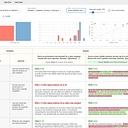
Data as of Aug 25, 2026 · Based on 266 AI responses from ChatGPT Search and Google AI Mode · See how Parse measures this
The best prompt engineering tool depends on your team's workflow and existing tech stack. For teams comfortable with version control workflows, 

Brands AI recommends here
Named in 76% of answers
Best for ease of use and rapid integration via middleware. It provides a visual registry for logging and versioning prompts through a simple SDK. It is less specialized than Git-based or framework-native tools.
Named in 53% of answers
Named in 51% of answers
The definitive choice if your application uses LangChain. It provides full-stack tracing, evaluation, and central prompt management. Its efficacy is highly dependent on your commitment to the LangChain ecosystem.
Named in 38% of answers
Ideal for teams wanting Git-style version control, including branching, commits, and merging. It is best used for secure, managed prompt deployment, though it requires adapting to a Git-based workflow pattern.
Source | Citation share |
|---|---|
 Best Prompt Versioning Tools for Production Teams (2026) - Articles - Braintrusthttps://www.braintrust.dev/articles/best-prompt-versioning-tools-2025 | 5.4% |
 Prompt Management Tools That Actually Make Life Easier | Snippets AIhttps://www.getsnippets.ai/articles/prompt-management-tools | 3.3% |
 8 Best Prompt Engineering Tools in 2026 | Mirascopehttps://mirascope.com/blog/prompt-engineering-tools | 3.2% |
 Any good prompt management & versioning tools out ... - Reddithttps://www.reddit.com/r/LangChain/comments/18rb334/any_good_prompt_management_versioning_tools_out/ | 2.6% |
 10 Best Prompt Engineering Tools for Accurate AI in 2026 - Kanerikahttps://kanerika.com/blogs/prompt-engineering-tools/ | 2.2% |
 9 Best Prompt Management Tools for ML and AI Engineering Teams - ZenML Bloghttps://www.zenml.io/blog/best-prompt-management-tools | 2.1% |
 5 Best Tools for Prompt Versioning - Maxim AIhttps://www.getmaxim.ai/articles/5-best-tools-for-prompt-versioning/ | 2.0% |
 Top Prompt Engineering Tools For Upcoming Yearshttps://www.myidcm.com/blog/prompt-engineering-tools | 2.0% |
7 best prompt management tools in 2026 (tested and compared) - Articleshttps://www.braintrust.dev/articles/best-prompt-management-tools-2026 | 1.9% |
 Top Prompt Engineering Tools to Boost AI Productivity and Workflow Efficiencyhttps://www.sprintzeal.com/blog/prompt-engineering-tools | 1.6% |
To manage, version control, and integrate prompts directly into your app logic without hardcoding them into your codebase , you need an **LLMOps platform with a centralized Prompt Registry and robust…
To manage, version control, and integrate prompts directly into your app logic without hardcoding them into your codebase , you need an LLMOps platform with a centralized Prompt Registry and robust SDKs.
The top industry tools built explicitly for this workflow allow non-engineers to tweak prompts in a UI, assign production/staging labels, and let your app fetch them dynamically with zero-latency client caching.
Top Prompt Engineering & Versioning Tools
production, staging ) in the UI and fetch them via Python/JS/TS SDKs or Vercel AI SDK. Updates happen instantly without redeploying code.How Integration Works (Conceptual Pattern)
Instead of hardcoding a prompt string, your app code queries the provider's SDK using a unique prompt name and environment label:
python```
prompt = langfuse.get_prompt("customer-support-agent")
compiled_prompt = prompt.compile(user_name=user.name, context=user.history)
response = openai.chat.completions.create( model=prompt.config.get("model", "gpt-4o"), messages=[{"role": "user", "content": compiled_prompt}], )
Use code with caution.

To help narrow down the best fit, tell me:

- What is your **primary tech stack** (Python, Node.js/TypeScript, Go)?
- Do you prefer an **open-source/self-hosted** tool or a **managed cloud** service?
Yes. If your key requirements are **prompt versioning + runtime integration with application logic**, I’d shortlist these: Tool | Best fit | Versioning | App integration | Notable strength --- | --- | --- | --- | ---
Yes. If your key requirements are prompt versioning + runtime integration with application logic, I’d shortlist these:
| Tool | Best fit | Versioning | App integration | Notable strength |
|---|---|---|---|---|
| langfuse.com | Engineering-led teams | Versions + labels, staging/prod, rollback | Python, TS/JS, API, OpenAI, Vercel AI SDK, etc. | Open-source/self-hostable + observability |
| promptlayer.com | Prompt-centric product teams | Versions, diffs, release labels, rollback | SDK, REST API, webhooks, GitOps | Strong prompt registry/workflow tooling |
| humanloop.com | Teams with PM/domain-expert involvement | Versioned prompts/flows/tools + rollback | UI, code, APIs, CI/CD | Collaboration + evaluations |
| futureagi.com | Code/CI-oriented teams | Versions + labels | TypeScript/JS + Python SDK | Prompt Workbench designed for programmatic management |
If you're building a production application and want prompts to behave like deployable application artifacts, I'd start with Langfuse. Its prompt management supports immutable versions and labels such as staging and production; your application can fetch a deliberately deployed version rather than having prompt text hardcoded in application logic. It also supports rollbacks and prompt diffs.
The architecture I'd use is:
                  ┌──────────────────────┐
                  │    Prompt Registry   │
                  │                      │
                  │ support-agent        │
                  │ v17 → production     │
                  │ v18 → staging        │
                  └──────────┬───────────┘
                             │
                       SDK / API fetch
                             │
┌──────────────┐      ┌──────▼──────┐      ┌─────────────┐
│ Your app     │─────►│ Prompt      │─────►│ LLM         │
│ business     │      │ + variables │      │ provider    │
│ logic        │      └─────────────┘      └─────────────┘
└──────────────┘
        │
        └──────────────► traces / evals / metrics
For example, your application code can essentially do:
prompt = langfuse.get_prompt(
    "support-agent",
    label="production"
)

messages = prompt.compile(
    customer_name=name,
    issue=issue
)

response = llm.generate(messages)
That gives you a useful separation:
Langfuse also caches prompts in the SDK, so prompt retrieval doesn't put a network request on every LLM call.
Choose PromptLayer if you specifically want a polished prompt registry and a workflow around testing/releasing prompts. It supports versioning, diffs, release labels, rollback, and several integration patterns including direct SDK calls, caching, GitOps/CI/CD, and managed workflows.
Choose Humanloop if prompt development will involve product managers, subject-matter experts, or other non-engineers heavily. It supports UI/code workflows, automatic versioning, evaluations, rollback, and syncing prompt artifacts with your codebase/Git workflow.
Choose Future AGI if you want a more code-first/CI-oriented prompt workflow. Its Prompt Workbench SDK explicitly supports creating, versioning and deploying prompts from TypeScript/JavaScript or Python, including runtime resolution by name/label.
Bottom line: for a typical engineering team, I'd evaluate Langfuse first, then PromptLayer. If you tell me your stack (e.g. Node/TypeScript + OpenAI, Python, Java, etc.) and whether you want Git as the source of truth or a UI, I can narrow it to the best 1–2 options and show exactly how I'd integrate it.
If your main requirements are **prompt version control + direct integration with application logic**, I’d shortlist these: - **[langfuse.com](https://langfuse.com/?utm_source=chatgpt.com) — my top pick.** It gives prompts immutable versions, environment labels like `staging`/`production`, diffs, rollbacks, SDK/API…
If your main requirements are prompt version control + direct integration with application logic, I’d shortlist these:
staging/production, diffs, rollbacks, SDK/API access, and prompt configs that can include model parameters and even tool/function definitions. Langfuse if you want the prompt to become a versioned runtime dependency of your application.
A useful architecture is:
Your app
   │
   ├── fetch "customer-support-agent" @ production
   │
   ▼
Langfuse Prompt Registry
   │
   ├── v17 → staging
   ├── v16 → production
   └── v15 → archived
   │
   ▼
LLM call
   │
   └── trace records exact prompt version
This means your application can reference something stable like customer-support-agent:production rather than embedding the prompt itself. Promoting or rolling back a prompt can then happen without an application redeploy.
A particularly nice feature for app logic is that Langfuse lets you version prompt configuration alongside the prompt—including model settings, structured-output schemas, and tool/function definitions.
It also has GitHub integration if you want prompt changes to participate in your existing CI/CD workflow.
If you tell me your stack (e.g. Python/FastAPI, Node/TypeScript, Java, etc.) and whether you want self-hosted or SaaS, I can narrow this to the best 1–2 options and show exactly how I'd integrate it.
To version control prompts and pull them dynamically into your application logic without hardcoding or redeploying code , you need an **LLM Prompt Registry** . These tools store prompts as immutable versions, assign environment labels (like `production` or `staging` ), and provide SDKs/APIs to fetch them at…
To version control prompts and pull them dynamically into your application logic without hardcoding or redeploying code , you need an LLM Prompt Registry . These tools store prompts as immutable versions, assign environment labels (like production or staging ), and provide SDKs/APIs to fetch them at runtime.
Top production-ready tools that fit this exact use case include:
production label dynamically via Python or JS/TS SDKs).If you'd like to narrow this down, tell me:
To version control prompts and integrate them seamlessly into your app logic without forcing a full code deployment for every text tweak, several specialized **LLMOps and prompt management platforms** fit the bill.[](https://www.youtube.com/watch?v=VboFN06QKUc)…
To version control prompts and integrate them seamlessly into your app logic without forcing a full code deployment for every text tweak, several specialized LLMOps and prompt management platforms fit the bill.
Top tools are categorized below by how they handle versioning and application integration:
These tools let non-engineers or team members edit and version prompts in a web UI , assign production labels , and fetch the active version directly in your code via lightweight SDKs or REST APIs.
production or staging), and fetch them using native backend SDKs. It also links prompts directly to observability traces.production, dev ), side-by-side diffing, and an API/SDK structure that decouples prompt updates from your core codebase.If you prefer your prompts to live inside your existing codebase and repository rather than a third-party SaaS dashboard:
How the Integration Pattern Works
No matter which platform you choose, implementing this architecture generally follows a standard pattern:
summarize-ticket ) in the tool's registry or repo . Assign variables using standard formatting (like {{user_input}}).production.To help narrow down the right choice, tell me:
If you need a **prompt engineering tool that treats prompts like production assets**—with version control, runtime integration, and the ability to update prompts without redeploying your app—look at these categories: | Tool | Best fit | Key capabilities | |---|---|---|
If you need a prompt engineering tool that treats prompts like production assets—with version control, runtime integration, and the ability to update prompts without redeploying your app—look at these categories:
| Tool | Best fit | Key capabilities |
|---|---|---|
| Langfuse | Engineering teams building LLM apps | Prompt registry, versions, labels (dev/prod), SDK integration, tracing prompt versions against application behavior. langfuse.com |
| PromptLayer | Teams wanting a collaborative prompt CMS | Version history, prompt diffs, release labels, analytics, A/B testing, automated evaluations. www.promptlayer.comwww.honeyhive.aidocs.aws.amazon.com |
| HoneyHive | Teams focused on experimentation and evaluation | Shared prompt workspace, automatic versioning, model comparisons, deployment workflows. www.honeyhive.ai |
| Amazon Bedrock Prompt management | AWS-native applications | Prompt versions, variables, variants, testing, and integration into Bedrock workflows. docs.aws.amazon.com |
| Grepture | Developers wanting runtime prompt APIs | Versioned prompts, stable IDs, API fetching, rollback, tracing, and prompt comparison. grepture.com |
| Promptman | Agentic AI workflows | Runtime prompt fetching, environments/stages, version control, REST API, MCP support. promptman.devgrepture.com |
If prompts are part of your application logic (recommended for production apps):
If you want a Git-like workflow: Look for:
A typical integration pattern looks like:
Application code
      |
      | fetch("customer-support-agent", version="production")
      v
Prompt registry
      |
      +-- v1 (old)
      +-- v2 (tested)
      +-- v3 (production)
Your app logic stays stable:
const prompt = promptRegistry.get("support-agent", {
  environment: "prod"
});

const response = llm.chat({
  messages: prompt.render({
    customer_name,
    issue
  })
});
The team can improve the prompt, test it, and promote a new version without changing application code.
For a serious production stack, I’d prioritize:
If you tell me your stack (OpenAI API, Anthropic, AWS Bedrock, LangChain, Vercel AI SDK, Python/Node, etc.), I can narrow this to the best fit.

To version control prompts and integrate them seamlessly into your application logic (decoupling prompt text from code deployments), several specialized LLMOps and prompt management platforms fit this exact…
To version control prompts and integrate them seamlessly into your application logic (decoupling prompt text from code deployments), several specialized LLMOps and prompt management platforms fit this exact workflow.
Top options for managing, versioning, and dynamically fetching production prompts include:
production or staging , and fetch them dynamically via SDKs at runtime without redeploying your application code.Would you prefer an open-source/self-hosted solution (like Langfuse or Promptfoo) or a hosted SaaS platform (like PromptLayer or Braintrust)? Let me know your primary tech stack (Python, Node.js, LangChain, etc.) so I can provide a specific integration code snippet.
If you need **prompt version control + runtime integration with application logic**, you’re looking for a **prompt management platform** (sometimes called a prompt registry or prompt ops platform), not just a prompt playground. Good options to evaluate: | Tool | Best fit | Key capabilities |
If you need prompt version control + runtime integration with application logic, you’re looking for a prompt management platform (sometimes called a prompt registry or prompt ops platform), not just a prompt playground.
Good options to evaluate:
| Tool | Best fit | Key capabilities |
|---|---|---|
| Langfuse | Engineering teams that want open-source control | Prompt storage, versioning, labels/environments, SDK integration, tracing, evaluations. langfuse.com |
| Humanloop | Product teams iterating with engineers | Prompt collaboration, testing, deployment workflows, evaluation tooling |
| PromptLayer | Teams migrating from hardcoded prompts | Prompt registry, version history, request tracking, rollback workflows |
| Helicone | Teams focused on production monitoring | Logging, analytics, prompt experiments, operational visibility |
| HoneyHive | Teams building complex AI systems | Prompt versioning, collaborative workspace, model comparisons, evaluations. www.honeyhive.ai |
| Aisle | Teams wanting prompts as deployable components | Versioned prompts, APIs, workflows, model portability. aisle.shwww.honeyhive.ai |
| PromptVersions | Teams wanting Git-style workflows | Immutable versions, diffs, environments, evaluations, A/B testing. promptversions.com |
A typical architecture would look like:
Your application
      |
      |  getPrompt("customer-support-agent", env="prod")
      |
Prompt management service
      |
      ├── v12 (production)
      ├── v13 (staging experiment)
      └── v14 (draft)
      |
LLM provider (OpenAI / Anthropic / Gemini)
What I’d prioritize:
Runtime fetching
support_agent_v1
SYSTEM_PROMPT = "You are a helpful support agent..."
Environment promotion
Prompt diffs
Prompt + code compatibility
{
  "prompt": "refund_agent",
  "version": 7,
  "required_inputs": [
    "customer_history",
    "order_id"
  ],
  "output_schema": "RefundDecisionV2"
}
Evaluation hooks
My shortlist by scenario:
If you’re already using a stack (Node/Python, OpenAI SDK, LangChain, React app, Kubernetes, etc.), the best choice changes quite a bit.
Yes. What you want is less a “prompt engineering playground” and more a **prompt management / deployment platform**: prompts should be versioned independently, fetched by your application at runtime, and tied to the exact version/configuration that produced an output. ### My shortlist | Tool | Best fit | Why |
Yes. What you want is less a “prompt engineering playground” and more a prompt management / deployment platform: prompts should be versioned independently, fetched by your application at runtime, and tied to the exact version/configuration that produced an output.
| Tool | Best fit | Why |
|---|---|---|
| Langfuse | Engineering-heavy teams / open source | Versioned prompts, labels such as staging/production, SDK retrieval, rollback, diffs, and versioned model/tool configuration. langfuse.comlangfuse.com |
| Braintrust | Best all-around production workflow | Prompt versioning plus evaluations, tracing, CI/CD quality gates, and production monitoring. www.braintrust.dev |
| Humanloop | Product + engineering collaboration | Visual prompt editing, version history/rollback, evaluations, and integration with Git/CI/CD. humanloop.com |
| PromptLayer | Primarily prompt CMS/versioning | Good choice if the central requirement is letting people manage and iterate on prompts without treating every edit as an application deployment. www.braintrust.dev |
My default recommendation: Langfuse if your team is engineering-oriented and you value open source/self-hosting. It explicitly supports decoupling prompt changes from application deployments: your app retrieves the selected prompt version through its SDK, while labels control which version is deployed.
If you're building a serious production AI product and evaluations + release controls are as important as prompt versioning, I'd look hardest at Braintrust.
                    ┌─────────────────────┐
                    │ Prompt management UI │
                    │  prompt + versions   │
                    │  evals + approvals   │
                    └──────────┬──────────┘
                               │
                         production: v17
                               │
┌─────────────┐        ┌───────▼────────┐
│ Your app    │───────►│ Prompt SDK/API  │
│ business    │        └───────┬────────┘
│ logic       │                │
└──────┬──────┘          fetch v17
       │                       │
       └──────────────► LLM call
                              │
                              ▼
                         trace/evaluation
The important design choice is don't make your business logic depend on prompt text. Instead, your code says something like:
getPrompt("customer_support")
and the prompt system determines that production currently means customer_support:v17.
That gives you:
One caveat: I'd still put the identity/contract of the prompt in your application code—e.g. customer_support and the variables it accepts—while keeping the actual prompt content and deployment version in the prompt platform. That avoids turning your prompt registry into an ungoverned second codebase.
If you tell me your stack (e.g. TypeScript/Node, Python, Java, etc.) and whether you want self-hosted vs. SaaS, I can narrow this to 2–3 options and show exactly how I'd integrate one into your app.
To version control prompts and integrate them dynamically into your app logic without code redeploys, you should use a dedicated **Prompt Registry and Management Platform** . The top production-ready tools for this use case include **[Langfuse](https://langfuse.com/docs/prompt-management/overview)** for an…
To version control prompts and integrate them dynamically into your app logic without code redeploys, you should use a dedicated Prompt Registry and Management Platform . The top production-ready tools for this use case include Langfuse for an open-source/flexible approach, PromptLayer for visual stakeholder collaboration, and Braintrust for evaluation-driven workflows.
Core Comparison of Leading Tools
| Tool | Primary Advantage | Version Control & Management | App Integration & Logic |
|---|---|---|---|
| Langfuse | Open-source, tracing-first | Semantic versioning with production or custom labels | Native JS/TS and Python SDKs to fetch prompts at runtime |
| PromptLayer | Collaborative no-code UI | Git-style prompt registry with notes, tags, and diffs | run() method in SDK handles fetch and execution |
| Braintrust | Evaluation and test-sets | Slugs, immutability, and environment pinning | Type-safe deployment functions and REST/SDK fetching |
How Integration Works in Practice
production or staging.const prompt = await langfuse.prompt.get("my-prompt-name", { label: "production" });If you can share your tech stack (Python, Node.js, etc.) and whether you prefer an open-source self-hosted or managed cloud solution, I can recommend the exact integration pattern or code snippet you need.