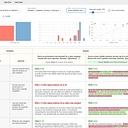
Data as of Aug 25, 2026 · Based on 327 AI responses from ChatGPT Search and Google AI Mode · See how Parse measures this
For collaborative prompt management and evaluation, several platforms stand out based on your team's specific requirements. 

Brands AI recommends here
Named in 68% of answers
Named in 65% of answers
Best for teams that need a visual, user-friendly CMS to track and version prompts. It allows non-technical team members to edit and collaborate on prompts, though it is less focused on deep production-level performance tracing.
Named in 46% of answers
The primary choice if your development team already uses LangChain or LangGraph. It provides tight integration for debugging, tracing, and versioning, but its greatest utility is maximized within the LangChain ecosystem.
Named in 39% of answers
Source | Citation share |
|---|---|
 Best Prompt Evaluation Tools in 2026 (Tested & Compared) - Articles - Braintrusthttps://www.braintrust.dev/articles/best-prompt-evaluation-tools-2025 | 3.8% |
 Prompt Management Systems Compared | Nearformhttps://nearform.com/digital-community/prompt-management-systems-compared/ | 2.9% |
 Top 5 AI Prompt Management Tools for 2026https://arize.com/blog/top-5-ai-prompt-management-tools-of-2025/ | 2.8% |
 5 LLM Evaluation Tools You Should Know in 2025https://humanloop.com/blog/best-llm-evaluation-tools | 2.7% |
Best LLM evaluation platforms 2025 - Articles - Braintrusthttps://www.braintrust.dev/articles/best-llm-evaluation-platforms-2025 | 2.6% |
 Top 9 Prompt Engineering Platforms to Improve LLM Responseshttps://medium.com/@kuldeep.paul08/top-9-prompt-engineering-platforms-to-improve-llm-responses-9b07997c06e0 | 2.2% |
 Top 5 Prompt Management Platforms in 2025: A Comprehensive Guide for AI Teamshttps://www.getmaxim.ai/articles/top-5-prompt-management-platforms-in-2025-a-comprehensive-guide-for-ai-teams/ | 2.2% |
7 best prompt management tools in 2026 (tested and compared) - Articleshttps://www.braintrust.dev/articles/best-prompt-management-tools-2026 | 2.1% |
8 Top Prompt Testing & Optimization Tools (2026) - Arize AIhttps://arize.com/blog/8-top-prompt-testing-and-optimization-tools-for-llms-and-multiagent-systems-2025/ | 2.0% |
 9 Best Prompt Management Tools for ML and AI Engineering Teams - ZenML Bloghttps://www.zenml.io/blog/best-prompt-management-tools | 1.8% |
Managing and evaluating prompts across a development team requires a tool that handles version control, collaborative workspaces, remote playgrounds, and rigorous CI/CD evaluation metrics.[](https://mlflow.org/articles/best-llm-evaluation-platforms-5-alternatives/)…
Managing and evaluating prompts across a development team requires a tool that handles version control, collaborative workspaces, remote playgrounds, and rigorous CI/CD evaluation metrics.
Top platforms specialized for prompt management, tracing, and evaluation include:
To help narrow down the ideal platform for your team, tell me:
Yes. For a development team, I’d shortlist **PromptLayer, Braintrust, and Langfuse** rather than adopting a simple prompt library. The important distinction is whether you mainly need collaborative prompt management or a full evaluation/release loop. Platform | Best fit | Prompt management | Evals | Production tracing…
Yes. For a development team, I’d shortlist PromptLayer, Braintrust, and Langfuse rather than adopting a simple prompt library. The important distinction is whether you mainly need collaborative prompt management or a full evaluation/release loop.
| Platform | Best fit | Prompt management | Evals | Production tracing | Self-host |
|---|---|---|---|---|---|
| PromptLayer | Cross-functional prompt collaboration | ⭐⭐⭐⭐⭐ | ⭐⭐⭐⭐ | ⭐⭐⭐⭐ | No |
| Braintrust | Engineering teams where evals drive releases | ⭐⭐⭐⭐ | ⭐⭐⭐⭐⭐ | ⭐⭐⭐⭐⭐ | Limited |
| Langfuse | Open-source / data-control requirements | ⭐⭐⭐⭐ | ⭐⭐⭐⭐ | ⭐⭐⭐⭐⭐ | Yes |
| LangSmith | Teams heavily using LangChain/LangGraph | ⭐⭐⭐⭐ | ⭐⭐⭐⭐⭐ | ⭐⭐⭐⭐⭐ | — |
Start with PromptLayer if your primary requirement is “give the whole team one place to create, version, compare, evaluate, and deploy prompts.” It has a visual prompt registry, immutable versions, release labels, regression evaluations, human review, and production tracing. It specifically supports non-engineers changing prompts without requiring an application redeploy.
Choose Braintrust if you're building a more rigorous AI quality/release system—for example, every PR or prompt change should run a dataset, invoke deterministic/LLM/human scorers, and potentially block deployment when quality regresses.
Choose Langfuse if self-hosting, open source, or control over your observability data is particularly important. It combines prompt versioning with tracing and evaluation and has a self-hostable open-source core.
For your use case, I'd make these non-negotiable:
The biggest architectural mistake is treating prompt management as just a shared editor. You want a loop of prompt → eval dataset → scores → production traces → failures → improved prompt → regression test → release. Current platforms increasingly converge around that workflow.
If you tell me team size, whether you're using OpenAI/Anthropic/etc., whether you use LangChain, and whether self-hosting is required, I can narrow this to a 2–3 option recommendation and a concrete evaluation/rollout architecture.
Choose Braintrust if you're building a more rigorous AI quality/release system—for example, every PR or prompt change should run a dataset, invoke deterministic/LLM/human scorers, and potentially block deployment when quality regresses.
Choose Langfuse if self-hosting, open source, or control over your observability data is particularly important. It combines prompt versioning with tracing and evaluation and has a self-hostable open-source core.
For a development team managing LLM features, you’ll usually want more than a prompt editor. A good platform should cover: - **Prompt registry** — version prompts, track owners, review changes, roll back. - **Evaluation datasets** — maintain test cases from real user scenarios.
For a development team managing LLM features, you’ll usually want more than a prompt editor. A good platform should cover:
Some strong options:
| Platform | Best fit | Key capabilities |
|---|---|---|
| Langfuse | Engineering teams wanting an open platform | Prompt management, tracing, datasets, experiments, evaluations, human review workflows. Langfuse Langfuse |
| PromptLayer | Teams needing a prompt CMS workflow | Prompt versioning, visual editing, deployment, regression tests, evals, observability. PromptLayer |
| MLflow | Teams already using ML tooling | Prompt registry, experiment tracking, evaluation across models/datasets, centralized results. MLflow AI Platform MLflow AI Platform |
| Helicone | Teams focused on production monitoring | Prompt experiments, side-by-side comparisons, LLM-as-judge/custom evaluators. Helicone |
| Arize AI | Enterprise AI observability needs | Strong monitoring and evaluation workflows for production AI systems. |
| Orq AI | Product teams building AI applications | Prompt experiments, model experiments, evaluation frameworks, guardrails. Orq |
A practical stack choice:
For a team-wide rollout, I’d define the workflow first:
The most important feature is not the prompt editor—it’s preventing regressions when someone changes a prompt that powers a customer-facing feature.
If you share your team size, stack (OpenAI/Anthropic/local models), and whether prompts need to be editable by non-engineers, I can narrow this to a few candidates.
You should use a dedicated **LLM engineering and prompt management platform** to version, test, and evaluate prompts collaboratively across your development team.[](https://nearform.com/digital-community/prompt-management-systems-compared/)…
You should use a dedicated LLM engineering and prompt management platform to version, test, and evaluate prompts collaboratively across your development team.
The top platforms for team-based prompt management and evaluation include:
| Platform | Best For | Key Features |
|---|---|---|
| LangSmith | Integrated debugging and tracing | Prompt versioning, CI/CD evaluation, and deep tracing with LangChain/LangGraph |
| Langfuse | Open-source flexibility | Cost tracking, prompt management, and analytics with self-hosted or cloud options |
| Braintrust | Evaluation-driven development | Production branches, reproducible datasets, and rigorous unit testing for prompts |
| PromptLayer | Cross-functional collaboration | Visual prompt editing, request logging, and A/B testing for developers and non-technical stakeholders |
| Vellum | Production workflows | Visual prompt builders, CI regression testing, and fallback management |
Core Capabilities to Look For
To help narrow down the best choice for your team, let me know:
Managing and evaluating prompts across a development team requires moving away from static text files and scattered Notion docs into a centralized **PromptOps** workflow . The right choice depends heavily on your team's preference for **open-source self-hosting** vs. **all-in-one commercial platforms** , and whether…
Managing and evaluating prompts across a development team requires moving away from static text files and scattered Notion docs into a centralized PromptOps workflow . The right choice depends heavily on your team's preference for open-source self-hosting vs. all-in-one commercial platforms , and whether non-technical team members (like product managers) need to edit prompts.
Top platforms are categorized below by their core strengths:
To help narrow down the ideal platform for your team, tell me:
Yes. What you’re describing is essentially an **LLM prompt management + evaluation platform**: a shared place where engineers can version prompts, test them against representative datasets, compare model/prompt variants, and prevent regressions before deployment. Based on the current landscape, I’d shortlist these:…
Yes. What you’re describing is essentially an LLM prompt management + evaluation platform: a shared place where engineers can version prompts, test them against representative datasets, compare model/prompt variants, and prevent regressions before deployment.
Based on the current landscape, I’d shortlist these:
| Platform | Best fit | Why |
|---|---|---|
| braintrust.dev | Best overall for a development team | Prompt versioning, playground, datasets, experiments, automated evals, production tracing, and CI/CD quality gates in one workflow. Braintrust Braintrust |
| langfuse.com | Best open-source/self-hosted option | Open-source, self-hostable, with prompt management, experiments, evaluations, tracing, and human feedback. Langfuse Langfuse |
| promptfoo.dev | Best developer/CI-first option | Evaluation and red-teaming live naturally alongside application code, with CLI/YAML workflows and CI integration. Braintrust |
| agenta.ai | Best open-source all-in-one playground | Combines prompt management, experimentation, and built-in evaluations. Braintrust |
| promptlayer.com | Best for prompt registry/replay | Strong prompt versioning and request replay/debugging workflow. Braintrust |
I'd start with Braintrust vs. Langfuse.
Choose Braintrust if your goal is to give the whole development organization a polished shared workflow:
Prompt → dataset → eval → compare versions → approve → deploy → monitor → turn production failures back into eval cases Braintrust specifically supports editing prompts without changing application code, experiments across models/providers, versioning, production traces, and release-quality gates.
Choose Langfuse if self-hosting, open source, extensibility, or keeping more infrastructure under your control is important. It covers essentially the same development loop while being open-source and self-hostable.
Choose Promptfoo if your engineering culture strongly favors Git + YAML + CI and you don't necessarily want a centralized SaaS prompt workspace. It's particularly compelling for security testing/red-teaming and regression tests treated as code.
Don't evaluate these platforms just on their prompt editor. For a team-wide system, I'd make these capabilities mandatory:
That last production loop is particularly important. The strongest current platforms are converging on prompt management + evaluation + observability, rather than treating prompt editing as a standalone tool.
If you tell me roughly team size, cloud vs. self-hosted preference, and whether prompts need to be editable by non-engineers, I can narrow this to 2–3 choices and give you a concrete evaluation matrix.
Choose Braintrust if your goal is to give the whole development organization a polished shared workflow:
Prompt → dataset → eval → compare versions → approve → deploy → monitor → turn production failures back into eval cases Braintrust specifically supports editing prompts without changing application code, experiments across models/providers, versioning, production traces, and release-quality gates.
Choose Langfuse if self-hosting, open source, extensibility, or keeping more infrastructure under your control is important. It covers essentially the same development loop while being open-source and self-hostable.
Choose Promptfoo if your engineering culture strongly favors Git + YAML + CI and you don't necessarily want a centralized SaaS prompt workspace. It's particularly compelling for security testing/red-teaming and regression tests treated as code.
Managing and evaluating prompts across a development team requires moving away from scattered text files or hardcoded strings into a centralized system of record . The right platform should handle versioning, environment rollouts (dev/staging/prod), collaborative editing, and automated evaluations (using golden…
Managing and evaluating prompts across a development team requires moving away from scattered text files or hardcoded strings into a centralized system of record . The right platform should handle versioning, environment rollouts (dev/staging/prod), collaborative editing, and automated evaluations (using golden datasets and LLM-as-a-judge).
Top platforms categorized by team needs and workflows:
To help narrow down the ideal platform, could you share:
Yes. For a development team that needs **shared prompt management + versioning + evaluation + regression testing**, I’d shortlist three platforms: | Platform | Best fit | Why | |---|---|---|
Yes. For a development team that needs shared prompt management + versioning + evaluation + regression testing, I’d shortlist three platforms:
| Platform | Best fit | Why |
|---|---|---|
| PromptLayer | Prompt-centric teams | Strong prompt registry, versioning, collaborative editing, datasets, visual eval pipelines, backtesting, regression tests, and release labels. www.promptlayer.com |
| Braintrust | Evaluation-first engineering | Excellent experiment/eval workflow, versioned prompts, playgrounds, CI/CD regression testing, custom scorers, and production online evaluation. www.braintrust.dev |
| LangSmith | Complex LLM/agent applications | Particularly strong if you need tracing and production observability alongside offline/online evaluations, datasets, human review, and prompt iteration. It is framework-agnostic. docs.langchain.comwww.langchain.com |
Start with PromptLayer if your primary problem is “our team needs one place to manage, test, and safely ship prompts.”
It maps unusually closely to what you described: prompts live in a shared registry, changes are versioned, teams can collaborate on them, and evaluation pipelines can automatically run when a prompt changes. It also supports historical production backtests and model comparisons.
Choose Braintrust instead if your biggest concern is building a rigorous evaluation/experimentation system—for example, you want every prompt/model change to produce comparable experiments and enforce quality gates in CI/CD.
Choose LangSmith if your features are evolving toward agents, RAG, tool calling, and multi-step workflows where debugging full production traces is as important as managing prompts.
Don't just compare prompt editors. I'd make these must-have capabilities:
PromptLayer, for example, exposes APIs for prompts, workflows, evaluations, datasets, logs, and traces, which makes it suitable for integrating this into an existing engineering workflow.
If you tell me your stack (OpenAI/Anthropic/etc.), number of developers, whether you're building agents/RAG, and whether you need self-hosting, I can narrow this to a specific recommendation and give you a PromptLayer vs. Braintrust vs. LangSmith comparison with pricing, security, integrations, and an implementation architecture.
Managing prompts across a development team requires moving away from hardcoded strings and scattered files into a unified prompt CMS with version control, collaborative playgrounds, and evaluation pipelines.[](https://www.youtube.com/watch?v=Qddc_DNo9qY)…
Managing prompts across a development team requires moving away from hardcoded strings and scattered files into a unified prompt CMS with version control, collaborative playgrounds, and evaluation pipelines.
The top platforms specialized in collaborative prompt management, evaluation, and CI/CD integration span commercial, open-source, and ecosystem-native options:
To help narrow down the ideal platform for your team, tell me:
For a **development team managing prompts across multiple LLM-powered features**, I’d look at a dedicated prompt/evaluation platform rather than treating prompts as code-only artifacts. ### My shortlist | Platform | Best fit | Why I’d consider it |
For a development team managing prompts across multiple LLM-powered features, I’d look at a dedicated prompt/evaluation platform rather than treating prompts as code-only artifacts.
| Platform | Best fit | Why I’d consider it |
|---|---|---|
| PromptLayer | Prompt-centric teams | Strong prompt registry/versioning, collaborative editing, evaluations, datasets, release labels, A/B testing, and observability. www.promptlayer.comwww.promptlayer.com |
| LangSmith | Teams building complex LLM apps/agents | Excellent for tracing, datasets, offline + online evals, human review, and iterating on prompts alongside agent workflows. www.langchain.comwww.promptlayer.com |
| Braintrust | Evaluation/release-quality focused teams | Particularly compelling if you want evaluations to become part of the software delivery process—production traces → eval datasets → CI/CD quality gates. www.braintrust.dev |
| Langfuse | Open-source/self-hosting priority | Worth evaluating if you want more control over deployment and an open-source-oriented stack. Community comparisons consistently put it in this category. www.braintrust.dev |
I'd make these non-negotiable requirements:
PromptLayer is particularly aligned with the first half of that workflow: it provides a shared prompt CMS, versioning, release labels, datasets, regression testing, and evaluation pipelines.
If your bigger concern is "How do we prevent bad prompt/model changes from reaching production?", I'd lean toward Braintrust or LangSmith. LangSmith explicitly supports development-time dataset evaluations, production online evals, and expert feedback. www.langchain.comwww.promptlayer.com Braintrust is especially interesting when CI/CD quality gates are a core requirement.
If the main problem is "Our developers and product/domain experts need one place to collaboratively manage hundreds of prompts", I'd start with PromptLayer.
My recommendation: run a bake-off between PromptLayer, Braintrust, and LangSmith using 2–3 of your actual LLM features rather than evaluating them from feature checklists. Measure how easily the team can go from prompt change → evaluation → review → approval → production → failure → new regression test. That workflow is much more important than the individual feature lists.
If you tell me roughly team size, whether you're using OpenAI/Anthropic/etc., whether you need self-hosting, and whether prompts live in Git today, I can narrow this to a 2–3 product recommendation and a concrete evaluation matrix.