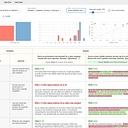
Data as of Aug 25, 2026 · Based on 337 AI responses from ChatGPT Search and Google AI Mode · See how Parse measures this
For RAG evaluation, 


Brands AI recommends here
Named in 75% of answers
Best for general-purpose RAG evaluation using research-backed, automated metrics. It is the industry standard for measuring component-level performance like faithfulness.
Named in 69% of answers
Best for software teams who want to incorporate LLM evaluation into CI/CD pipelines. It treats LLM outputs like standard code units and allows for Pytest-style testing.
Named in 54% of answers
Named in 42% of answers
Source | Citation share |
|---|---|
 Best RAG Evaluation Tools in 2026, Compared - Articles - Braintrusthttps://www.braintrust.dev/articles/best-rag-evaluation-tools | 5.6% |
RAG evaluationhttps://docs.anyscale.com/rag/evaluation | 3.2% |
 Evaluating RAG: A Comprehensive Guide to Measuring Qualityhttps://medium.com/@SkywardITSolutions/evaluating-rag-a-comprehensive-guide-to-measuring-quality-6ebc5bdf506e | 3.0% |
 Best Practices in RAG Evaluation: A Comprehensive Guide - Qdranthttps://qdrant.tech/blog/rag-evaluation-guide/ | 2.5% |
Evaluate a RAG application - Docs by LangChainhttps://docs.langchain.com/langsmith/evaluate-rag-tutorial | 2.0% |
 7 RAG Evaluation Tools You Must Know - Iguaziohttps://www.iguazio.com/blog/best-rag-evaluation-tools/ | 1.9% |
 A complete guide to RAG evaluation: metrics, testing and best practiceshttps://www.evidentlyai.com/llm-guide/rag-evaluation | 1.8% |
 Best LLM Evaluation Tools: Top 9 Frameworks for Testing AI Models - ZenML Bloghttps://www.zenml.io/blog/best-llm-evaluation-tools | 1.8% |
RAG Evaluation Tools: How to Evaluate Retrieval Augmented Generation Applicationshttps://medium.com/@alexchen3292/rag-evaluation-tools-how-to-evaluate-retrieval-augmented-generation-applications-45aba7b8ffe3 | 1.8% |
 RAG Evaluation Metrics: Best Practices for Evaluating RAG Systemshttps://www.patronus.ai/llm-testing/rag-evaluation-metrics | 1.7% |
If your goal is specifically **evaluating a RAG system's answers**, my default choice today would be **DeepEval**. [DeepEval](https://deepeval.com/docs/metrics-introduction?utm_source=chatgpt.com) [DeepEval](https://deepeval.com/guides/guides-rag-evaluation?utm_source=chatgpt.com) ### My recommendation Framework |…
If your goal is specifically evaluating a RAG system's answers, my default choice today would be DeepEval.
| Framework | Best for | My take |
|---|---|---|
| DeepEval | RAG + automated testing + CI/CD | ⭐ Best overall |
| Ragas | RAG-specific metrics and experimentation | ⭐ Excellent alternative |
| TruLens | Observability + evaluation/tracing | Good if monitoring matters |
| LangSmith | LangChain ecosystem + datasets/tracing | Great if you're already using LangChain |
For a RAG system, I wouldn't judge the final answer with just one "correctness" score. You want to separate retrieval quality from generation quality.
DeepEval gives you five particularly useful RAG metrics:
The first two primarily evaluate generation; the latter three diagnose retrieval.
This is where I'd start with the RAG triad:
Question → Retrieved Context → Answer
Measure:
These can be run without an expected_output, making them particularly useful when you have thousands of real user questions but don't have manually written reference answers.
Then create a smaller, high-quality golden dataset—say 100–500 representative questions with expected answers—and add contextual precision/recall and your own correctness criteria.
Ragas is absolutely worth considering. It has a strong RAG-specific metric set, including context precision/recall, response relevancy, faithfulness, noise sensitivity, and others.
But I'd lean DeepEval if you're building an evaluation system, rather than just calculating RAG metrics. It has:
That last part is particularly useful: a score of 0.62 isn't nearly as useful as "the answer made claim X, but no retrieved chunk supports X."
Don't blindly trust LLM-as-a-judge scores. For a serious production evaluation, I'd combine:
Automated evals → faithfulness, relevancy, retrieval precision/recall
+ Human evaluation → correctness, usefulness, domain-specific quality
+ Regression tests → a fixed golden dataset that runs whenever you change chunking, embeddings, reranking, prompts, or the generation model.
I'd also keep your evaluation dimensions to roughly 5 metrics or fewer initially rather than creating a giant dashboard of scores. DeepEval itself recommends limiting the number of metrics and adding custom criteria only where they matter to your application.
Bottom line: If you're starting from scratch, I'd use DeepEval + a 100–500 question golden set + the RAG triad, then add domain-specific G-Eval criteria for whatever "good answer" means in your application.
The best and most popular framework for evaluating Retrieval-Augmented Generation (RAG) systems is **[Ragas (Retrieval Augmented Generation Assessment)](https://docs.ragas.io/)** , closely followed by **[DeepEval](https://docs.confident-ai.com/)** and **[Arize…
The best and most popular framework for evaluating Retrieval-Augmented Generation (RAG) systems is Ragas (Retrieval Augmented Generation Assessment) , closely followed by DeepEval and Arize Phoenix.
The choice of framework depends on your specific workflow, but most modern setups use the "LLM-as-a-judge" approach rather than legacy word-overlap metrics like BLEU or ROUGE.
Top RAG Evaluation Frameworks
| Framework | Best For | Key Metrics Checked |
|---|---|---|
| Ragas | Automated pipeline evaluation & CI/CD integration | Faithfulness, Answer Relevance, Context Precision, Context Recall |
| DeepEval | Unit testing RAG components during development | Hallucination, Bias, Toxicity, Summarization, RAG Triad |
| Arize Phoenix | Visualizing traces, embeddings, and debugging retrieval | Latency, Token Usage, Retrieval Relevance, Step-by-Step Tracing |
Core Metrics You Need to Measure
Instead of testing the final output as a single block, effective RAG evaluation splits performance into the "RAG Triad":
If you share what data formats you are querying (e.g., PDFs, SQL databases, APIs) or your current tech stack , I can recommend a specific evaluation script or metric configuration.
Evaluating a RAG system requires looking at two distinct layers: **retrieval quality** (did you fetch the right chunks?) and **generation quality** (did the LLM synthesize a truthful, helpful answer without hallucinating?).[](https://www.youtube.com/watch?v=qe22zt5z3MI&t=97)…
Evaluating a RAG system requires looking at two distinct layers: retrieval quality (did you fetch the right chunks?) and generation quality (did the LLM synthesize a truthful, helpful answer without hallucinating?).
There is no single "best" framework universally, but rather a few top-tier open-source options tailored to different workflows.
Top RAG Evaluation Frameworks Compared
The Core Metrics You Must Measure
No matter which framework you pick, make sure you are evaluating the RAG Triad:
To help narrow down the ideal framework for your stack, tell me:
If your goal is specifically **evaluating the quality of a RAG system's answers**, my default recommendation today is **DeepEval**. It has first-class RAG metrics, pytest-style regression testing, component-level evaluation, and customizable LLM-as-a-judge metrics.…
If your goal is specifically evaluating the quality of a RAG system's answers, my default recommendation today is DeepEval. It has first-class RAG metrics, pytest-style regression testing, component-level evaluation, and customizable LLM-as-a-judge metrics.
| Framework | Best for | My take |
|---|---|---|
| DeepEval | RAG + CI/CD + systematic testing | Best overall |
| Ragas | RAG-specific experimentation/research | Excellent alternative |
| Arize Phoenix | RAG observability + evaluation | Best if you also need tracing/production debugging |
| LangSmith | LangChain-heavy applications | Great integrated platform |
Don't use a single "answer quality" score. RAG has two failure points: retrieval and generation.
I'd start with these five:
DeepEval explicitly provides these five RAG metrics, with the first two focused on generation and the latter three on retrieval.
If you don't have human-written ground-truth answers, start with the RAG triad:
Answer relevancy + faithfulness + contextual relevancy These can be evaluated without an
expected_output, which makes them practical for evaluating an existing production RAG corpus.
If you do have gold answers, add contextual precision/recall for much stronger retrieval evaluation.
I'd choose DeepEval if you're building a repeatable engineering test suite:
I'd choose Ragas if you're primarily doing RAG experimentation and benchmarking. It has a particularly broad collection of RAG metrics, including context precision/recall, entity recall, noise sensitivity, response relevancy, and faithfulness.
One important detail: faithfulness isn't the same thing as correctness. A response can be perfectly faithful to retrieved context that happens to be wrong or incomplete. Ragas, for example, defines faithfulness in terms of whether the response's claims are supported by the retrieved context.
For a serious RAG evaluation suite, I'd structure it roughly like:
                         RAG EVALUATION
                              │
              ┌───────────────┴───────────────┐
              │                               │
          RETRIEVAL                       GENERATION
              │                               │
     ┌────────┼────────┐               ┌──────┴──────┐
     │        │        │               │             │
 Precision   Recall  Relevancy     Faithfulness  Answer
                                                   Relevancy
Then add one domain-specific correctness metric. For example, if you're building a customer-support RAG, you might evaluate:
"Would this answer resolve the customer's issue correctly according to our policy?" That custom criterion is often more valuable than adding another generic metric. DeepEval supports custom G-Eval criteria for exactly this kind of evaluation.
Bottom line: Start with DeepEval + 5 RAG metrics + a small human-labeled golden set. Use the evaluation suite to distinguish "the retriever didn't find the answer" from "the LLM found it but answered incorrectly." That distinction is what makes RAG evaluation actually useful for improving the system.
If your goal is specifically **evaluating the quality of a RAG system's answers**, my current recommendation is **DeepEval** as the best general-purpose starting point. ### My ranking | Framework | Best for | My take |
If your goal is specifically evaluating the quality of a RAG system's answers, my current recommendation is DeepEval as the best general-purpose starting point.
| Framework | Best for | My take |
|---|---|---|
| DeepEval | RAG + regression testing + CI/CD | Best overall |
| Ragas | Research-oriented RAG metrics | Excellent, especially if you want a focused RAG toolkit |
| TruLens | Deep observability + RAG tracing | Great if you want evaluation tightly coupled to tracing |
| LangSmith | Teams already using LangChain | Best integrated platform rather than purely an eval framework |
DeepEval explicitly separates the two failure modes you care about:
1. Retrieval quality
2. Generation quality
That gives you a very useful diagnostic matrix:
                    GENERATION
                 Good        Bad
              ┌──────────┬──────────┐
Retrieval Good│  Great   │ Generator│
              │   RAG    │  problem │
              ├──────────┼──────────┤
Retrieval Bad │ Retriever│ Everything│
              │  problem │  broken  │
              └──────────┴──────────┘
DeepEval specifically recommends evaluating retriever and generator separately because a poor final answer can originate in either component.
It also supports LLM-as-a-judge, custom criteria through G-Eval, multi-turn RAG evaluation, synthetic evaluation datasets, and CI/CD testing.
Don't start with 15 metrics. I'd use five at most, with these four as the core:
Retriever:
  ContextualRelevancy
  ContextualPrecision
  ContextualRecall

Generator:
  Faithfulness
  AnswerRelevancy
If you don't have ground-truth answers, start with the "RAG triad":
Question
   │
   ├──► Retrieved context ──► Contextual Relevancy
   │
   └──► Answer ─────────────► Answer Relevancy
              │
              └─────────────► Faithfulness
Those three can evaluate a RAG system without an expected_output, which makes them particularly useful when you're starting with a production query log rather than a hand-labeled benchmark.
If you do have gold answers, add contextual precision/recall because they give you much stronger information about retrieval performance.
LLM evaluation ≠ ground truth. Even excellent LLM judges can disagree with humans. For a serious evaluation, I'd create a few hundred representative questions and have humans label at least a subset for:
Then measure how well your LLM-based metrics correlate with those human judgments. This is much more valuable than simply picking whichever framework has the highest metric score.
Bottom line: If you're building a RAG evaluation pipeline today, I'd start with DeepEval + a human-labeled golden set, using the five metrics above. Ragas is my second choice if your emphasis is specifically on RAG experimentation/research rather than software-engineering-style regression testing. Ragas likewise defines faithfulness as consistency between the response and retrieved context.
If you tell me what kind of RAG you have (QA, document search, customer support, agentic RAG, etc.), I can give you a concrete evaluation architecture and dataset/metrics setup.
There is no single "best" framework because RAG evaluation splits into two different jobs: **offline experimentation/benchmarking** during development and **online tracing/monitoring** in production.[](https://deepeval.com/blog/top-5-llm-evaluation-frameworks)…
There is no single "best" framework because RAG evaluation splits into two different jobs: offline experimentation/benchmarking during development and online tracing/monitoring in production.
The industry has largely converged on separating retrieval quality from generation quality rather than looking for a single composite accuracy score.
The top-tier frameworks and when to use them include:
The Core Metrics Every Framework Measures
Regardless of which tool you pick, your evaluation suite should score these four fundamental dimensions separately:
To help narrow down the ideal choice for your setup, let me know:
There is no single "best" framework, because the right choice depends on **where your evaluation happens** (offline testing vs. production monitoring) and **how your team works**.[](https://deepeval.com/blog/top-5-llm-evaluation-frameworks)…
There is no single "best" framework, because the right choice depends on where your evaluation happens (offline testing vs. production monitoring) and how your team works.
The industry has converged on a few leading open-source frameworks, each optimized for a specific workflow:
pytest -style framework. If you want your GitHub actions or GitLab pipelines to automatically fail a pull request when RAG accuracy or hallucination metrics drop past a threshold, DeepEval is the strongest fit.Regardless of the framework you choose, your RAG evaluation should measure these four core metrics separated into two stages:
If you tell me whether you are looking to run offline unit tests in CI/CD or live production monitoring , I can help you pick the right tool and sketch out a basic evaluation script.

If your goal is specifically **evaluating the quality of a RAG system**, my default recommendation in 2026 is **Ragas**—unless you need CI/CD-style regression testing, in which case I'd choose **DeepEval**. ### My shortlist | Framework | Best for | RAG fit |
If your goal is specifically evaluating the quality of a RAG system, my default recommendation in 2026 is Ragas—unless you need CI/CD-style regression testing, in which case I'd choose DeepEval.
| Framework | Best for | RAG fit |
|---|---|---|
| Ragas | Dedicated RAG evaluation | ⭐⭐⭐⭐⭐ |
| DeepEval | Automated tests + CI/CD | ⭐⭐⭐⭐⭐ |
| Arize Phoenix | Tracing + production debugging | ⭐⭐⭐⭐ |
| TruLens | RAG evaluation + observability | ⭐⭐⭐⭐ |
| LangSmith | LangChain users + experiment management | ⭐⭐⭐⭐ |
| Promptfoo | Prompt/model comparison + red teaming | ⭐⭐⭐ |
Ragas is purpose-built around RAG and gives you the metrics I'd want to start with:
It also supports reference-free evaluation, so you don't need a manually written "correct answer" for every query.
That's particularly useful early on when you have thousands of real user queries but relatively few labeled examples.
DeepEval is what I'd pick if you want evaluation to behave like unit tests for your RAG pipeline.
It has the same important RAG dimensions—faithfulness, answer relevancy, contextual relevancy, contextual precision, and contextual recall—and can put thresholds around them so a regression can fail CI.
For example, conceptually:
PR changes retriever
       ↓
run 500 golden queries
       ↓
┌─────────────────────────────┐
│ Faithfulness      ≥ 0.90    │
│ Answer relevance  ≥ 0.85    │
│ Context recall    ≥ 0.90    │
│ Context precision ≥ 0.85    │
└─────────────────────────────┘
       ↓
   PASS / FAIL
That's a very nice workflow once your RAG system is in active development.
I'd evaluate three separate failure modes:
1. Retrieval
Did I retrieve the information necessary to answer?
Measure context relevance/precision/recall.
2. Grounding
Did the model stick to what was retrieved?
Measure faithfulness/groundedness.
3. Answer quality
Did the user actually get a correct and useful answer?
Measure answer relevancy and, where possible, answer correctness.
This distinction matters enormously. A RAG system can have excellent faithfulness while still giving a wrong answer if retrieval brought back the wrong or outdated information.
If I were setting up your evaluation stack, I'd use:
Ragas + a small human-labeled golden set
with roughly:
                    RAG Evaluation
                         │
          ┌──────────────┼──────────────┐
          ↓              ↓              ↓
      Retrieval       Grounding      Answer
          │              │              │
   context recall    faithfulness   correctness
   context precision                 relevance
          │              │              │
          └──────────────┼──────────────┘
                         ↓
                  Human evaluation
Have humans label perhaps 200–500 representative queries initially. Then compare your LLM-judge metrics against those human judgments. Don't blindly trust an LLM evaluator; judge models themselves can be biased or inconsistent.
For offline RAG development, I'd choose Ragas.
For a production engineering team where evals need to gate deployments, I'd choose DeepEval.
For production debugging/observability, I'd add Arize Phoenix or TruLens rather than expecting the evaluation library alone to diagnose every failure. Current comparisons similarly position Ragas as the RAG specialist, DeepEval as the testing/CI-oriented choice, and Phoenix/TruLens more toward tracing and observability.
If you tell me your stack (LangChain/LlamaIndex/custom, vector DB, model, and whether you have labeled Q&A pairs), I can recommend the exact evaluation setup and metrics I'd use.
If your goal is specifically **evaluating RAG answer quality**, my default recommendation in 2026 is **DeepEval**—with **Ragas** as the strongest alternative. ### My ranking | Framework | Best for | My take |
If your goal is specifically evaluating RAG answer quality, my default recommendation in 2026 is DeepEval—with Ragas as the strongest alternative.
| Framework | Best for | My take |
|---|---|---|
| DeepEval | RAG + CI/CD + custom LLM judges | ⭐ Best overall |
| Ragas | Research-oriented RAG evaluation | ⭐ Excellent, especially for retrieval metrics |
| Arize Phoenix | RAG observability + tracing + evaluation | Best if you need production debugging |
| TruLens | Evaluation + instrumentation | Good, particularly if you're already using its ecosystem |
DeepEval has a particularly useful decomposition of RAG quality into retrieval and generation:
Retrieval
Generation
That gives you a very useful diagnostic matrix rather than a single mysterious "RAG score."
It also supports custom LLM-as-a-judge criteria through G-Eval, which is valuable for things like domain-specific correctness, citation quality, completeness, tone, or adherence to a response format.
And importantly, you can run evaluations as pytest-style tests in CI/CD, so you can catch regressions when you change your embedding model, chunking, retriever, prompt, or generation model.
I'd lean toward Ragas if you're primarily doing RAG research/experimentation and want a focused collection of RAG metrics. Its current metric set includes Context Precision, Context Recall, Noise Sensitivity, Response Relevancy, Faithfulness, and others.
For example, Ragas's Faithfulness explicitly measures whether claims in the response can be supported by the retrieved context.
So I'd characterize them as:
DeepEval = evaluation framework for an LLM application that happens to be RAG
Ragas = specialized toolkit for measuring RAG quality
Don't rely on one metric. I'd start with these 5 dimensions:
                 RAG Evaluation

Retriever ──► Context Recall
          ──► Context Precision
          ──► Context Relevancy

Generator ─► Faithfulness
          ─► Answer Relevancy

Custom    ─► Domain-specific correctness
              / citation accuracy / completeness
Then create a golden evaluation set of perhaps 100–500 representative questions, including:
I'd also have humans label a subset. The most important thing isn't whether your framework says the score is 0.87; it's whether 0.87 actually correlates with humans saying "this answer is good."
If by "quality" you mean "Did the RAG system give the right answer?", don't stop at faithfulness.
A response can be perfectly faithful to the retrieved documents and still be wrong because retrieval missed the relevant document.
For example:
User: "Who founded Company X?"
Retriever finds a document saying "Company X opened its first office in 2012."
LLM: "Company X was founded in 2012."
That's potentially high faithfulness—the answer doesn't contradict the retrieved context—but poor retrieval/answer correctness.
That's why I'd evaluate the pipeline at both levels rather than treating faithfulness as equivalent to correctness.
Bottom line: If you're building a serious production RAG system, I'd start with DeepEval, use its retrieval + generation metrics, add 1–2 custom domain-specific judges, and maintain a human-labeled golden set. Ragas is an excellent choice if your work is more RAG-research/benchmark oriented. DeepEval itself also exposes Ragas metrics, so you don't necessarily have to choose one ecosystem exclusively.
If you tell me your RAG stack (e.g. LangChain/LlamaIndex/custom, vector DB, and which LLM), I can recommend a concrete evaluation architecture and metric suite for it.
`There is no single "best" LLM evaluation framework for RAG` because tools are built for different workflows. Instead, the industry relies on a few standout options depending on whether you want a lightweight metrics calculator, a software-testing style framework, or a full production observability…
There is no single "best" LLM evaluation framework for RAG because tools are built for different workflows. Instead, the industry relies on a few standout options depending on whether you want a lightweight metrics calculator, a software-testing style framework, or a full production observability suite.
The leading frameworks and their ideal use cases include:
The Core RAG Metrics You Must Track
No matter which framework you choose, make sure your evaluation covers these essential pillars:
To help narrow down the ideal choice for your project, tell me: