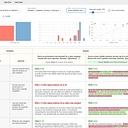
Data as of Aug 25, 2026 · Based on 346 AI responses from ChatGPT Search and Google AI Mode · See how Parse measures this



Brands AI recommends here
Named in 56% of answers
Best for engineering teams that want automated testing and CI/CD checks: create custom metrics, detect hallucinations, and validate RAG pipelines. Tradeoff: it’s an engineering-focused Python framework requiring integration work.
Named in 34% of answers
Named in 30% of answers
Named in 30% of answers
Ideal when you need end-to-end tracing and production debugging: log inputs/outputs, trace flows, and evaluate behavior in live apps. Caveat: focused on observability/tracing rather than being a standalone RAG metric library.
Source | Citation share |
|---|---|
 LLM-as-a-judge: a complete guide to using LLMs for evaluationshttps://www.evidentlyai.com/llm-guide/llm-as-a-judge | 3.2% |
 LLM Evaluation: Key Concepts & Best Practices | Nexlahttps://nexla.com/ai-readiness/llm-evaluation/ | 2.9% |
 How to Evaluate If Your LLM Outputs Are Satisfying Users - Traceloophttps://www.traceloop.com/blog/how-to-evaluate-if-your-llm-outputs-are-satisfying-users | 2.3% |
 LLM Evaluation: Frameworks, Metrics, and Best Practiceshttps://www.superannotate.com/blog/llm-evaluation-guide | 2.1% |
 Best LLM Evaluation Tools: Top 9 Frameworks for Testing AI Models - ZenML Bloghttps://www.zenml.io/blog/best-llm-evaluation-tools | 2.1% |
LLM evaluation: a beginner's guidehttps://www.evidentlyai.com/llm-guide/llm-evaluation | 1.9% |
 Best Prompt Evaluation Tools in 2026 (Tested & Compared) - Articles - Braintrusthttps://www.braintrust.dev/articles/best-prompt-evaluation-tools-2025 | 1.6% |
 Mastering LLM Evaluation: Metrics and Challenges | by Abhisek Omkar Prasad | Mediumhttps://medium.com/@abhisekprasad8/mastering-llm-evaluation-metrics-and-challenges-7d6f9436a43c | 1.6% |
 5 LLM Evaluation Tools You Should Know in 2025https://humanloop.com/blog/best-llm-evaluation-tools | 1.3% |
 LLM Evaluations: Techniques, Challenges, and Best Practices | Label Studiohttps://labelstud.io/blog/llm-evaluations-techniques-challenges-and-best-practices/ | 1.2% |
If the core problem is **“our LLM gives different-quality answers across prompt/model changes, and we need to score that objectively,”** I’d recommend **Braintrust** as the best overall starting point. It is particularly strong for turning a dataset of real examples into repeatable evaluations, comparing model/prompt…
If the core problem is “our LLM gives different-quality answers across prompt/model changes, and we need to score that objectively,” I’d recommend Braintrust as the best overall starting point. It is particularly strong for turning a dataset of real examples into repeatable evaluations, comparing model/prompt versions, tracking scores over time, and putting evals into CI/CD.
| Tool | Best for | My take |
|---|---|---|
| Braintrust | General-purpose LLM evals + regression testing | ⭐ Best overall |
| DeepEval | Developer/pytest-style automated tests | ⭐ Best open-source testing framework |
| Promptfoo | Prompt/model comparison + red teaming | Excellent for regression testing |
| RAGAS | RAG quality | Best if retrieval is the main issue |
| LangSmith | LangChain/LangGraph applications | Best if you're already deep in LangChain |
| Arize Phoenix | Open-source tracing + production evaluation | Best OSS observability/eval stack |
Recent comparisons broadly converge on the same point: there isn't one universal winner—the right choice depends on whether you're evaluating general response quality, RAG, agents, prompts, or production behavior.
Don't just ask an evaluator, “Is this answer good?” Build a golden evaluation set of perhaps 100–500 representative inputs, including your known failures.
For each response, score dimensions such as:
Then use a combination of LLM-as-a-judge + deterministic checks + human-labeled examples. The important part is that you establish a stable baseline and compare every new model/prompt against it rather than relying on subjective spot-checking.
For example:
                   Golden Dataset
                         │
              ┌──────────┴──────────┐
              │                     │
          Model A               Model B
              │                     │
              └──────────┬──────────┘
                         ↓
                    Evaluators
              ┌──────────┼──────────┐
              ↓          ↓          ↓
          Correctness  Relevance  Groundedness
              │          │          │
              └──────────┼──────────┘
                         ↓
                   Overall score
                         ↓
                  Regression test
                         ↓
                 PASS / FAIL / REVIEW
If you tell me what you're building (RAG chatbot, agent, customer support, code generation, etc.) and your stack (Python/TypeScript, OpenAI/Anthropic/etc.), I can recommend the specific eval setup and scoring rubric I'd use.
Tackling LLM response inconsistency requires shifting from traditional unit testing to **LLM-as-a-judge metrics**, **deterministic assertions** , and **regression test suites**.[](https://deepeval.com/blog/top-5-llm-evaluation-frameworks)…
Tackling LLM response inconsistency requires shifting from traditional unit testing to LLM-as-a-judge metrics, deterministic assertions , and regression test suites.
Because no single tool handles every stack or workflow equally, the "best" choice depends on your specific bottleneck. The top tools for evaluating and scoring LLM outputs are categorized below by their strengths:
pytest for AI. It is Python-native, handles unit testing locally, integrates smoothly into CI/CD pipelines, and includes 50+ research-backed metrics (hallucination, answer relevance, bias).Quick Recommendation
To help narrow down the ideal fit, tell me:
If the core problem is **“our LLM gives different-quality answers and we need to measure whether a change made it better or worse,”** I’d start with **Braintrust** or **DeepEval**, rather than looking for a single generic “LLM score.” ### My picks - **🥇 Braintrust — best overall for a team**
If the core problem is “our LLM gives different-quality answers and we need to measure whether a change made it better or worse,” I’d start with Braintrust or DeepEval, rather than looking for a single generic “LLM score.”
🥇 Braintrust — best overall for a team
Build a dataset of real inputs/expected behaviors.
Run multiple prompts/models against it.
Use LLM-as-a-judge plus custom scoring functions.
Track scores across experiments and regressions.
Particularly good if you want a shared UI for engineers, PMs, and reviewers.
🥈 DeepEval — best developer-first/open-source choice
Feels more like writing unit tests for your LLM.
Good for correctness, relevance, hallucination, toxicity, RAG, etc.
Easy to put into CI so a prompt/model change can fail a build when quality drops.
Promptfoo — best for prompt/model regression testing
Excellent if you're asking: “Which of these 5 prompts/models produces the best answer?”
Strong CLI/config-as-code workflow and CI integration, plus red-team testing.
Ragas — best if your problem is RAG
Particularly useful for measuring things like context relevance, faithfulness, context recall/precision, and answer correctness.
Arize Phoenix — best if you also need production observability
Open-source, with tracing, datasets, experiments, and LLM-based evaluation in one system.
Don't rely on a single “quality score.” That's usually where LLM evaluation goes wrong.
Create a golden evaluation set of perhaps 100–500 representative prompts, then score each response on several dimensions:
| Metric | Example question |
|---|---|
| Correctness | Is the answer factually correct? |
| Relevance | Did it answer the actual question? |
| Completeness | Did it cover everything required? |
| Instruction following | Did it obey the requested format/constraints? |
| Groundedness | Did it stay within the supplied context? |
| Style | Is it appropriately concise/clear? |
| Safety | Did it avoid undesirable behavior? |
Then have an LLM judge produce structured scores and explanations, while periodically calibrating those scores against human reviewers.
The important part is to track regressions, not just absolute scores. For example:
Prompt v17: 8.1/10 Prompt v18: 8.4/10 Prompt v19: 7.6/10 ← regression Current evaluation guidance broadly converges on combining a development/CI evaluator such as DeepEval or Promptfoo with a platform for experiments, annotation, and production monitoring such as Braintrust, LangSmith, or Phoenix.
If you tell me what you're building (chatbot, RAG, coding assistant, agent, API, etc.) and your stack (Python/TypeScript, OpenAI/Anthropic/etc.), I can recommend the specific eval stack and scoring methodology I'd use.
Tackling inconsistent LLM outputs requires a `structured evaluation stack` —combining automated unit testing, LLM-as-a-judge metrics, tracing, and human review. Because "the best" tool depends heavily on your workflow (CI/CD vs. production monitoring vs. open-source vs. enterprise platform), the top tools are…
Tackling inconsistent LLM outputs requires a structured evaluation stack —combining automated unit testing, LLM-as-a-judge metrics, tracing, and human review. Because "the best" tool depends heavily on your workflow (CI/CD vs. production monitoring vs. open-source vs. enterprise platform), the top tools are categorized below by their strengths:
To help narrow down the ideal choice, tell me:
There is no single "best" tool because the right choice depends on whether you are writing unit tests in code, tracking experiments in a dashboard, or monitoring live production traffic.[](https://www.getmaxim.ai/articles/top-5-llm-evaluation-platforms-in-2026/)…
There is no single "best" tool because the right choice depends on whether you are writing unit tests in code, tracking experiments in a dashboard, or monitoring live production traffic.
The top evaluation and scoring tools are categorized below by how and where they fit best:
To help narrow down the ideal choice, tell me:
If the core problem is **inconsistent LLM responses**, I’d recommend **[LangSmith](https://smith.langchain.com/?utm_source=chatgpt.com)** as the best general-purpose choice. It’s particularly good because it lets you turn “quality” into measurable evaluations rather than relying on vibes: - **Build a test dataset** of…
If the core problem is inconsistent LLM responses, I’d recommend LangSmith as the best general-purpose choice.
It’s particularly good because it lets you turn “quality” into measurable evaluations rather than relying on vibes:
Don't use a single “overall quality” score. I'd create something like:
| Metric | Method | Weight |
|---|---|---|
| Correctness | LLM judge + reference | 40% |
| Instruction following | LLM judge | 20% |
| Relevance | LLM judge | 15% |
| Completeness | LLM judge | 10% |
| Format/schema | Deterministic | 10% |
| Safety/undesired behavior | Deterministic + judge | 5% |
Then calculate a composite score and establish a minimum pass threshold.
One important caveat: LLM-as-a-judge isn't ground truth. LangSmith itself recommends calibrating automated judges against human feedback. docs.langchain.comwww.langchain.com For your inconsistency problem, I'd have humans label an initial 100–300 representative responses, use those to tune the judge, and then use automated evals for the bulk of regression testing.
If you're choosing one today, I'd start with LangSmith. Its offline + online evaluation workflow maps very closely to the problem you're describing: establish a representative dataset, score responses, compare versions, then continuously monitor production quality.
If you tell me what kind of LLM app you're evaluating (RAG, chatbot, agents, extraction, coding, etc.), I can recommend the specific eval stack and scoring rubric I'd use.
If your problem is **inconsistent LLM responses**, you usually don’t want a single “score the output” tool—you want an **LLM evaluation framework** that lets you create a repeatable test set, run outputs through graders, and track regressions over time. The best choice depends on your stack. ### Strong options | Tool…
If your problem is inconsistent LLM responses, you usually don’t want a single “score the output” tool—you want an LLM evaluation framework that lets you create a repeatable test set, run outputs through graders, and track regressions over time. The best choice depends on your stack.
| Tool | Best for | Why use it |
|---|---|---|
| Arize AI Phoenix | Production quality monitoring + evals | Strong for tracing, datasets, experiments, and LLM-as-a-judge scoring. Supports metrics like relevance, correctness, and faithfulness. arize.com |
| LangChain LangSmith | Agent apps and LangChain users | Good end-to-end workflow: traces → datasets → evaluations → prompt iteration. www.langchain.com |
| Promptfoo | CI/CD testing and prompt regression tests | Great if you want “every code change runs 500 prompts and fails if quality drops.” aiml.qa |
| DeepEval | Developer-first automated testing | Useful for unit-test-style LLM evaluations (hallucination, correctness, RAG metrics). aiml.qa |
| Ragas | Retrieval-augmented generation systems | Best when inconsistency comes from retrieval quality rather than generation. aiml.qa |
A practical evaluation stack:
Create a golden dataset
Score every response on multiple dimensions
Use LLM-as-a-judge scoring Example rubric:
Score 1-5:
5 = Fully correct, complete, and directly answers the request
4 = Mostly correct, minor omissions
3 = Mixed quality, needs human review
2 = Significant errors
1 = Incorrect or unusable
One important note: avoid relying on a single “overall quality score.” LLMs fail in different ways, so a response with an 8/10 average could still be unacceptable if its hallucination score is poor. A score breakdown is much more actionable.
If you tell me your stack (OpenAI API vs Anthropic vs local models, RAG vs chat vs agents, LangChain or not), I can narrow this down to a specific setup.
There is no single "best" tool because the LLM evaluation ecosystem is specialized by `workflow, language, and architecture` . The right choice depends on whether you are writing unit tests, comparing prompts, evaluating RAG pipelines , or monitoring production…
There is no single "best" tool because the LLM evaluation ecosystem is specialized by workflow, language, and architecture . The right choice depends on whether you are writing unit tests, comparing prompts, evaluating RAG pipelines , or monitoring production traffic.
The leading tools fall into distinct categories based on what they do best:
pytest , letting you write unit-test style assertions for metrics like hallucination, faithfulness, and G-Eval directly in your code. Ideal if you want to block bad prompt or model updates in your pipeline.To narrow this down to the exact tool for your team, tell me:
If your core problem is **“the same prompt sometimes gets a great answer and sometimes a mediocre one, and we need a reliable way to measure that”**, I’d start with **DeepEval**. [DeepEval](https://deepeval.com/?utm_source=chatgpt.com) is particularly good for this because it treats LLM evaluation much like software…
If your core problem is “the same prompt sometimes gets a great answer and sometimes a mediocre one, and we need a reliable way to measure that”, I’d start with DeepEval.
DeepEval is particularly good for this because it treats LLM evaluation much like software testing: you create test cases, define quality metrics, score outputs, and can run the evaluations in CI/CD. It has 50+ built-in metrics plus customizable LLM-as-a-judge evaluations.
| Tool | Best for | My take |
|---|---|---|
| DeepEval | Automated quality scoring + regression tests | Best starting point |
| Braintrust | Full eval platform, experiments, production monitoring | Best if you want a polished team platform |
| Arize Phoenix | Evaluation + tracing/observability | Excellent for debugging why outputs fail |
| Ragas | RAG-specific evaluation | Great if retrieval/grounding is the main issue |
Braintrust supports systematic evaluation from prompt/model experiments through production monitoring.
Arize Phoenix combines deterministic evaluators and LLM-as-a-judge with tracing, datasets, and experiments, which makes it particularly useful when you need to diagnose regressions.
Ragas is especially focused on RAG quality—faithfulness, answer relevancy, contextual precision/recall, etc.
For inconsistent outputs, I'd build an eval suite with 3–5 dimensions, rather than one vague “quality” score:
For RAG, add faithfulness/groundedness. For agents, add task completion and tool correctness. DeepEval has built-in metrics for these categories and supports custom criteria through G-Eval.
Don't rely exclusively on an LLM judge. Make a hybrid evaluator:
                    Your LLM
                       │
                       ▼
                  Test dataset
                       │
             ┌─────────┴─────────┐
             ▼                   ▼
       Deterministic          LLM judge
       checks                 evaluations
       ─────────              ────────────
       JSON/schema            correctness
       exact values            relevance
       citations               helpfulness
       forbidden content       completeness
             │                   │
             └─────────┬─────────┘
                       ▼
                 Overall score
                       │
                       ▼
              Regression threshold
That's important because LLM-as-a-judge itself can be noisy. DeepEval explicitly recommends validating judges against human annotations and offers more deterministic DAG-based evaluation when criteria require strict branching logic.
So, if I were building this today: start with DeepEval + a small hand-labeled golden dataset + 3–5 explicit metrics, then put the eval suite into CI so every prompt/model change gets scored before deployment.
If you tell me what kind of LLM application you have (RAG, chatbot, agent, summarizer, extraction, etc.), I can recommend the exact evaluation setup and metrics I'd use.
There is no single "best" tool because fixing inconsistent LLM outputs requires two distinct phases: **offline testing** (running experiments and blocking regressions before you ship) and **online observability** (scoring live production…
There is no single "best" tool because fixing inconsistent LLM outputs requires two distinct phases: offline testing (running experiments and blocking regressions before you ship) and online observability (scoring live production traffic).
The industry has converged on a few standout frameworks depending on how your team builds and deploys.
pytest).How to Approach the Evaluation Process
If you are struggling with variance, start small:
To help narrow down the ideal stack, tell me: