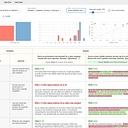
Data as of Aug 25, 2026 · Based on 274 AI responses from ChatGPT Search and Google AI Mode · See how Parse measures this
To assess factual accuracy at scale, several platforms offer LLM-as-a-judge evaluation frameworks. Leading commercial options like 


Brands AI recommends here
Named in 42% of answers
Named in 42% of answers
Best for teams needing a complete pipeline to set up, monitor, and manage evaluation for chatbots and retrieval-augmented systems, leveraging pre-built rubrics for factual accuracy and hallucination detection.
Named in 41% of answers
Named in 38% of answers
Source | Citation share |
|---|---|
 The Rise of Agent-as-a-Judge Evaluation for LLMs - arXivhttps://arxiv.org/html/2508.02994v1 | 3.3% |
LLM-as-a-judge: a complete guide to using LLMs for evaluationshttps://www.evidentlyai.com/llm-guide/llm-as-a-judge | 3.0% |
 LLM-as-a-Judge - Wikipediahttps://en.wikipedia.org/wiki/LLM-as-a-Judge | 1.8% |
 The Definitive LLM-as-a-Judge Guide for Scalable LLM Evaluation | by Jeffrey Ip | Mediumhttps://medium.com/@jeffreyip54/the-definitive-llm-as-a-judge-guide-for-scalable-llm-evaluation-a4aad7b455b9 | 1.7% |
 LLM Evaluators: Tutorial & Best Practiceshttps://www.patronus.ai/llm-testing/llm-evaluators | 1.6% |
LLMs Cannot Reliably Judge (Yet?): A Comprehensive Assessment on the Robustness of LLM-as-a-Judgehttps://arxiv.org/html/2506.09443v2 | 1.4% |
 LLM-as-a-Judge - Langfusehttps://langfuse.com/docs/evaluation/evaluation-methods/llm-as-a-judge | 1.4% |
 LLM as a Judge - Primer and Pre-Built Evaluatorshttps://arize.com/llm-as-a-judge/ | 1.3% |
A Survey on LLM-as-a-Judgehttps://arxiv.org/html/2411.15594v6 | 1.3% |
 LLM-as-a-judge on Amazon Bedrock Model Evaluation | Artificial Intelligencehttps://aws.amazon.com/blogs/machine-learning/llm-as-a-judge-on-amazon-bedrock-model-evaluation/ | 1.3% |
Scaling evaluation for LLM outputs is a common bottleneck, and "LLM-as-a-judge" patterns have become the industry standard for automating this at scale . Several open-source frameworks, enterprise LLMOps platforms, and specialized toolsets offer ready-to-use LLM-as-a-judge…
Scaling evaluation for LLM outputs is a common bottleneck, and "LLM-as-a-judge" patterns have become the industry standard for automating this at scale . Several open-source frameworks, enterprise LLMOps platforms, and specialized toolsets offer ready-to-use LLM-as-a-judge capabilities:
Open-Source Frameworks
Commercial LLMOps & Enterprise Evaluation Platforms
If you share your primary use case (e.g., RAG, complex multi-step agents, or creative generation) and whether you prefer an open-source library or a managed enterprise platform , I can help you pick the best fit.
Yes. The market is fairly mature now, and there are two broad categories: **developer-focused evaluation frameworks** and **managed evaluation/observability platforms**. ### Strong options Framework / platform | Best fit | LLM-as-a-judge | Open source?
Yes. The market is fairly mature now, and there are two broad categories: developer-focused evaluation frameworks and managed evaluation/observability platforms.
| Framework / platform | Best fit | LLM-as-a-judge | Open source? |
|---|---|---|---|
| DeepEval / Confident AI | General-purpose LLM/agent testing and CI | ✅ | ✅ framework |
| Ragas | RAG factuality/faithfulness | ✅ | ✅ |
| Braintrust | Production evals, experiments, regression testing | ✅ | No |
| LangSmith | LangChain/LangGraph apps and trace-based evaluation | ✅ | No |
| Arize Phoenix | Open-source observability + evaluations | ✅ | ✅ |
| Humanloop | Managed evals + human feedback + LLM judges | ✅ | No |
| Galileo | Production monitoring and custom LLM judges | ✅ | No |
| Promptfoo | Prompt/model comparisons, CI and red-teaming | ✅ | ✅ |
| TruLens | RAG/agent evaluation and observability | ✅ | ✅ |
| OpenAI Evals | Benchmark-style model evaluation | ✅/custom | ✅ |
These aren't merely theoretical capabilities: for example, DeepEval provides 50+ evaluation metrics including LLM-as-a-judge metrics and is designed to run in CI/CD; its G-Eval implementation lets you define custom judging criteria. DeepEval DeepEval Ragas is particularly oriented toward RAG metrics such as faithfulness and answer/context relevance.
I'd narrow the field to:
An LLM judge isn't itself a reliable source of truth. For factual accuracy, you generally want to calibrate the judge against a human-labeled set and measure false positives/false negatives. DeepEval explicitly recommends comparing judge results against human annotations for this reason.
A robust architecture is often:
production outputs → sampled evaluation set → deterministic checks + LLM judge → human-labeled calibration set → regression dashboard
rather than simply:
LLM output → another LLM says "correct"
If you tell me what kind of outputs you're evaluating (RAG answers, customer support, agents, generated reports, etc.) and whether you need self-hosting, I can narrow these down to the 3–4 best choices and compare them on accuracy, judge calibration, cost, scale, and integration effort.
If you need to evaluate factual accuracy of LLM outputs at scale, the main category you are looking for is usually called **LLM-as-a-judge**, **LLM evaluation**, or **AI quality evaluation platforms**. These systems use a stronger model (or specialized judge model) to score outputs against rubrics such as correctness,…
If you need to evaluate factual accuracy of LLM outputs at scale, the main category you are looking for is usually called LLM-as-a-judge, LLM evaluation, or AI quality evaluation platforms. These systems use a stronger model (or specialized judge model) to score outputs against rubrics such as correctness, faithfulness, groundedness, relevance, safety, and completeness.
Common vendors and frameworks include:
| Provider / Framework | Best fit | LLM-as-a-judge capabilities |
|---|---|---|
| Arize AI / Phoenix | Production LLM monitoring and debugging | Trace-based evaluation, hallucination/faithfulness evaluation, custom evaluators, open-source observability workflows |
| Databricks MLflow | Enterprise ML pipelines | Built-in LLM judges, custom judges, evaluation tracking across model/prompt versions, support for correctness and groundedness metrics MLflow AI Platform |
| LangChain LangSmith | Teams building with LangChain | Dataset-based evaluation, human feedback loops, custom LLM evaluators, regression testing DataCamp |
| DeepEval | Developer-centric automated testing | Pytest-style LLM tests, G-Eval judges, RAG metrics, CI/CD evaluation gates DeepEval |
| Ragas | Retrieval-augmented generation (RAG) | Faithfulness, answer relevance, context precision/recall, retrieval quality evaluation DataCamp |
| Braintrust | Managed evaluation platform | Experiment tracking, evaluators, human review workflows, production quality monitoring Inside AI Media |
| Patronus AI | Enterprise AI reliability | Specialized evaluators, hallucination detection, policy/compliance evaluation |
| Promptfoo | Prompt/model regression testing | Automated comparisons, red teaming, judge-based scoring across models and prompts Aiml QA |
| OpenAI Evals | Custom eval harnesses | Build and run evaluation suites for model behavior and task performance |
Look for evaluators that support:
For RAG systems, Ragas and Phoenix-style tracing/evaluation are common choices because they separate retrieval failures from generation failures.
A mature setup often combines:
A key caveat: LLM judges are not perfect truth machines. They can inherit biases from the judge model (for example, preferring verbose answers or agreeing with models from the same family), so teams typically calibrate them against human labels and use multiple checks for high-stakes factuality.
If your main problem is "our chatbot answers are sometimes factually wrong", I would usually shortlist:
To solve the scaling bottleneck of manual review, a robust ecosystem of open-source and commercial platforms now provides **LLM-as-a-judge** frameworks. These tools automate scoring using rubrics, unit-test approaches, or specialized RAG (Retrieval-Augmented Generation)…
To solve the scaling bottleneck of manual review, a robust ecosystem of open-source and commercial platforms now provides LLM-as-a-judge frameworks. These tools automate scoring using rubrics, unit-test approaches, or specialized RAG (Retrieval-Augmented Generation) metrics.
The primary providers offering LLM-as-a-judge evaluation frameworks are categorized below by their ecosystem focus:
If you'd like to narrow down which framework fits your stack, tell me:
Yes. There’s now a fairly mature ecosystem of **LLM-as-a-judge** evaluation frameworks—tools that use one model (the “judge”) to score another model’s outputs against a rubric, often at thousands/millions of examples.…
Yes. There’s now a fairly mature ecosystem of LLM-as-a-judge evaluation frameworks—tools that use one model (the “judge”) to score another model’s outputs against a rubric, often at thousands/millions of examples.
| Framework / platform | Best fit | LLM-as-judge | Open source? |
|---|---|---|---|
| DeepEval / Confident AI | Developer-first regression testing & CI | ✅ | ✅ |
| Ragas | RAG / groundedness evaluation | ✅ | ✅ |
| Arize Phoenix | Evaluation + production observability | ✅ | ✅ |
| Braintrust | Managed eval platform, datasets & experiments | ✅ | No |
| LangSmith | LangChain/LangGraph applications | ✅ | No |
| Promptfoo | Prompt testing, red teaming, model comparisons | ✅ | ✅ |
| Giskard | AI testing, safety & regression testing | ✅ | ✅ |
| OpenAI Evals | Custom model evaluations / OpenAI ecosystem | ✅ | ✅ |
| Weights & Biases Weave | Experiment tracking + LLM evaluation | ✅ | Partly |
| Galileo | Production evaluation, agents & guardrails | ✅ | No |
Recent comparisons put DeepEval, Ragas, Promptfoo, Braintrust, LangSmith, Phoenix, Weave, and TruLens among the major frameworks, but they occupy somewhat different niches.
If your specific problem is “we can't assess factual accuracy at scale”:
LLM-as-a-judge doesn't magically solve factual accuracy. You're replacing “human reviews every answer” with “a second model evaluates the answer.” Judges can themselves hallucinate, be insensitive to subtle errors, or drift when the judge model changes. Giskard, for example, explicitly discusses this meta-evaluation problem.
For factual accuracy, the strongest systems tend to combine:
deterministic checks + retrieval/reference-based checks + LLM judge + a small human-calibrated test set
rather than relying exclusively on a single judge score. Recent production guidance similarly recommends layered offline regression, online/shadow evaluation, and human-calibrated anchors.
If you tell me what kind of outputs you're evaluating (RAG, customer support, coding, agents, general QA, etc.), I can narrow this to the 3 best frameworks and compare their APIs, metrics, self-hosting, and cost.

Giskard
giskard.ai
Assessing non-deterministic LLM outputs at scale is one of the defining engineering challenges in AI. To solve the human bottleneck, a mature ecosystem of open-source libraries and commercial platforms now offers built-in **LLM-as-a-judge** frameworks.[](https://arize.com/guides/llm-as-a-judge/)…
Assessing non-deterministic LLM outputs at scale is one of the defining engineering challenges in AI. To solve the human bottleneck, a mature ecosystem of open-source libraries and commercial platforms now offers built-in LLM-as-a-judge frameworks.
These tools supply pre-tested rubrics (like G-Eval for faithfulness, relevancy, toxicity, and agent trajectory) so you don't have to hand-write and maintain scoring prompts from scratch.
Open-Source Evaluation Frameworks (Code-First & CI/CD)
mlflow.genai.evaluate() API comes with research-validated built-in LLM judges for groundedness and correctness, while supporting third-party scorers like DeepEval and Ragas.Commercial & Enterprise Platforms (Dashboards, Tracing, & Collaboration)
If you can share what kind of LLM architecture you are evaluating (e.g., standard RAG, multi-step AI agents, or general chat) and whether you prefer an open-source library or a hosted enterprise platform , I can help you pick the best fit.
Assessing LLM factual accuracy and semantic nuance at scale requires moving beyond rigid string-matching metrics like BLEU or ROUGE . An **LLM-as-a-judge** approach uses a capable model (backed by a clear rubric) to grade application outputs consistently across thousands of…
Assessing LLM factual accuracy and semantic nuance at scale requires moving beyond rigid string-matching metrics like BLEU or ROUGE . An LLM-as-a-judge approach uses a capable model (backed by a clear rubric) to grade application outputs consistently across thousands of traces.
A diverse ecosystem of open-source libraries, developer-first platforms, and enterprise observability tools now offer pre-built and custom LLM-as-a-judge frameworks:
- DeepEval by Confident AI : A pytest-style framework providing 50+ out-of-the-box LLM-as-a-judge metrics (like G-Eval for custom natural language rubrics) geared toward CI/CD integration.
- Arize Phoenix : An open-source observability and evaluation library focusing on OTEL-native tracing, evaluation experiments, and local LLM-as-a-judge workflows.
- [MLflow Evaluation](https://mlflow.org/llm-as-a-judge/) : Offers an open-source unified evaluation harness with built-in or custom LLM judges, tracking capabilities, and human-feedback alignment APIs.
- RAGAS (Retrieval Augmented Generation Assessment): Specialized for reference-free evaluation of RAG pipelines, using model-based scoring to measure faithfulness and answer relevance.[](https://www.braintrust.dev/articles/best-human-in-the-loop-llm-evaluation-platforms-2026) [[1]](https://www.braintrust.dev/articles/best-human-in-the-loop-llm-evaluation-platforms-2026)[[2]](https://deepeval.com/blog/llm-as-a-judge)[[3]](https://www.getmaxim.ai/articles/top-5-ai-evaluation-platforms-in-2026-2/)[[4]](https://www.reddit.com/r/AI_Agents/comments/1pa02zc/top_llm_evaluation_platforms_in_depth_comparison/)[[5]](https://mlflow.org/llm-as-a-judge/)[[6]](https://mlflow.org/top-5-agent-evaluation-frameworks/)[[7]](https://atlan.com/know/llm-evaluation-frameworks-compared/)
- Braintrust : An end-to-end evaluation and observability suite where human review loops, prompt playgrounds, and automated LLM judge scoring operate inside a unified platform.
- Galileo AI : Focuses on enterprise-grade RAG and agent evaluation, emphasizing judge consistency, hallucination detection, and real-time safety monitoring.
- LangSmith : Built natively for the LangChain/LangGraph ecosystem, providing robust tooling for dataset creation, tracing, and custom LLM-as-a-judge evaluation pipelines.
- Langfuse : An open-source (MIT core) LLM engineering platform featuring managed or self-hosted tracing, evaluations, and scoring rubrics that bridge development and production logs.
- Patronus AI : Specialized in automated evaluation, hallucination detection, and custom rubric scoring with high correlation benchmarks against human annotators.[](https://www.kosmoy.com/resources/blog/best-llm-evaluation-platforms-2026/) [[1]](https://www.kosmoy.com/resources/blog/best-llm-evaluation-platforms-2026/)[[2]](https://galileo.ai/blog/best-llm-evaluation-tools-enterprise-teams)[[3]](https://futureagi.substack.com/p/the-complete-guide-to-llm-evaluation)[[4]](https://futureagi.com/blog/llm-evaluation-frameworks-metrics-best-practices/)[[5]](https://langfuse.com/docs/evaluation/evaluation-methods/llm-as-a-judge)[[6]](https://www.patronus.ai/llm-testing/llm-as-a-judge)
If you can share your tech stack (e.g., LangChain, LlamaIndex, custom Python) and whether you need self-hosted or cloud-based infrastructure, I can help you select and configure the right framework.
A number of vendors and open-source projects provide **LLM-as-a-judge** evaluation frameworks. These systems use one LLM (the “judge”) to score another LLM’s outputs against a rubric, reference answer, retrieved context, or task-specific criteria such as correctness, faithfulness, relevance, safety, or style.…
A number of vendors and open-source projects provide LLM-as-a-judge evaluation frameworks. These systems use one LLM (the “judge”) to score another LLM’s outputs against a rubric, reference answer, retrieved context, or task-specific criteria such as correctness, faithfulness, relevance, safety, or style.
The main options:
| Framework / Platform | Provider | Best fit | LLM-as-a-judge capabilities |
|---|---|---|---|
| Arize AI Arize Phoenix | Arize | Production observability + evals | Judge-based evaluators for relevance, hallucination/faithfulness, custom criteria, and evaluation over traces/datasets. arizeai-433a7140.mintlify.app |
| Confident AI / DeepEval | Confident AI | Developer-first testing | Pytest-style LLM tests, custom judges, RAG metrics, hallucination checks, regression suites. arizeai-433a7140.mintlify.appaiml.qawww.datacamp.com |
| Ragas | Ragas | RAG evaluation | Strong focus on retrieval-augmented generation: faithfulness, answer relevance, context precision/recall, correctness-style judges. arizeai-433a7140.mintlify.appaiml.qawww.datacamp.com |
| LangChain LangSmith | LangChain | LangChain/LangGraph applications | Dataset-based evaluations, custom LLM judges, trace-linked scoring, human feedback workflows. aiml.qa |
| Braintrust Braintrust AI | Braintrust | Enterprise eval workflows | Experiment tracking, datasets, custom scorers/judges, production feedback loops. aiml.qa |
| OpenAI Evals | OpenAI | Custom evaluation pipelines | Framework for building and running model evaluations; often paired with judge-model grading. futureagi.com |
| Promptfoo | Promptfoo | Prompt/model regression testing | CLI-driven evals, model comparisons, rubric-based grading, red teaming. aiml.qa |
| Weights & Biases Weave | Weights & Biases | ML teams already using W&B | LLM tracing, evaluation, and custom scoring workflows. aiml.qa |
| TruLens | TruLens | Feedback functions and RAG monitoring | Feedback functions using LLM judges for quality and groundedness. aiml.qa |
| MLflow Evaluation | MLflow | ML platform integration | Built-in LLM evaluation APIs and custom evaluators. arizeai-433a7140.mintlify.appaiml.qawww.datacamp.com |
Many teams combine:
One important caveat: LLM judges are not automatically objective. They can inherit biases from the judge model, be sensitive to wording, and disagree with human experts. Mature setups usually calibrate the judge against human labels and track judge reliability over time.
For a large enterprise trying to assess factual accuracy at scale, a common shortlist would be Arize Phoenix + DeepEval/Ragas for open-source control, or Braintrust/LangSmith for managed evaluation workflows.
Evaluating LLM outputs at scale using an automated model-based approach—commonly called **LLM-as-a-judge** —has become a standard practice for engineering teams. Rather than writing brittle regex or paying for slow manual human annotation, specialized platforms and open-source frameworks provide pre-built rubrics,…
Evaluating LLM outputs at scale using an automated model-based approach—commonly called LLM-as-a-judge —has become a standard practice for engineering teams. Rather than writing brittle regex or paying for slow manual human annotation, specialized platforms and open-source frameworks provide pre-built rubrics, metric libraries (such as G-Eval, faithfulness, and hallucination detection), and CI/CD integrations.
The primary providers offering LLM-as-a-judge evaluation frameworks are categorized below by open-source libraries and end-to-end commercial platforms.
Open-Source & Developer-First Frameworks
pytest for LLMs. It provides over 50 research-backed metrics (including G-Eval for custom criteria), handles multi-turn conversational/agent evaluation, and runs directly in CI/CD pipelines.Commercial & Enterprise Platforms
To help narrow down which framework fits your stack, could you share:
Yes. There’s now a fairly mature ecosystem of **LLM-as-a-judge** evaluation frameworks. The main distinction is whether you want a **developer library** you run yourself or a **managed evaluation/observability platform**. | Provider | Best fit | LLM-as-judge | Particularly useful for | |---|---|---|---|
Yes. There’s now a fairly mature ecosystem of LLM-as-a-judge evaluation frameworks. The main distinction is whether you want a developer library you run yourself or a managed evaluation/observability platform.
| Provider | Best fit | LLM-as-judge | Particularly useful for |
|---|---|---|---|
| DeepEval / Confident AI | Code-first engineering teams | Strong | General LLM/agent evals, hallucination, correctness, CI |
| Ragas | RAG applications | Strong | Faithfulness, answer correctness, retrieval quality |
| LangSmith | LangChain/LangGraph or general agent apps | Strong | Offline + production evals, human calibration, tracing |
| Braintrust | Product/engineering teams wanting an eval platform | Strong | Datasets, experiments, production-to-regression-test loop |
| Arize Phoenix / Arize AX | Observability + evaluation | Strong | Production traces, RAG/agent evaluation, OpenTelemetry |
| Humanloop | Teams combining AI, code, and human evaluators | Strong | Custom rubric-based judges, factuality, human review |
| Promptfoo | Developers doing systematic testing/red-teaming | Strong | Model comparisons, assertions, adversarial testing |
| Langfuse | Open-source/self-hosted observability | Strong | Tracing, datasets, experiments and LLM judges |
Current comparisons put DeepEval, Promptfoo, Ragas, Phoenix and TruLens among the major open/developer-oriented frameworks, while platforms such as Braintrust and LangSmith add more dataset management, production monitoring and collaboration.
I'd narrow the shortlist to four:
1. Ragas — particularly compelling if your outputs are grounded in retrieved documents. Its faithfulness metrics ask whether the answer is supported by the supplied context, while answer-correctness metrics can compare against references.
2. DeepEval — probably the most straightforward starting point if you want evaluations embedded in your engineering/CI workflow. It supports LLM-judge metrics for things such as hallucination, correctness, task completion and agent behavior.
3. LangSmith — attractive if you need to go beyond a batch evaluation script into continuous evaluation: curated datasets, offline comparisons, production scoring, and human feedback for calibrating LLM judges.
4. Braintrust — especially interesting if the workflow is production output → identify bad example → add to eval dataset → test new model/prompt. It supports custom scorers, LLM judges and human annotation.
Humanloop is another strong option if human evaluation + LLM evaluation needs to live in the same system; its AI evaluators explicitly support using an LLM to judge another LLM, including factuality against supplied facts.
Don't treat the judge's score as ground truth. LLM judges themselves have measurable biases—including position, verbosity and self-preference biases—and their agreement with humans varies by task.
For factual accuracy, I'd therefore build the evaluation around:
reference/context → LLM judge → structured claim-level verdict → sampled human audit
rather than simply asking “Is this answer correct? Score 1–5.”
If you tell me what your LLM produces (RAG answers, customer support, summaries, agents, code, etc.) and roughly how many outputs/day, I can narrow these down to the 2–3 frameworks I'd actually evaluate.