Data as of Aug 25, 2026 · Based on 297 AI responses from ChatGPT Search and Google AI Mode · See how Parse measures this
For a suburban home with a 200-amp panel, the 

Brands AI recommends here
Named in 77% of answers
Named in 40% of answers
Named in 32% of answers
Named in 30% of answers
Source | Citation share |
|---|---|
 Best Level 2 EV Chargers in 2026 - EnergySagehttps://www.energysage.com/ev-charging/ev-charging-stations/ | 6.9% |
 The 8 Best Level 2 EV Chargers For Home In 2026https://simpleswitch.io/best-home-ev-level-2-charger/ | 4.1% |
 Best Level 2 Home EV Chargers Tested - EVchargerReviewshttps://www.evchargerreviews.net/best-ev-chargers-for-home-use/ | 3.5% |
 Best Level 2 EV Chargers for Home: An Electrician's Recommendations (2026)https://epicelectrical.com/best-level-2-ev-chargers/ | 2.1% |
 Best Level 2 EV Chargers 2025: Top Picks & Buying Guide | Rechargedhttps://recharged.com/articles/best-level-2-charger | 1.9% |
 Discover the Best Level 2 EV Charger for Fast, Efficient Charginghttps://jdehs.com/blog/best-level-2-ev-charger/ | 1.8% |
 These Are The Best Home EV Charging Stations Of 2025https://evchargingstations.com/chargingnews/best-home-ev-charging-stations-of-2025/ | 1.7% |
 Home Level 2 EV Charger Buying Guide: The 3 Answers Every First-Time Buyer Needshttps://swtchenergy.com/blog/ev-insights/home-level-2-ev-charger-buying-guide-the-3-answers-every-first-time-buyer-needs/ | 1.6% |
Do You Need an Electrical Panel Upgrade for Your EV? | EnergySagehttps://www.energysage.com/ev-charging/do-you-need-an-electrical-panel-upgrade-for-your-ev-/ | 1.6% |
 How to Find the Best Home EV Charger - Consumer Reportshttps://www.consumerreports.org/cars/hybrids-evs/how-to-choose-the-best-home-wall-charger-for-your-electric-vehicle-a6908889697/ | 1.5% |
For a typical suburban house with a **200-amp service and a 2-car garage**, I’d prioritize **reliability, adjustable amperage, hardwiring, and load management** over chasing the highest possible charging rate. A 48–50A Level 2 charger is already plenty for overnight charging. ### My shortlist - **Tesla Universal Wall…
For a typical suburban house with a 200-amp service and a 2-car garage, I’d prioritize reliability, adjustable amperage, hardwiring, and load management over chasing the highest possible charging rate. A 48–50A Level 2 charger is already plenty for overnight charging.
A 200A panel doesn't automatically mean you can install a 60A EV circuit. EV charging is treated as a continuous load, so the electrician needs to perform a load calculation. A 48A charger typically means a 60A dedicated circuit.
For a two-car garage, I'd generally have the electrician install one properly sized hardwired circuit and put the charger between the two parking spaces. If you expect to own two EVs, I'd strongly consider a charger ecosystem with load/power sharing rather than immediately installing two 60A circuits.
And you don't necessarily need 48A. 40A charging (9.6 kW) is already extremely fast for overnight use; lowering the charger to 32–40A can make the electrical installation easier while having little practical impact for a car sitting in the garage overnight.
My recommendation:
If you tell me which EV(s) you have, whether your garage panel is directly fed from the main 200A panel, and your major electric loads (pool, HVAC, electric water heater, dryer, range, etc.), I can narrow this down to the best charger and the likely breaker size/wiring configuration for your house.
A standard **200-amp electrical panel** provides plenty of overall capacity for a modern suburban home, but adding a continuous 48-amp or 50-amp Level 2 EV load means you need a unit that won't risk tripping your main breaker or forcing an expensive panel upgrade. For a 2-car garage setup, look for dependable chargers…
A standard 200-amp electrical panel provides plenty of overall capacity for a modern suburban home, but adding a continuous 48-amp or 50-amp Level 2 EV load means you need a unit that won't risk tripping your main breaker or forcing an expensive panel upgrade.
For a 2-car garage setup, look for dependable chargers that offer adjustable amperage settings (so your electrician can dial it down to 32A or 40A if your home has heavy simultaneous loads like a central AC or electric heat) or dynamic load management capabilities.
Most Dependable & Integrated Level 2 Chargers
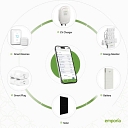
The Integration Advantage: Emporia stands out for home energy management. The Emporia Pro Go to product viewer dialog for this item. model integrates directly with an included whole-home energy monitor (like the Emporia Vue Go to product viewer dialog for this item. ) to use real-time data from your 200-amp panel . Its "PowerSmart" load-balancing technology automatically throttles the EV charging speed up or down depending on what else your house is drawing, preventing overloads without needing an expensive panel upgrade.
Specs: Up to 48A (hardwired), adjustable, available in J1772 or NACS (Tesla) connectors.
The Integration Advantage: Highly dependable with a robust build quality and a 4-year warranty. The "Universal" version features a built-in Magic Dock (an integrated J1772 adapter), meaning it cleanly charges both Tesla and non-Tesla EVs in a 2-car household without loose adapters floating around. It can also be hardwired and power-shared if you eventually want a second unit.
Specs: Up to 48A, fully adjustable via commissioning configuration during installation.
The Integration Advantage: Widely regarded as one of the most reliable "smart" units with an app that tracks energy use and lets you schedule charging strictly during off-peak hours to lower utility bills. It is flexible because it can be installed via a NEMA plug (14-50 or 6-50) or hardwired, though hardwiring is always recommended for continuous 48A loads.
Specs: Up to 50A (hardwired) or 40A (plug-in), adjustable amperage during setup.
The Integration Advantage: Built like a tank with a heavy-duty aluminum enclosure meant to withstand extreme weather if mounted outside the garage. If you want pure, bulletproof dependability without flaky Wi-Fi connectivity or complex smart apps, the non-smart Grizzl-E Go to product viewer dialog for this item. is a favorite. If you have two EVs in that 2-car garage, the Grizzl-E Duo Go to product viewer dialog for this item. can split a single 40A/50A circuit dynamically between two vehicles.
Specs: Up to 40A–48A depending on the model.
Key Considerations for a 2-Car Garage & 200A Panel
If you'd like, let me know:
I can help you narrow down whether a power-sharing setup or a dynamic load-management system fits your panel best.
For a suburban homeowner with a standard 200-amp electrical panel and a 2-car garage, your biggest asset is having plenty of overall household capacity, but you still need to be mindful of continuous load rules (charging an EV maxes out a circuit for hours at a time). To hook up a Level 2 charger cleanly and…
For a suburban homeowner with a standard 200-amp electrical panel and a 2-car garage, your biggest asset is having plenty of overall household capacity, but you still need to be mindful of continuous load rules (charging an EV maxes out a circuit for hours at a time).
To hook up a Level 2 charger cleanly and dependably, a hardwired installation on a dedicated 60-amp breaker (delivering 48 amps to the car) or a 50-amp breaker (delivering 40 amps) is the gold standard. Hardwiring avoids the heavy, expensive heavy-duty NEMA 14-50 plug/receptacle that can wear out or suffer from heat buildup in a garage setting.
The top dependable, garage-friendly Level 2 chargers that integrate smoothly with a 200-amp panel include:
Amperage: Up to 48A (adjustable via internal/app configuration for your exact breaker size).
Why it fits: It features a built-in "Magic Dock" adapter , meaning it natively supports both Tesla (NACS) and traditional J1772 vehicles without needing loose adapters. If your 2-car garage houses (or will house) a mix of EV brands over the years, this provides complete future-proofing.
Panel Integration: Hardwires cleanly to a 60A breaker. Tesla's ecosystem also allows power-sharing if you ever decide to add a second unit for the second car slot without upgrading your panel.
Amperage: Up to 50A hardwired (adjustable down to 16A if you ever need to de-rate it to match a tighter load calculation).
Why it fits: Widely regarded as one of the most reliable "smart" units on the market with a bulletproof weather-resistant NEMA rating (for indoor/outdoor flexibility) and a very long 23-foot flexible cable . The app tracks energy usage and syncs with local utility time-of-use (TOU) rates effortlessly.
Panel Integration: Available as both plug-in (NEMA 14-50, capped at 40A) or hardwired (delivering full 50A capability). Hardwiring is recommended to eliminate receptacle heat issues on a 200A panel.
Amperage: Up to 48A hardwired (or 40A via plug).
Why it fits: Routinely praised for high value and raw reliability . If you plan to add home solar or an energy monitoring system down the road, Emporia integrates natively with the Emporia Vue Smart Home Energy Monitor to dynamically throttle your car charging based on your home's live electrical load—a great safety net for a 200-amp panel.
Panel Integration: Offers granular app-based current configuration to match whatever dedicated breaker size your electrician installs.
Amperage: Up to 40A or 48A.
Why it fits: Built like a tank with a heavy cast-metal enclosure. If you don't care about fancy cloud apps and just want a rugged, weather-proof, ultra-dependable "plug-it-in-and-forget-it" workhorse that handles extreme garage temperature swings, Grizzl-E Go to product viewer dialog for this item. is a favorite among electricians.
Panel Integration: Available in hardwired configurations that clamp down solidly onto a dedicated heavy-gauge copper line from your main panel.
To help narrow down the ideal pick, tell me:
For a suburban home with a **200-amp service and a 2-car garage**, I’d prioritize **reliability, straightforward installation, and load management** over chasing the highest amperage. A properly installed 40–48A Level 2 charger is plenty for overnight charging. ### My top choices - **Tesla Universal Wall Connector** -…
For a suburban home with a 200-amp service and a 2-car garage, I’d prioritize reliability, straightforward installation, and load management over chasing the highest amperage. A properly installed 40–48A Level 2 charger is plenty for overnight charging.
The big advantage in a 2-car garage is that Tesla supports power sharing between Wall Connectors, so adding a second charger later is considerably more elegant than simply installing two independent 60A circuits. Watson's Charging Stations & Electric 2. Best non-Tesla choice: ChargePoint Home Flex This is the "install it and forget about it" option I'd choose for a single EV. It can be hardwired, is adjustable up to 50A, and has a mature app and 24/7 customer support. EnergySage rated it among its top home chargers for 2026, while J.D. Power's 2026 study put ChargePoint below Tesla and Emporia for overall home-charging satisfaction—so I'd call it very dependable, but not the outright reliability leader. EnergySage JD Power 3. Best if you want electrical load management: Emporia Pro This is particularly attractive if your 200A panel is busy with an electric range, heat pump, electric water heater, pool equipment, etc. Its included Vue 3 monitor measures whole-house demand and automatically throttles the EV charger to stay within your configured electrical limit.
For a 200A panel with plenty of spare capacity, though, I wouldn't buy the Pro just for load management. Its installation is more involved because of the panel monitoring hardware. Car and Driver 4. Good compact alternative: Wallbox Pulsar Plus The Pulsar Plus is small, supports up to 48A, and offers power sharing—useful if you eventually want charging at both garage bays. It's a good choice, although I'd put Tesla/ChargePoint/Emporia ahead of it for a typical homeowner focused primarily on long-term dependability.
For one EV today, I'd have an electrician install a dedicated 60A, 240V circuit and hardwire a 48A charger, assuming the required load calculation confirms adequate capacity. A 48A EV load is continuous, so the electrical design needs to account for that rather than simply looking at the panel's 200A label.
For two EVs eventually, I'd strongly consider two Tesla Wall Connectors with power sharing rather than immediately provisioning two full 60A circuits. That gives you much more flexibility when both cars aren't charging simultaneously.
One important point: 200A service doesn't automatically mean you have 200A available for EV charging. Your HVAC, range, dryer, water heater, pool equipment and other loads determine the actual spare capacity. A load calculation by the electrician is the right way to decide.
My ranking for your situation: Tesla Universal > ChargePoint Home Flex > Emporia Pro > Wallbox Pulsar Plus.
If you tell me which EV(s) you have or are considering, whether the panel is in the garage, and whether your range/water heater/HVAC are gas or electric, I can narrow this down to the best specific charger and circuit setup for your house.
For a typical suburban home with a **200-amp service and a 2-car garage**, I’d prioritize **reliability, adjustable amperage, hardwiring, and load management** over chasing the absolute highest charging rate. ### My shortlist ### [Tesla Universal Wall…
For a typical suburban home with a 200-amp service and a 2-car garage, I’d prioritize reliability, adjustable amperage, hardwiring, and load management over chasing the absolute highest charging rate.
$595.00
$657.99
$599.00
$699.00
| Charger | Best fit | Why I like it for a 200A home |
|---|---|---|
| Tesla Universal Wall Connector | Best overall if you may have different EVs | 48A, hardwired, built-in NACS/J1772 compatibility, and PowerShare for multiple chargers. installerev.com |
| ChargePoint Home Flex | Best simple all-around choice | Adjustable 16–50A, hardwired or plug-in, excellent app/support, and broad EV compatibility. www.energysage.com |
| Emporia Pro | Best for making a 200A panel work comfortably | Dynamic load management watches your home's electrical consumption and automatically reduces EV charging when the house is heavily loaded. www.caranddriver.com |
| Wallbox Pulsar Plus | Best if you might charge two EVs | Compact and supports power sharing between chargers, although Wallbox's load-sharing setup can require additional hardware. www.caranddriver.com |
A 200A panel doesn't automatically mean you can add a 48A charger without checking capacity. A 48A continuous EV load generally requires a 60A circuit, and your electrician needs to perform a load calculation considering things like the electric range, HVAC, heat pump, water heater, dryer, etc.
For a suburban house, I'd generally choose:
If you have plenty of panel capacity:
→ ChargePoint Home Flex or Tesla Universal Wall Connector, hardwired at 48–50A.
If your panel is fairly busy:
→ Emporia Pro. Its dynamic load management is particularly attractive because it can throttle charging when the house is drawing heavily, potentially avoiding a service/panel upgrade.
If you expect two EVs eventually:
→ Tesla Wall Connectors or Wallbox Pulsar Plus, using power sharing rather than installing two independent 60A circuits.
I'd hardwire rather than install a NEMA 14-50 outlet unless you specifically want the portability. It eliminates the receptacle/plug as another high-current connection point and makes a 48A installation straightforward.
Also, don't feel compelled to run 60A charging. 40A (9.6 kW) is already plenty for overnight charging for most drivers, and it puts less demand on the home's electrical system.
My personal pick for your scenario:
If you tell me whether your house has gas or electric heat, range, dryer and water heater—and which EV(s) you own—I can narrow this down to the best setup for your 200A panel, including what breaker size/circuit I'd target.
A standard 200-amp service panel provides plenty of total capacity for a typical suburban home, but when you add a Level 2 EV charger, you need to respect the National Electrical Code (NEC) 80% continuous load rule. For a 48-amp max continuous output, you need a 60-amp breaker; for 40 amps, a 50-amp…
A standard 200-amp service panel provides plenty of total capacity for a typical suburban home, but when you add a Level 2 EV charger, you need to respect the National Electrical Code (NEC) 80% continuous load rule. For a 48-amp max continuous output, you need a 60-amp breaker; for 40 amps, a 50-amp breaker.
Because you have a 2-car garage, you may also want to consider future-proofing for a second EV. The most dependable, highly integrated Level 2 chargers on the market excel in different scenarios:
Widely considered the best overall choice. It offers flexible amperage settings (16A to 50A) so your electrician can dial it into whatever capacity your panel allocation allows. It features an exceptional Wi-Fi app for tracking off-peak utility rates and comes in both plug-in (NEMA 14-50) or hardwired configurations.
The best smart home/load management choice. It integrates with an Emporia Vue home energy monitor to dynamically balance your home's total electrical load in real time via PowerSmart technology. This is ideal if your 200-amp panel runs heavy simultaneous loads (like an electric dryer, HVAC, or oven) and you want to prevent overloads without buying an expensive panel upgrade. It outputs up to 48A hardwired.
The best future-proof/mixed-fleet choice. If your household features—or might eventually feature—both a Tesla (native NACS) and a non-Tesla EV (J1772), this 48-amp unit features a cleanly integrated, locking "Magic Dock" adapter that handles both connector types natively.
The most rugged/durable choice. If your garage gets freezing, dusty, or humid, its heavy-duty aluminum enclosure is built like a tank. It's a straightforward, high-reliability "set-it-and-forget-it" charger that avoids fussy software.
To help narrow down the ideal unit for your garage, let me know:
For a suburban home with a standard 200-amp electrical panel and a 2-car garage, your main goal is balancing fast overnight charging (4 8 A to 5 0 A output delivering up to 1 1.5 k W to 1 2 k W ) with electrical load safety. A hardwired installation is strongly recommended over a plug-in NEMA 14-50 setup because it…
For a suburban home with a standard 200-amp electrical panel and a 2-car garage, your main goal is balancing fast overnight charging (4 8 A to 5 0 A output delivering up to 1 1.5 k W to 1 2 k W ) with electrical load safety. A hardwired installation is strongly recommended over a plug-in NEMA 14-50 setup because it eliminates failure-prone heavy-duty outlets and handles continuous max loads much more safely.
Top-tier, dependable Level 2 chargers integrate smoothly with a 200-amp panel through high reliability, flexible amperage configuration, or native load management:
Emporia Pro / Emporia Classic Go to product viewer dialog for this item. — Best for Panel Integration & Value: The Emporia ecosystem stands out for energy management . If you opt for the Emporia Pro with its Vue energy monitor integration in your main panel, it features dynamic PowerSmart load management . It scales your EV charging speed up and down in real time based on total household electricity consumption, ensuring you never risk overloading your service (and potentially avoiding costly panel upgrades if you run heavy simultaneous loads like a/c or electric heat). It delivers up to 4 8 A hardwired and is budget-friendly.
ChargePoint Home Flex — Best Overall & Ecosystem Reliability: A staple for suburban garages, the ChargePoint Home Flex delivers up to 5 0 A on a hardwired 6 0 A breaker. It is exceptionally well-built, handles extreme garage temperatures, features a robust 23-foot cable, and has a bulletproof, highly reliable scheduling app that syncs with time-of-use utility rates.
Tesla Universal Wall Connector — Best Future-Proof / Mixed-Fleet Option: If your 2-car garage houses (or will house) a mix of Tesla and non-Tesla vehicles, the Tesla Universal Wall Connector is ideal. It outputs up to 4 8 A hardwired and features a built-in "Magic Dock" (an integrated J1772 adapter), meaning no loose adapters are needed regardless of which brand you park in front of it.
Grizzl-E Ultimate 48A — Best for Pure Weatherproof Durability: If your garage is unconditioned, drafty, or prone to heavy humidity and dust, the Grizzl-E Ultimate Go to product viewer dialog for this item. offers an ultra-rugged metal enclosure designed to take a beating while supplying a dependable 4 8 A stream.
If you'd like to narrow this down, let me know:
For a suburban home with a **200-amp service and a 2-car garage**, I’d prioritize a charger that is hardwired, UL-listed, adjustable, and has good load-management options. A 200A panel is generally a comfortable starting point for **one 48–50A Level 2 charger**, but an electrician should still perform a load…
For a suburban home with a 200-amp service and a 2-car garage, I’d prioritize a charger that is hardwired, UL-listed, adjustable, and has good load-management options. A 200A panel is generally a comfortable starting point for one 48–50A Level 2 charger, but an electrician should still perform a load calculation—especially if you have electric HVAC, a heat pump water heater, electric range/dryer, pool equipment, etc. A 48A EVSE is a continuous load, typically requiring a 60A circuit.
$600.00
$494.00
$599.00
$699.99
1. Tesla Universal Wall Connector — best overall for a mixed-EV household
If you want something you'll probably never outgrow, this is my first choice. It supports NACS and J1772 with the adapter integrated into the unit, delivers up to 48A/11.5 kW, and supports power sharing if you eventually want two chargers in the garage. That's particularly attractive for a 2-car garage.
2. ChargePoint Home Flex — best conventional homeowner choice
I'd pick this if you value a mature app, scheduling, energy tracking and broad EV compatibility. It can be configured from lower current levels up to 50A, which makes it relatively easy to match the charger to your home's electrical capacity.
$494.00
3. Emporia Pro — best if panel capacity is your concern
This is the interesting one if your 200A panel is already heavily loaded. Its PowerSmart load management can dynamically manage EV charging against household consumption, potentially avoiding an expensive service/panel upgrade where the electrical system permits it.
$599.00
4. Wallbox Pulsar Plus — best compact/two-car-garage option
It's physically compact and supports power sharing, making it appealing if you eventually install two EVSEs. Its main downside is price, and independent cold-weather testing found the cable can become quite stiff at very low temperatures.
If you have one EV today but may have two later:
I would hardwire rather than install a 14-50 receptacle for a permanent garage installation unless you specifically want portability. It eliminates the high-current receptacle/plug connection and makes a 48A installation straightforward.
One other point: don't automatically buy the biggest charger your 200A panel can accommodate. Most EVs won't benefit much from 60–80A charging, and 48A/11.5 kW is already plenty for overnight charging. For a typical commuter, even 40A/9.6 kW can replenish a very large amount of driving overnight.
If you tell me your EV model(s), whether your range is NACS or J1772, and whether your house uses gas or electric for the furnace, water heater, range and dryer, I can narrow this to the best charger and the likely circuit size for your 200A panel.
For a suburban home with a standard **200-amp electrical panel** and a **2-car garage** , you have plenty of total electrical capacity to run a robust Level 2 charger. However, continuous heavy loads (like pulling 48 amps for hours) still require mindful installation to respect your panel's headroom, especially if you…
For a suburban home with a standard 200-amp electrical panel and a 2-car garage , you have plenty of total electrical capacity to run a robust Level 2 charger. However, continuous heavy loads (like pulling 48 amps for hours) still require mindful installation to respect your panel's headroom, especially if you have central air conditioning, an electric water heater, or a dry-and-cook setup.
The most dependable, highly rated Level 2 home chargers that integrate cleanly and safely with a 200-amp service include the following:
The gold standard for future-proofing and reliability . It features an integrated "Magic Dock" adapter, meaning it natively outputs both J1772 and NACS (Tesla) connectors seamlessly. It supports up to 4 8 A charging (1 1.5 k W ) when hardwired to a 6 0-a m p breaker, and it comes with an industry-leading 4-year warranty.
Widely considered the best smart charger for non-Tesla or mixed-brand households. It delivers up to 5 0 A (1 2 k W ) (adjustable down during setup to match a 4 0 A or 5 0 A breaker configuration) and has a stellar reputation for its robust app, scheduling tools, and weather-resistant build. Available in both J1772 and native NACS options.
The value and innovation leader . The Emporia Classic Go to product viewer dialog for this item. pushes 4 8 A (1 1.5 k W ) with a lengthy 25-foot cable at a fraction of the cost of competitors. If you are worried about your 200-amp panel running close to capacity during peak household hours, the Emporia Pro Go to product viewer dialog for this item. includes PowerSmart dynamic load management (integrating with an Emporia Vue home monitor) to automatically dial back charging speed when your house draws heavy current, preventing panel overloads.
Built like a tank with a heavy-duty metal enclosure, this is the go-to pick if you prefer raw durability over flashy smart-app features. It supports up to 4 8 A and is fully adjustable down to match your exact circuit capacity.
Garage Integration Tips for a 200-Amp Panel
To help narrow down the best fit, tell me:
For a typical suburban home with a **200-amp service panel and a 2-car garage**, I’d prioritize a charger that is **UL-listed, hardwire-capable, has good cable management, supports future EVs, and can handle load management if your panel gets crowded**. A 200-amp panel usually gives you a good starting point for Level…
For a typical suburban home with a 200-amp service panel and a 2-car garage, I’d prioritize a charger that is UL-listed, hardwire-capable, has good cable management, supports future EVs, and can handle load management if your panel gets crowded. A 200-amp panel usually gives you a good starting point for Level 2 charging, but the actual available capacity depends on your home’s electrical loads (heat pumps, electric water heater, hot tub, etc.).
My top picks:
| Charger | Best for | Why it stands out |
|---|---|---|
| Tesla Universal Wall Connector | Most homeowners wanting maximum simplicity | Excellent hardware, clean installation, works with Tesla and many non-Tesla EVs using the built-in adapter; 48A hardwired charging is a good match for many 200A panels. |
| ChargePoint Home Flex | Best all-around choice | Very mature product, adjustable amperage, strong app experience, and flexible plug-in or hardwired installation. leveltwoclub.com |
| Emporia Energy EV Charger / Pro | Best if you care about panel capacity and energy monitoring | Its ecosystem is strong for whole-home monitoring and load management, useful if you want to avoid a panel upgrade. |
| Grizzl-E Ultimate | Best for rugged simplicity | Fewer “smart” features, but a reputation for durable construction and straightforward operation. www.energysage.com |
Best default setup:
A 48A charger gives about 11.5 kW charging and is more than enough for most overnight charging. Many households do not need more than 32–40A, especially if daily driving is modest.
Consider 32A or 40A if:
The difference in real life is often small because the car sits overnight.
Since you have a 2-car garage, consider:
I would avoid installing two full 60A circuits unless you know you need them; your panel capacity may become the limiting factor.
Before buying, I’d check three things:
Those three answers can change the best choice.