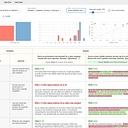
Data as of Aug 25, 2026 · Based on 38 AI responses from ChatGPT Search and Google AI Mode · See how Parse measures this
 OpenRouter
Your brand can be here too.
Source | Citation share |
|---|---|
 WhatLLM.orghttps://whatllm.org/ | 2.9% |
WhatLLM.org: Compare LLMs by Benchmarks, Price & Speed — Live Rankingshttps://whatllm.org/ | 2.6% |
VerticalAPI Benchmarkhttps://verticalapi.com/benchmark/ | 2.2% |
 Artificial Analysis: AI Model & API Providers Analysishttps://artificialanalysis.ai/ | 1.8% |
Compare LLM Endpoints with Benchmark Results | Benchscopehttps://benchscope.ai/ | 1.8% |
 Best Llm Model Comparison Tools - Prompts.aihttps://www.prompts.ai/blog/best-llm-model-comparison-tools.html | 1.8% |
Top 10 Model Latency & Cost Optimization Tools: Features, Pros, Cons & Comparison – AiOps Schoolhttps://aiopsschool.com/blog/top-10-model-latency-cost-optimization-tools-features-pros-cons-comparison/ | 1.5% |
 Benchmarks and comparison of LLM AI models and API ...https://news.ycombinator.com/item | 1.3% |
ProviderBenchhttps://providerbench.ai/ | 1.3% |
 LangSmith: Agent & LLM Observability Platformhttps://www.langchain.com/langsmith | 1.3% |
If you mean tools/sites for evaluating LLMs and their API providers side-by-side, these are the strongest options I found:
This is the catch: very few tools put safety on an equally rigorous footing with cost/latency/quality. Most of the comparison sites above treat safety separately or don't provide a single standardized safety score.
If your goal is specifically a procurement/evaluation dashboard with four axes — quality × latency × cost × safety — across dozens of providers, I'd start with Artificial Analysis + a dedicated safety benchmark/source, rather than relying on one composite leaderboard.
Best overall: Artificial Analysis Best for provider/host selection: WhatLLM or ProviderBench Best for broad provider discovery: LLMScape / ModelCap Best for combining benchmark datasets: AI Stats
If you tell me whether you're evaluating APIs for production, open-weight models, or enterprise vendors, I can narrow this to the 3–5 tools that are actually worth using.
Evaluating and comparing LLMs across multiple infrastructure and performance dimensions (quality, speed/latency, cost, and safety) requires specialized benchmarking platforms and developer tools.
If you need tools that actively monitor, benchmark, or route traffic dynamically based on cost, quality, and latency across providers:
If you are looking to integrate these metrics into a live application , would you prefer an API gateway/router that switches models automatically, or a pure analytics/benchmarking dashboard for manual model selection?
Several tools compare LLMs across quality, latency, cost, and (to varying degrees) safety/reliability across many providers. The best fit depends on whether you want a public leaderboard, an engineering routing tool, or your own evaluation platform.
| Tool | What it compares | Providers/models coverage | Safety-related signals |
|---|---|---|---|
| Artificial Analysis | Intelligence/quality scores, price, tokens/sec, latency, context length | Hundreds of models from many providers | Some reliability/quality indicators; not a full safety benchmark suite Artificial Analysis |
| whatllm.org | Quality rankings, benchmarks, price, speed, provider comparisons | 100+ models and many providers | Includes dimensions like hallucination/conversational quality filters, but safety depth varies WhatLLM WhatLLM |
| llmscape.dev | Model catalog, pricing, context, capabilities, provider availability | Large catalog across many hosts | More market intelligence than safety evaluation |
| providerbench.ai | Provider-level latency, throughput, price, reliability, routing performance | Dozens of inference providers | Reliability metrics; not primarily model safety |
| lmarena.ai | Human preference quality comparisons | Large set of chat models | Quality-focused; limited safety coverage |
| openrouter.ai | Access, pricing, availability, routing across many LLM providers | Many hosted models/providers | Has provider/model metadata; not a complete safety benchmark |
| crfm.stanford.edu | Standardized evaluation across accuracy, robustness, fairness, toxicity, efficiency | Research-oriented model evaluations | One of the stronger choices for safety/fairness-style evaluation |
Artificial Analysis ProviderBench## If you specifically need quality + latency + cost + safety
A practical stack is usually:
Teams often also use:
A key caveat: there is no single universally accepted “LLM safety score.” Quality and latency are relatively easy to benchmark; safety usually requires defining your threat model (toxicity, jailbreak resistance, privacy leakage, misinformation, regulated-domain compliance, etc.) and running targeted evaluations.
Comparing model quality, latency, cost, and safety across dozens of LLM providers requires a mix of live leaderboards, LLM gateways, and evaluation frameworks . Because no single platform completely owns all four metrics (quality, latency, cost, and safety) in one monolithic view, different tools serve different parts of the comparison workflow:
If you're building an application right now, are you leaning more toward an all-in-one API gateway (like OpenRouter) for live routing, or do you need a rigorous evaluation framework to test these models against your proprietary dataset?
If you want to compare LLMs across many providers on quality, latency, cost, and safety, these are the strongest options:
| Tool | Providers/models | Quality | Latency/speed | Cost | Safety | Best for |
|---|---|---|---|---|---|---|
| Artificial Analysis | 500+ API endpoints | ⭐⭐⭐⭐⭐ | ⭐⭐⭐⭐⭐ | ⭐⭐⭐⭐⭐ | Some | Best overall provider/API comparison |
| LLM Stats | 300+ models | ⭐⭐⭐⭐⭐ | ⭐⭐⭐⭐ | ⭐⭐⭐⭐ | Some | Broad model benchmarking |
| OpenRouter Stats | Large OpenRouter catalog | ⭐⭐⭐ | ⭐⭐⭐⭐⭐ | ⭐⭐⭐⭐⭐ | Limited | Live price/throughput/latency comparisons |
| modelgrep | 300+ LLMs | ⭐⭐⭐⭐ | ⭐⭐⭐⭐ | ⭐⭐⭐⭐ | Limited | Convenient side-by-side search/comparison |
| Top AI Hubs LLM Leaderboard | 180+ models | ⭐⭐⭐⭐ | ⭐⭐⭐⭐ | ⭐⭐⭐⭐ | Limited | Quick benchmark exploration |
Artificial Analysis is probably the closest match to what you're describing. It explicitly compares 500+ model/API endpoints and tracks intelligence, cost per task, tokens/sec, time-to-first-token, total response time, and provider differences. Its measurements are also based on recent API observations rather than just published specifications.
For model quality, LLM Stats is particularly useful because it breaks performance down across reasoning, coding, math, search, writing, vision, tools, SWE-bench, GPQA, AIME, etc., alongside price, speed, and latency.
One caveat: safety is the weak spot across these aggregators. They generally don't provide a single, rigorous safety score comparable to their quality/price/latency metrics. For safety, I'd supplement them with dedicated evaluations such as HELM Safety, AISI/UK AI Safety Institute evaluations, or model-specific safety reports rather than trusting a generic "safety" ranking.
If you're choosing an LLM API provider rather than just a model, I'd start with Artificial Analysis, because the same model can have substantially different latency and cost depending on whether it's served by Anthropic, Google, AWS Bedrock, Azure, etc.
Comparing model quality, latency, cost, and safety across dozens of LLM providers requires a mix of third-party benchmarking platforms, AI-specific observability tools, and multi-model gateways.
If you share your specific primary use case (e.g., real-time chat, heavy data extraction, or complex agentic coding), I can recommend which specific tools or models match your budget and latency requirements.
If you mean tools that let you compare many LLM providers/models on a common dashboard, these are the strongest options:
| Tool | Coverage | Quality | Latency / speed | Cost | Safety | Best for |
|---|---|---|---|---|---|---|
| Artificial Analysis | 500+ model endpoints | ⭐⭐⭐⭐⭐ | ⭐⭐⭐⭐⭐ | ⭐⭐⭐⭐⭐ | Some safety/security data, but not its core metric | Best overall comparison |
| WhatLLM.org | 150+ models / 52+ providers | ⭐⭐⭐⭐ | ⭐⭐⭐⭐ | ⭐⭐⭐⭐⭐ | Limited | Quick model/provider comparisons |
| ProviderBench | Many inference providers | ⭐⭐⭐ | ⭐⭐⭐⭐⭐ | ⭐⭐⭐⭐ | Limited | Provider infrastructure: TTFT, throughput, reliability, price |
| VerticalAPI Benchmark | 26 providers | ⭐⭐⭐⭐ | ⭐⭐⭐⭐⭐ | ⭐⭐⭐⭐ | Limited | Real API testing across regions |
| OpenRouter | Dozens of providers, many models | Benchmarks + routing data | ⭐⭐⭐⭐⭐ | ⭐⭐⭐⭐⭐ | Limited | Actually routing production traffic |
Artificial Analysis is probably closest to exactly what you're describing. It compares 500+ API/model endpoints and provides intelligence/quality scores, cost per task, tokens/sec, time-to-first-token, total response time, context window, and other dimensions. Its measurements are refreshed from live API testing.
For same-model provider comparisons, WhatLLM is particularly useful: you can take, say, one Llama or Qwen model and compare the hosts offering it on price, throughput, and TTFT.
For real-world production infrastructure, I'd also look at ProviderBench and VerticalAPI. ProviderBench measures things like response time, first-token speed, output speed, price and reliability; VerticalAPI reports measurements from 1,000 calls per provider across EU and US regions.
One caveat: “safety” is much less standardized than quality, latency, or price. These sites generally don't provide a single trustworthy cross-provider safety score. If safety is a first-class requirement, you'd want to combine a provider leaderboard with dedicated safety benchmarks (toxicity, jailbreak resistance, refusal consistency, privacy, etc.).
If you tell me whether you're evaluating API providers for production or models for an AI application, I can narrow this down to the 3 best tools and explain exactly what each measures.
The top independent benchmarking platforms and unified gateways for comparing model quality, live latency, pricing, and performance metrics across dozens of LLM providers include Artificial Analysis, WhatLLM.org , and OpenRouter.
Comparison Platforms & Unified Tools
| Tool / Platform | Primary Focus | Metrics Tracked | Scope / Breadth |
|---|---|---|---|
| Artificial Analysis | Independent Performance Benchmarking | Quality, Latency, Throughput (t/s), Price | Dozens of frontier/open models |
| WhatLLM.org | Provider Price & Speed Matching | Price, Time-to-First-Token, Speed | 80+ models across multi-provider hosts |
| OpenRouter | Unified API & Routing Gateway | Cost, Latency, Quality, Fallback Routing | 300+ routed models/providers |
| Helicone | Production Observability & Logging | Token Spend, Latency, Usage Logs | Integrated custom API traffic |
If you share your primary constraints (such as whether you prioritize sub-second latency for real-time voice, lowest token price , or strict data privacy compliance ), I can recommend the exact model and provider combination for your workflow.
Several specialized tools and platforms evaluate, compare, and benchmark Large Language Models (LLMs) across multiple providers based on quality, latency, cost, and safety.
These platforms are specifically designed to live-track performance metrics across various hosting providers.
These tools allow you to query dozens of providers through a single integration while providing native dashboards to compare performance.
If you want to run comparative tests using your own data to analyze quality and safety, you should use evaluation frameworks.
If you would like, I can help you find specific up-to-date pricing comparisons or latency benchmarks for the exact models you are planning to deploy. Which models are you currently considering?
If you mean tools that let you compare many LLM providers/models on a common scorecard, these are the strongest options:
| Tool | Quality | Latency / speed | Cost | Safety | Provider coverage |
|---|---|---|---|---|---|
| Artificial Analysis | ⭐⭐⭐⭐⭐ | ⭐⭐⭐⭐⭐ | ⭐⭐⭐⭐⭐ | ◐ | 500+ endpoints |
| Vellum LLM Leaderboard | ⭐⭐⭐⭐⭐ | ⭐⭐⭐⭐⭐ | ⭐⭐⭐⭐⭐ | ◐ | Dozens of models/providers |
| ProviderBench | — | ⭐⭐⭐⭐⭐ | ⭐⭐⭐⭐⭐ | — | 295 provider comparisons |
| Microsoft Azure AI Foundry | ⭐⭐⭐⭐ | ⭐⭐⭐⭐ | ⭐⭐⭐⭐ | ⭐⭐⭐⭐⭐ | 1,900+ models |
| OpenRouter | ⭐⭐⭐ | ⭐⭐⭐⭐ | ⭐⭐⭐⭐⭐ | — | Hundreds of models/providers |
1. Artificial Analysis — best overall for your exact question.
Its provider leaderboard currently compares 500+ LLM API endpoints on intelligence/quality, price, output speed, first-token latency, total response time, and other dimensions.
2. Vellum — best for model-selection research.
Its leaderboard provides side-by-side quality benchmarks plus price, tokens/sec and TTFT. Its open-model leaderboard also breaks performance down by inference provider, which is useful when the same model is hosted by multiple providers.
3. ProviderBench — interesting if you're specifically comparing providers.
Unlike model leaderboards that can accidentally make a provider look faster because it happens to offer smaller models, ProviderBench says it compares providers on identical model IDs, including response time, time-to-first-response, throughput, price, uptime and context.
4. Azure AI Foundry — strongest if safety/governance is a first-class requirement.
Microsoft has added safety alongside quality, cost and throughput for its model comparisons; its catalog covers more than 1,900 models.
There isn't really a universally accepted single safety score comparable to price or latency. Safety depends on what you're measuring—jailbreak resistance, harmful content, bias, cybersecurity misuse, privacy, etc. So I'd use Artificial Analysis/Vellum for quality × cost × latency, then add a dedicated safety evaluation such as AILuminate, StrongREJECT, JailbreakBench, or Llama Guard for the models you're seriously considering. Recent research itself treats these as distinct safety-evaluation methodologies.
If you're building a production model-routing decision, I'd start with Artificial Analysis + ProviderBench, then run your own workload benchmark and safety suite. That gives you a much more meaningful quality/cost/latency/safety Pareto frontier than relying on any single leaderboard.