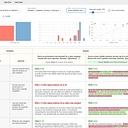
Data as of Aug 25, 2026 · Based on 324 AI responses from ChatGPT Search and Google AI Mode · See how Parse measures this
To evaluate LLM cost-performance, use platforms like 


Brands AI recommends here
Named in 36% of answers
Named in 31% of answers
Named in 30% of answers
Named in 28% of answers
Source | Citation share |
|---|---|
Best LLM evaluation platforms 2025 - Articles - Braintrusthttps://www.braintrust.dev/articles/best-llm-evaluation-platforms-2025 | 3.1% |
 Who Routes LLM Routers? RouterArena: Building the Evaluation Foundation for LLM Routinghttps://huggingface.co/blog/JerryPotter/who-routes-the-routers | 1.2% |
RouteLLM: An Open-Source Framework for Cost-Effective LLM Routing | LMSYS Orghttps://lmsys.org/blog/2024-07-01-routellm/ | 1.2% |
 GitHub - lm-sys/RouteLLM: A framework for serving and evaluating LLM routers - save LLM costs without compromising quality · GitHubhttps://github.com/lm-sys/RouteLLM | 1.0% |
 Comparing LLMs for optimizing cost and response qualityhttps://developer.ibm.com/tutorials/awb-comparing-llms-cost-optimization-response-quality/ | 0.9% |
 LLM Routing — Intuitively and Exhaustively Explained - Mediumhttps://medium.com/intuitively-and-exhaustively-explained/llm-routing-intuitively-and-exhaustively-explained-5b0789fe27aa | 0.9% |
RouteLLM: Optimizing the Cost-Quality Trade-Off in Large Language Model Deployment | by Vivek Pandit | Mediumhttps://vivekpandit.medium.com/routellm-optimizing-the-cost-quality-trade-off-in-large-language-model-deployment-c48b7abb2cfa | 0.9% |
 Top Platforms For Side-By-Side LLM Comparison | Prompts.aihttps://www.prompts.ai/en/blog/platforms-side-by-side-llm-comparison | 0.9% |
Best LLM Model Comparison Tools | Prompts.aihttps://www.prompts.ai/blog/best-llm-model-comparison-tools | 0.9% |
 What is Rawbot? Everything we know about the AI comparison toolhttps://www.techradar.com/pro/what-is-rawbot-everything-we-know-about-the-ai-comparison-tool | 0.8% |
Yes. For **evaluating cost vs. quality for a specific workload**, I would not start with a pure model router. You want an **evaluation platform that can run the same dataset against many models, score the outputs, and expose cost/latency alongside quality**. ### My picks Tool | Best for | Cost/performance evaluation |…
Yes. For evaluating cost vs. quality for a specific workload, I would not start with a pure model router. You want an evaluation platform that can run the same dataset against many models, score the outputs, and expose cost/latency alongside quality.
| Tool | Best for | Cost/performance evaluation | Routing |
|---|---|---|---|
| Braintrust | Best overall for model selection | ⭐⭐⭐⭐⭐ | ⭐⭐⭐⭐⭐ |
| LangSmith | LangChain/LangGraph teams | ⭐⭐⭐⭐⭐ | ⭐⭐⭐ |
| Langfuse | Open-source/self-hosted | ⭐⭐⭐⭐ | ⭐⭐⭐ |
| LiteLLM | Build your own router | ⭐⭐⭐ | ⭐⭐⭐⭐⭐ |
| OpenRouter | Quickly test lots of models | ⭐⭐⭐⭐ | ⭐⭐⭐⭐ |
My default recommendation: Braintrust. It is unusually well aligned with the question you're actually asking: “For my task, which model gives me the best quality per dollar?” Its workflow combines datasets, experiments, scoring, production traces, cost information, and routing.
Don't optimize for generic benchmark scores. Build a representative dataset of, say, 100–1,000 real task examples, then run:
Dataset × Model A/B/C/D → quality score + latency + input/output tokens + actual cost Then calculate something like:
quality-adjusted cost = cost / task-quality score
or, better, plot the Pareto frontier:
That immediately tells you whether paying 3× or 10× more actually buys meaningful quality.
You can also use pairwise evaluation (“Which answer is better?”) rather than relying exclusively on an LLM-as-judge score. That's particularly useful when your task has subjective quality dimensions. LangSmith and Braintrust both support serious experiment/evaluation workflows.
If you ultimately want dynamic routing, I'd separate the problem into two stages:
That's important because a router by itself generally knows price, latency, availability, and perhaps context limits, but not whether your particular task was answered correctly. Braintrust's routing approach is interesting precisely because it connects production routing with evaluation scores.
One important distinction: Artificial Analysis is also useful as a model-selection/benchmarking reference for price, speed, and general capability, but it isn't a substitute for testing models on your own task.
If you tell me what the task is (e.g. extraction, coding, classification, customer support, RAG, agent/tool use) and roughly how many requests/month, I can recommend a concrete evaluation stack and show you how I'd measure the cost/quality frontier.
Evaluating the cost-performance tradeoff for a specific task requires separating the **inference/routing layer** (which handles dynamic model selection at runtime) from the **evaluation layer** (which scores the quality of responses against your task-specific…
Evaluating the cost-performance tradeoff for a specific task requires separating the inference/routing layer (which handles dynamic model selection at runtime) from the evaluation layer (which scores the quality of responses against your task-specific dataset).
Part 1: Best Model Routers (for Production Cost-Performance)
If your goal is to dynamically dispatch simple prompts to cheap, fast models (e.g., Llama 3/4 8B or GPT-4o-mini) and complex reasoning/coding prompts to frontier models (e.g., Claude Opus, GPT-5, or DeepSeek-V3), these are the top platforms:
Part 2: Best Evaluation Platforms (to Measure the Tradeoff)
To empirically prove which model actually hits your threshold for success on your specific task before committing to a router configuration, use these evaluation frameworks:
Recommended Workflow to Evaluate Your Task
If you'd like to narrow this down, tell me:
Evaluating the cost-performance tradeoff for a specific LLM task requires a two-pronged approach: an **evaluation platform** to rigorously measure how well different models perform on your specific "golden dataset," and a **model router/gateway** to dynamically direct traffic at runtime based on complexity, cost, and…
Evaluating the cost-performance tradeoff for a specific LLM task requires a two-pronged approach: an evaluation platform to rigorously measure how well different models perform on your specific "golden dataset," and a model router/gateway to dynamically direct traffic at runtime based on complexity, cost, and latency.
Part 1: Best Evaluation Platforms (To Measure the Tradeoff)
Before routing traffic, you need empirical data on how cheaper models (e.g., Llama 3 8B, Mistral Nemo, or smaller proprietary models) stack up against frontier models (e.g., GPT-4o, Claude 3.5 Sonnet) on your exact task.
Part 2: Best Model Routers & Gateways (To Implement the Tradeoff)
Once you know your performance thresholds, a router dynamically sends easy queries to cheap models and hard queries to expensive ones—slashing costs by 50% to 85% with minimal quality loss.
Recommended Workflow to Find Your Sweet Spot
If you share:
I can help you narrow down which specific model tiers or routing strategies make the most financial sense.
For evaluating **cost–performance tradeoffs for a specific LLM task**, I would usually separate the problem into two layers: 1. **Evaluation platform**: “Which model actually performs best on *my* workload?” 2. **Router/gateway**: “How do I automatically choose or serve the right model in production?”
For evaluating cost–performance tradeoffs for a specific LLM task, I would usually separate the problem into two layers:
The best choice depends on your maturity and whether you need experimentation or live routing.
Best when you want to answer:
“Does Model A justify costing 5× more than Model B for our customer support / coding / extraction / agent task?” Strengths:
This is my default recommendation for teams making model-selection decisions.
Best when you want:
“Give me one API and let me try dozens/hundreds of models cheaply.” Strengths:
Weakness:
Use this when you need:
It can route based on rules like cost, latency, availability, or custom logic.
Good fit if:
For a specific task, I would do:
| Metric | Why it matters |
|---|---|
| Task accuracy | Primary quality signal |
| Human preference | Catches subtle failures |
| Cost/request | Production economics |
| Latency | User experience |
| Token usage | Optimization opportunities |
| Failure rate | Reliability |
You usually find:
Research on LLM routing also suggests that routing quality depends heavily on choosing the right model pool and evaluation setup; more models alone do not guarantee better routing.
| Goal | Pick |
|---|---|
| Find the cheapest model that meets your quality bar | Braintrust + OpenRouter |
| Enterprise model evaluation workflow | Braintrust |
| Fast experimentation across many APIs | OpenRouter |
| Self-hosted production gateway | LiteLLM |
| LangChain/LangGraph application | LangSmith |
| Simple production routing | LiteLLM or OpenRouter |
If you tell me the task (e.g., RAG QA, coding agent, extraction, summarization, customer support, classification) and your constraints (volume, latency target, privacy requirements), I can suggest a more specific evaluation setup and scoring methodology.
For **evaluating the cost/performance tradeoff on a specific LLM task**, I’d separate the problem into two layers: 1. **Evaluation/experimentation** — determine which model actually performs best on *your* workload. 2. **Routing/gateway** — once you know the tradeoffs, automatically send each request to the…
For evaluating the cost/performance tradeoff on a specific LLM task, I’d separate the problem into two layers:
Braintrust is probably the best fit if your central question is “Which model gives me the best quality per dollar for this task?”
It lets you create a dataset of representative inputs, run multiple models against it, score outputs, and compare results. It also connects those evaluations to production traces, cost, latency, and eventually routing.
That's important because I wouldn't choose a router based simply on benchmark scores. You want something like:
quality ≥ 95% of frontier model, at ≤ 30% of the cost, with ≤ 500 ms added latency
and then empirically find the cheapest model satisfying that constraint.
| Platform | Best for | My take |
|---|---|---|
| Braintrust | Eval + model comparison + eventual quality-based routing | Best overall for your use case |
| Langfuse | Open-source observability + evals + experiments | Best open-source choice |
| Humanloop | Enterprise evaluation + human/domain-expert review | Best when subjective quality matters |
| OpenRouter | Quickly testing lots of models/providers | Best for exploration, not evaluation |
| LiteLLM | Self-hosted model gateway/router | Best infrastructure layer |
Langfuse is particularly compelling if you want open source. It supports datasets, side-by-side model experiments, LLM-as-judge/code/human evaluation, and cost/latency tracking.
Humanloop is stronger if you need domain experts to establish ground truth and review outputs; its evaluators can explicitly incorporate cost, token usage, latency, deterministic rules, and AI judges.
For the actual routing layer, OpenRouter is excellent for rapidly accessing hundreds of models through one API, while LiteLLM is attractive if you want to self-host the gateway.
For a serious cost/performance study, I'd use:
Braintrust or Langfuse → your evaluation dataset → 5–10 candidate models → automated + human scoring → cost/latency analysis → router
For each model, calculate something like:
Cost per successful task = model cost / task success rate
rather than merely comparing $/1M tokens.
For example:
| Model | Quality | Cost/task | Latency | Cost for 95%-quality |
|---|---|---|---|---|
| Frontier A | 98% | $0.020 | 1.2s | $0.020 |
| Model B | 96% | $0.006 | 0.7s | $0.006 |
| Model C | 91% | $0.002 | 0.4s | Doesn't qualify |
That makes the routing decision much more meaningful: Model B wins, even though it isn't the highest-quality model.
One particularly useful capability is quality-based routing: Braintrust's current positioning explicitly connects evaluation scores and production traces to model-selection/routing decisions, rather than treating routing as merely “cheapest model wins.”
Bottom line:
If you tell me what the specific task is (e.g. extraction, coding, classification, customer support, agentic workflow, RAG, etc.) and roughly how many requests/day, I can recommend an evaluation setup and the models I'd benchmark.
Evaluating the cost-performance tradeoff for a specific task requires combining an **AI Gateway / Router** (to handle traffic splitting, fallbacks, and cost tracking) with an **Evaluation/Observability Platform** (to measure actual task accuracy on your specific…
Evaluating the cost-performance tradeoff for a specific task requires combining an AI Gateway / Router (to handle traffic splitting, fallbacks, and cost tracking) with an Evaluation/Observability Platform (to measure actual task accuracy on your specific data).
The industry standard solutions for this are categorized below by their strengths.
Recommended Approach
To help narrow down the ideal stack, tell me:
For evaluating the **cost–performance tradeoff of LLMs for a specific task**, I would separate the problem into two layers: 1. **Evaluation platform** — “Which model gives the best quality on *my* workload?” 2. **Router/gateway** — “How do I automatically choose the best model per request in production?”
For evaluating the cost–performance tradeoff of LLMs for a specific task, I would separate the problem into two layers:
The best choice depends on your stage and goals.
| Tool | Best for | Strengths | Weakness |
|---|---|---|---|
| Braintrust | Teams doing serious model comparisons | Strong experiment workflows, custom scorers, production traces feeding evals, quality/cost analysis | More infrastructure than a simple playground |
| LangSmith | LangChain/LangGraph apps | Excellent tracing, agent debugging, eval integration | Less framework-neutral |
| Promptfoo | Fast local benchmarking and CI tests | Easy A/B tests, regression checks, model comparisons | Less of a production routing layer |
| OpenRouter | Trying many models quickly | Huge model catalog, one API, easy experimentation | Limited native quality evaluation |
| LiteLLM | Building your own router | Self-hostable, provider abstraction, routing controls | You build the evaluation loop yourself |
For most teams:
1. Start with Promptfoo or Braintrust for offline evaluation
Then plot:
        Quality
           ^
           |
           |        GPT-5 / Claude-class
           |          *
           |
           |    cheaper model *
           |
           | * small model
           +------------------------>
                    Cost
The goal is usually not “best model”; it is the Pareto frontier: models where no other model is both cheaper and better.
A common production architecture:
                 User request
                      |
                      v
              LLM Router/Gateway
                      |
        +-------------+-------------+
        |             |             |
   cheap model   medium model   premium model
        |             |             |
        +-------------+-------------+
                      |
              quality feedback
                      |
                 evaluation DB
For this, I would look at:
For a new LLM feature, I would usually do:
One caution: automated routers are not magic. Research on routing benchmarks has found that many routing strategies struggle to consistently beat simple baselines unless the evaluation data and model selection signals are carefully designed.
If you tell me the task type (RAG, coding agent, customer support, extraction, summarization, image+text, etc.), expected volume, and whether you need self-hosting, I can suggest a more specific stack and evaluation methodology.
To evaluate the cost-performance tradeoff of different large language models (LLMs) for a specific task, the top-tier production choice is **[Braintrust](https://www.braintrust.dev/articles/best-llm-routers-2026)** paired with an infrastructure gateway like **LiteLLM** or **[OpenRouter](https://openrouter.ai/)** ,…
To evaluate the cost-performance tradeoff of different large language models (LLMs) for a specific task, the top-tier production choice is Braintrust paired with an infrastructure gateway like LiteLLM or OpenRouter , while open-source routing frameworks like RouteLLM offer algorithmic request dispatching. The most effective strategy combines a unified gateway to manage multi-provider APIs with an evaluation harness that tracks task-specific quality via automated assertions or LLM-as-a-judge metrics.
Leading Evaluation & Routing Platforms
Recommended Workflow for Cost-Performance Optimization
If you can share what your specific task is (e.g., structured data extraction, creative writing, RAG-based Q&A, or code generation) and your approximate monthly request volume , I can recommend a targeted shortlist of models and an optimal budget threshold.
Evaluating the cost-performance tradeoff for a specific task requires combining an **AI Gateway/Router** (to direct traffic and log data) with an **Evaluation/Observability Platform** (to score output quality on your exact…
Evaluating the cost-performance tradeoff for a specific task requires combining an AI Gateway/Router (to direct traffic and log data) with an Evaluation/Observability Platform (to score output quality on your exact data).
Top LLM Routers & Gateways for Cost Optimization
Instead of locking your code into a single provider, these tools act as a unified proxy that handles fallbacks, tracking, and intelligent routing:
Top Evaluation & Observability Platforms
Public leaderboards (like LMSYS Chatbot Arena) tell you how models perform on general queries, but they won't tell you how a model handles your specific task. Use these to run offline and online evaluations:
Recommended Strategy to Evaluate Your Tradeoff
To find the precise sweet spot for your task rather than guessing:
If you share what your specific task is (e.g., classification, complex RAG, code generation, multi-step agentic workflows) and your expected monthly volume , I can recommend a specific model tier and routing architecture to target.
If your goal is specifically **“Which LLM gives me the best quality per dollar for *my* task?”**, I’d separate **evaluation** from **routing** conceptually—and, as of 2026, my first choice is **Braintrust**. ### My ranking | Platform | Best for | Cost/performance eval | Routing | My take |
If your goal is specifically “Which LLM gives me the best quality per dollar for my task?”, I’d separate evaluation from routing conceptually—and, as of 2026, my first choice is Braintrust.
| Platform | Best for | Cost/performance eval | Routing | My take |
|---|---|---|---|---|
| Braintrust | Task-specific model evaluation + production routing | ⭐⭐⭐⭐⭐ | ⭐⭐⭐⭐⭐ | Best overall |
| OpenRouter | Quickly testing lots of models | ⭐⭐⭐ | ⭐⭐⭐⭐ | Best for exploration |
| LiteLLM | Self-hosted routing | ⭐⭐⭐ | ⭐⭐⭐⭐ | Best open-source option |
| Portkey | Enterprise gateway/governance | ⭐⭐⭐ | ⭐⭐⭐⭐⭐ | Best for production controls |
| Langfuse | Observability + custom eval pipeline | ⭐⭐⭐⭐ | ⭐⭐ | Great if you want to build the routing layer |
The important distinction is that OpenRouter/LiteLLM/Portkey are primarily gateways/routers, whereas Braintrust is much closer to the workflow you described: run the same dataset through multiple models → score outputs → measure latency/token usage/cost → choose the Pareto-optimal model → monitor it in production. Braintrust specifically supports evaluation on production traces and quality-based routing.
For a specific application, don't optimize for a generic benchmark score. Build a representative eval set—say 200–1,000 real examples—and record:
Then calculate something like:
utility = quality / cost
and plot quality vs. cost for every candidate model.
You'll usually find that the answer isn't “the smartest model.” It's a Pareto frontier: perhaps a cheap model handles 80% of requests, while a more expensive model handles the difficult 20%. That's exactly where routing becomes valuable.
There is also good research evidence for doing this empirically rather than assuming a sophisticated router will automatically win: the 2026 LLMRouterBench study found that several routing approaches performed similarly and that some commercial routers didn't reliably beat simple baselines.
OpenRouter is excellent if you're at the “I need to try 30 models this afternoon” stage. It gives you a unified API and a very broad model/provider catalog, with provider routing and fallbacks. It doesn't, however, give you a native task-quality evaluation loop.
LiteLLM is my choice if you want to own the infrastructure. It's an open-source proxy supporting many models, with routing, fallbacks, budgets and spend tracking. I'd pair it with Braintrust or Langfuse for evaluation rather than expecting LiteLLM itself to answer “which model is best for this task?”
Portkey is particularly compelling when routing is only one part of a larger production-governance problem—rate limits, fallbacks, guardrails, budgets, auditability, etc.
If you're building a new LLM application, I'd start:
Braintrust for evals + OpenRouter or LiteLLM for model access.
If you want one platform and don't want to assemble the pieces, Braintrust is the strongest fit for your stated goal because it closes the loop between:
your data → model comparison → quality scoring → cost/latency measurement → production traces → routing.
If you tell me what the specific task is (e.g. extraction, coding, customer support, classification, agent/tool use, summarization), I can also recommend a concrete eval methodology + 5–10 models to benchmark + the cost/performance metric I'd use.